Paganism in 2026: Faith, Activism, Reconstruction, and the Question of What We Are Becoming

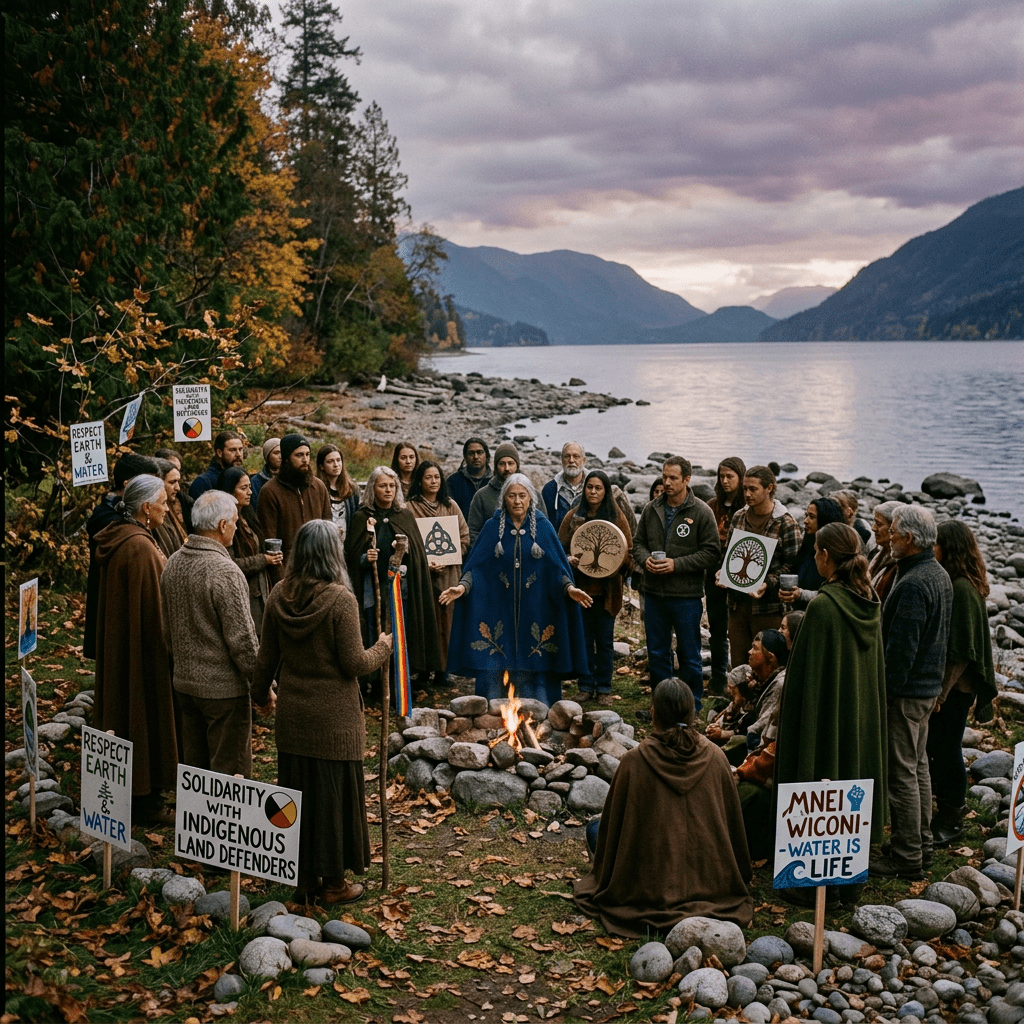
Group of people standing in a circle around a fire near a lake holding signs supporting Indigenous land and water rights

By Buck Beggins

What does it mean to be Pagan in 2026?

That question is not as simple as it sounds. To some outsiders, “Pagan” still means something vague, suspicious, theatrical, rebellious, or politically charged. To others, it means witchcraft, tarot, festivals, drums, herbs, candles, runes, robes, mead, moon water, or a general rejection of mainstream religion.

Some of that may touch the edges of Pagan life. But none of it fully defines it.

Paganism is not one church. It is not one book. It is not one dogma. It is not one political party. It is not simply recreation, costuming, rebellion, fantasy, or nostalgia. It is a wide family of living spiritual paths that often include reverence for nature, honouring gods and goddesses, respect for ancestors, seasonal ritual, personal responsibility, land-based spirituality, and community practice.

In Canada, this question carries its own weight. We live on land shaped by Indigenous stewardship long before modern Pagan groups existed here. We also live in a country where institutional Christianity has declined sharply, where more people report no religious affiliation, and where alternative spiritual practices are becoming more visible in public life. In that space, Paganism is no longer only hidden in the “broom closet,” but it is also not always understood.

What Do People Think a Pagan Is?

Many people still meet Paganism through stereotype before they meet it through practice.

They may think Pagan means anti-Christian. They may think it means Satanic. They may think it means unserious, theatrical, rebellious, or politically extreme. They may think a Pagan is someone who dresses a certain way, votes a certain way, owns certain books, attends certain festivals, or performs certain rituals.

Some of these misunderstandings come from old religious prejudice. Some come from pop culture. Some come from social media, where “witchy” aesthetics are often easier to sell than disciplined spiritual practice. Some come from political movements that misuse Pagan symbols for purposes many Pagans reject outright.

That is one of the central tensions of modern Paganism: the public often sees the symbol before it sees the person. It sees the pentacle, the hammer, the cauldron, the horned god, the rune, the cloak, the altar, or the festival fire — but not always the ethics, labour, study, prayer, service, or community behind them.

What Do Pagans Believe Pagans Are?

Ask ten Pagans what Paganism is, and you may get twelve answers. That is not a weakness. It is part of the structure.

For some, Paganism is polytheism: the gods are real, many, distinct, and worthy of honour.

For others, Paganism is nature religion: the land is sacred, the seasons matter, and the human being is part of the web of life, not above it.

For some, Paganism is witchcraft: ritual, spellwork, healing, divination, and personal transformation.

For others, Paganism is Druidry: land, inspiration, poetry, ancestors, trees, myth, and the long work of wisdom.

For Heathens, it may mean honouring the gods, ancestors, land-wights, household, community, gifting, oath, and right action.

For Wiccans, it may mean worship of the Gods, seasonal celebration, ritual training, magic, and community temple work.

For solitary Pagans, it may mean a candle at the table, a small altar in the corner, an offering outside, a whispered prayer, or a quiet observance of the moon and seasons.

The mistake is thinking one of these cancels the others. Paganism is not a single lane road. It is a crossroads.

Paganism Versus Activism

There is a real question in 2026: is Paganism a religion, or is it activism?

The answer, I think, is that Paganism is not activism by default, but it often produces consequences that look like activism.

If you believe the Earth is sacred, environmental issues stop being abstract.

If you believe the body is not sinful by nature, then dignity, gender, sexuality, and personal freedom matter.

If you honour ancestors honestly, you eventually have to face history honestly.

If you honour the land, then in Canada you cannot ignore Indigenous presence, Indigenous law, residential schools, land dispossession, and the responsibilities of living on territory that was never empty.

If you believe in many gods, many paths, and many ways of being human, then religious freedom and pluralism become more than political slogans. They become spiritual necessities.

That does not mean every Pagan must become a protester. It does not mean every ritual must become a political statement. It does not mean Pagan spaces should be hijacked by party politics.

But it does mean Paganism cannot hide forever behind incense and say, “Nothing in the world concerns me.”

There is a difference between being political and being captured by politics. Paganism should resist being reduced to a campaign sign. But it should also resist becoming so afraid of controversy that it forgets courage, hospitality, truth, justice, and right relationship.

Paganism Versus Reconstruction and Recreation

Another tension is the question of reconstruction.

Some Pagans try to reconstruct older religious practices as accurately as possible using history, archaeology, folklore, language, and scholarship. This is common in many Heathen, Hellenic, Roman, Kemetic, Celtic, and other polytheist circles.

That work matters. It keeps us honest. It reminds us that the past is not just a costume box. It challenges lazy invention. It asks us to study before claiming authority.

But reconstruction is not the same thing as pretending we live in the Iron Age.

We are modern people. We live with electricity, labour law, climate change, social media, reconciliation, mass migration, scientific medicine, and global crisis. A living religion cannot only recreate the past. It must also answer the present.

So the healthier question is not, “Can we perfectly copy the old ways?”

The better question is, “What can we recover, what must we adapt, and what must we refuse to carry forward?”

That last part matters. Not everything old is sacred. Some things belong to the past because humanity outgrew them. A modern Pagan path must have the courage to honour the ancestors without becoming enslaved to every assumption the ancestors held.

Paganism and Political Movements

This is where things get uncomfortable, but it needs to be said plainly.

Pagan symbols have been misused. Heathen symbols have been misused. Runes have been misused. Norse imagery has been misused by white supremacist, nationalist, and extremist movements.

That does not make Heathenry racist. It does not make Norse Paganism racist. It does not make runes racist. But it does mean responsible communities have to speak clearly when symbols are hijacked.

Silence creates a vacuum. If healthy Pagans do not define their own symbols, unhealthy movements will define them for us.

That is why inclusive Heathen groups in Canada matter. That is why Wiccan churches, Druid orders, Pagan federations, local groves, public rituals, study groups, and festivals matter. They do not just provide community for insiders. They also tell the public, “This is what we are. This is what we are not.”

In Canada, Paganism must be especially careful not to import every American culture-war frame as if it belongs here unchanged. We have our own history, our own wounds, our own land questions, our own Charter framework, our own multicultural reality, and our own responsibilities.

What Paganism Is Becoming in Canada

The Canadian Pagan picture is scattered, regional, and often hard to count. Some people identify openly. Some remain private. Some call themselves Wiccan, Druid, Heathen, Witch, Polytheist, Animist, Reconstructionist, Eclectic, or simply spiritual. Others may practice in Pagan-adjacent ways but report “no religion” on a census form.

That makes Paganism difficult to measure, but not meaningless.

In practical terms, Canadian Paganism exists in public Wiccan temples, Druid groves, Heathen kindreds, Pagan festivals, online circles, prison chaplaincy efforts, interfaith work, bookstores, kitchen tables, backyards, forests, and solitary altars.

It is not only a belief system. It is a practice system.

It is what someone does when they light the candle.

It is what someone does when they pour the offering.

It is what someone does when they keep their oath.

It is what someone does when they refuse racism dressed up as ancestry.

It is what someone does when they honour the land without pretending they own its whole story.

It is what someone does when they gather with others in good faith.

It is what someone does when they stand alone and still keep the holy.

So What Does It Mean to Be Pagan in 2026?

To be Pagan in 2026 is to live at the edge of old and new.

It is to remember that the world is alive.

It is to reject the idea that spirit only lives in buildings, books, or institutions.

It is to understand that ritual is not escapism when it returns us to responsibility.

It is to know that nature is not scenery. It is kin.

It is to know that ancestors are not props. They are memory, warning, inheritance, and obligation.

It is to know that gods are not fashion accessories. They are powers to be approached with respect.

It is to know that freedom without responsibility becomes vanity.

It is to know that community without boundaries becomes chaos.

It is to know that politics may touch the Pagan path, but politics must not replace the Pagan path.

It is to know that reconstruction without life becomes museum work, while spirituality without discipline becomes consumerism.

Maybe that is the real answer.

A Pagan in this century is not someone trying to flee the modern world.

A Pagan is someone trying to re-enchant responsibility within it.

We do not need to become a political movement to have ethics.

We do not need to become historical reenactors to honour the old ways.

We do not need to become influencers to be visible.

We do not need to become dogmatic to be serious.

We need roots. We need practice. We need courage. We need humility. We need better public understanding. We need community that can hold difference without collapsing into nonsense.

And perhaps most of all, we need to stop asking whether Paganism is real enough for the modern world.

The better question is whether the modern world is ready to remember that it is alive.

Thanks and Godspeed.

Research notes: Statistics Canada’s 2021 religion classification includes Pagan, Druidic, Neopagan, Wiccan, and related Pagan categories, and its census reporting shows Canada’s broader shift away from institutional religious affiliation. Public Canadian-facing Pagan sources emphasize reverence for nature, personal responsibility, the diversity of paths, and community-building, rather than a single central doctrine, including Wicca, Druidry, and Heathenry. Canadian Heathen sources and reporting strongly underline inclusive Heathenry and the need to reject racist misuse of Heathen symbols. The Wild Hunt’s recent coverage also points to Paganism’s growing visibility, the risk of public distortion, and renewed Canadian interest in witchcraft and Pagan-adjacent spirituality.

When the Rave Comes to the Knoll

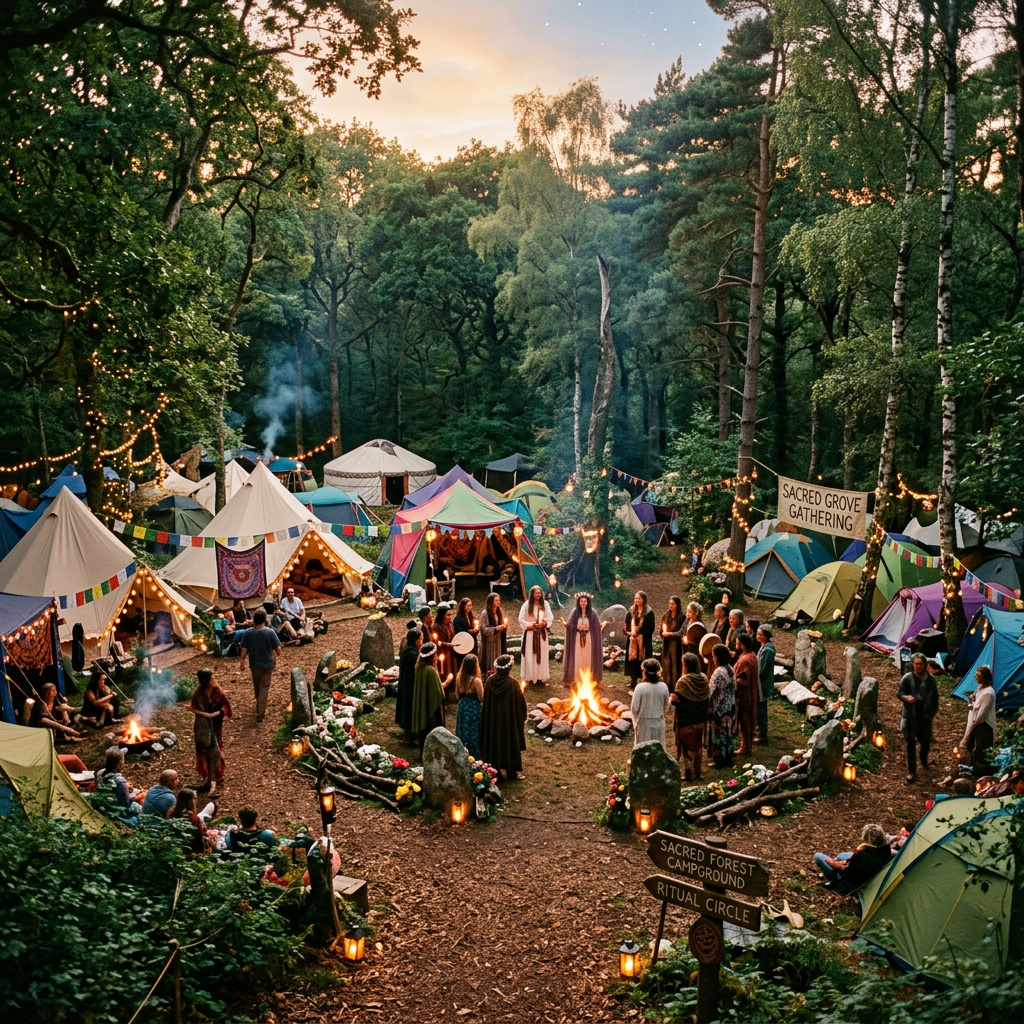
People standing in a ritual circle around a campfire with tents and festival decorations in a forest clearing at dusk

Author’s note: I have not had direct conversations with the owners, stewards, or current administration of Raven’s Knoll about KN¿WHERE Festival. I am not speaking for Raven’s Knoll, Kaleidoscope Gathering, Hail and Horn Gathering, KN¿WHERE, or the wider Pagan community. These are my own personal reflections, and mine alone, based on public information, memory, history, and concern for land that has meant a great deal to many of us.

There is a strange spell moving over Raven’s Knoll this year.

KN¿WHERE Festival is scheduled for early June at Raven’s Knoll, bringing a large electronic music and camping festival onto land that many Pagans and Heathens do not see as just a campground.

That distinction matters.

Raven’s Knoll has been many things over the years. It has been a campground. It has been a festival site. It has been a work site. It has been a business. It has been a gathering place. It has been, for some of us, home.

But it has also been sacred land.

That is the part I keep coming back to.

The Knoll was never just land

For many Pagans in Ontario and beyond, Raven’s Knoll became a home space around 2010, 2011, when Kaleidoscope Gathering found a permanent site there. Before that, Kaleidoscope Gathering had a more transient nature. It moved. It lived where it could live. Bob’s land. Gina’s land. Whispering Pines. Other places. It was carried by volunteers, by people showing up, by folk doing the work because the festival mattered enough to keep alive.

In those earlier days, my memory of KG is that the goal was simple: make enough money to run again next year.

That was the business model, if we can even call it that.

Survive. Gather. Feed the thing. Keep the doors open for next year.

Over time, that changed.

Kaleidoscope Gathering became tied to Raven’s Knoll as a permanent home. Raven’s Knoll itself became more established. The land developed. Sacred spaces were created. Structures changed. Policies changed. Leadership changed. The feel of things changed.

And somewhere along the way, at least from my own perspective, KG moved from being a festival shaped heavily by the people who attended it toward being a festival shaped more clearly by the people who run it.

That is not automatically evil.

Large events need structure. Land needs maintenance. Insurance exists. Hydro exists. Roads, toilets, wells, equipment, staffing, emergency plans, vendor systems, ticketing, food safety, fire rules, and municipal expectations do not magically take care of themselves.

But something changes when a folk gathering becomes a managed entity.

Something changes when a community space becomes a venue.

Something changes when sacred land also has to function as a business property.

And I think we need to be honest enough to sit with that tension.

Hail and Horn has changed too

The Heathen festival I was referring to was Hail and Horn Gathering.

That matters because Hail and Horn is not just another event on the calendar. It is tied directly to the Vé, to god-poles, to blót, húsel, symbel, the raising of sacred structures, and the maintenance of a Heathen sacred enclosure.

Looking at recent public materials, Hail and Horn itself appears to have gone through visible changes over the last few years. There have been changes in scheduling, volunteer structure, feast logistics, recognition practices, accessibility, non-alcoholic participation, and the way community decision-making is handled.

Again, change is not automatically bad.

Sometimes change is needed because a thing has grown.

Sometimes change is needed because the old structure can no longer carry the weight.

Sometimes change is a sign of health.

But sometimes change also leaves people wondering where the centre is now.

Who is the land for?

Who gets heard?

Who is considered part of the folk?

Who is a volunteer?

Who is staff?

Who is family?

Who is a customer?

And who gets called “not a team player” when they no longer fit the direction things are going?

My own sore spot

I need to name my own baggage here.

I volunteered at Kaleidoscope Gathering for roughly eight years. I volunteered at Raven’s Knoll. I lived there for a time. I worked. I helped. I cared about the place.

Then it became time for me to move on.

About a year after that, I was deemed by the owners to be “not a team player” and removed from staff at Raven’s Knoll and from staff at Kaleidoscope Gathering.

That is a sore spot for me.

I would be lying if I pretended otherwise.

And because it is a sore spot, I have to be careful. My hurt is not evidence of current wrongdoing. My personal history is not proof of anyone’s present motives. My experience does not give me the right to turn this into a revenge piece.

But it does shape the question I keep asking:

What does “team player” mean in the current Raven’s Knoll structure?

Does it mean someone who serves the land?

Does it mean someone who serves the community?

Does it mean someone who supports the owners?

Does it mean someone who does not question the direction?

Does it mean someone who helps keep the machine running?

I do not know the answer.

But when sacred land is also a business, the meaning of loyalty can get complicated very quickly.

Now KN¿WHERE enters the picture

This is where KN¿WHERE Festival becomes more than just another booking.

A rave-style bass music festival at Raven’s Knoll is not automatically a disaster. I want to be clear about that.

Rave culture, at its best, carries its own forms of community, embodiment, music, movement, release, care, chosen family, and ecstatic experience. Pagans should not be too quick to sneer at dancing, altered states, night music, drums, lights, or people seeking freedom in a field.

We have our own versions of that.

So this is not “ravers bad, Pagans good.”

That would be lazy.

The issue is not the music.

The issue is not the dancing.

The issue is not outsiders coming onto the land.

The issue is whether sacred land can host a large non-Pagan festival without having its sacredness reduced to atmosphere.

That is the line.

Sacred space is not scenery

Raven’s Knoll contains sacred gardens, art, ritual spaces, installations, shrines, the Vé, the Sacred Well, and places that have meaning because people have returned to them again and again with devotion.

Those spaces are not decorations.

They are not photo backdrops.

They are not “cool forest features.”

They are not interactive art unless they were created to be interacted with.

They are not rave infrastructure.

They are not there to add mystical branding to someone else’s weekend.

Most damage to sacred things does not begin with malice.

Often, it begins with ignorance.

Someone wanders somewhere they should not. Someone takes a picture they should not. Someone climbs something they do not understand. Someone leaves garbage. Someone thinks a shrine is an art piece. Someone thinks a god-pole is a prop. Someone thinks a sacred boundary is just rope.

And by the time everyone agrees that it mattered, the damage is already done.

The Witches’ Sabbat memory

Some of us remember Witches’ Sabbat at Raven’s Knoll.

Some remember it fondly. Some remember the way it ended. Some remember the spiral. Some remember the spitting incident. Some remember the rupture that followed.

I am not going to re-litigate that here. I was not in every room. I do not know every side. I am not turning memory into courtroom testimony.

But I will say this: Raven’s Knoll has already seen what happens when sacred space, conflict, public festival culture, and community trust collide.

You can repair a physical object.

You can clean stone.

You can rebuild a path.

You can replace rope.

You can replant a garden.

Trust is harder.

Trust is the real sacred infrastructure.

What happens if something is defaced?

This remains the question I cannot shake.

What happens if one of the sacred spaces is defaced?

What happens if multiple sacred spaces are disturbed?

What happens if someone wanders into the Vé?

What happens if someone messes with the Sacred Well?

What happens if someone treats a shrine as festival décor?

What happens if there is spray paint, stickers, carving, broken glass, garbage, bodily fluids, or some “funny” social media moment that is not funny to the people who hold the land sacred?

And more importantly:

Is there a clear plan before anything happens?

Because if there is a plan, then this is a managed risk.

If there is no plan, then this is a test of luck.

Sacred land should not be protected by luck.

What I would hope is in place

I do not know what has been arranged between Raven’s Knoll and KN¿WHERE. There may be strong protections already in place. There may be maps, signage, security, restricted areas, and staff briefings I know nothing about.

I hope there are.

If I were looking at this as someone who cares about the land, I would hope for at least the following:

  • Clear maps showing which sacred spaces are fully off-limits.
  • Physical barriers around sensitive areas, not just vague instructions.
  • Visible signs explaining that these are sacred sites, not decorations.
  • Security or land stewards assigned specifically to sacred-space protection.
  • A sacred-site orientation for KN¿WHERE staff, volunteers, and security.
  • A written removal policy for anyone crossing those boundaries.
  • A post-event inspection of all sacred spaces.
  • A restoration protocol if anything is damaged.
  • Transparent communication with the Pagan and Heathen community if something goes wrong.

That last one matters.

If something happens and the response is silence, minimization, or “it was just a festival,” the wound will be larger than the damage itself.

What does the Pagan community think?

That is harder to answer.

From what I can find publicly, much of the visible discussion around KN¿WHERE is not coming from Pagan spaces. It is coming from local residents, municipal concerns, rave communities, and festivalgoers trying to decide whether they trust the event after previous issues.

Some people seem excited.

Some people seem skeptical.

Some people want Ontario to have a strong bass music festival.

Some people are worried about logistics, trust, noise, safety, fire, refunds, and whether the event is ready.

But I have not seen enough public Pagan commentary to say, “the Pagan community thinks this.”

And maybe we will not really know until after the event happens.

That may be the uncomfortable truth.

The deeper concern

My concern is not only KN¿WHERE.

My concern is the direction of the land.

Over the last five years, Raven’s Knoll has changed. Kaleidoscope Gathering has changed. Hail and Horn Gathering has changed. The land itself has changed. The language around events has changed. The structure has changed.

Some of those changes may be necessary.

Some may be good.

Some may be overdue.

But change always raises a stewardship question:

What is being preserved while the structure evolves?

If Raven’s Knoll becomes more financially stable but less spiritually rooted, is that a win?

If more people come to the land but fewer understand what the land is, is that growth?

If sacred spaces remain physically intact but become background scenery for non-Pagan branding, have they really been protected?

If the land survives as a venue but weakens as a home space, what exactly has been saved?

Hospitality without surrender

I do not believe the answer is to close the gates forever.

I do not believe every non-Pagan event is a threat.

I do not believe Pagans should respond with panic, purity politics, or mob behaviour.

Hospitality matters.

Shared space matters.

Financial survival matters.

But hospitality without boundaries is not hospitality.

It is surrender.

If Raven’s Knoll is going to welcome large non-Pagan events, then the sacred identity of the land has to be made plain. Not hidden. Not assumed. Not whispered among those who already know.

Plain.

This land has sacred spaces.

This land has gods and spirits honoured on it.

This land has community memory embedded in it.

This land is not blank.

Come dance here if you are invited.

Come camp here if you are invited.

Come celebrate here if you are invited.

But do not mistake welcome for ownership.

Do not mistake beauty for permission.

Do not mistake sacred space for scenery.

What questions should be asked?

I think respectful questions are fair.

  • Which sacred spaces will be off-limits during KN¿WHERE?
  • How will those boundaries be marked?
  • Will attendees be told Raven’s Knoll is Pagan and Heathen sacred land?
  • Who will monitor the Vé, sacred gardens, ritual spaces, and Sacred Well?
  • Are KN¿WHERE staff and volunteers being briefed on the sacred nature of the site?
  • What happens if someone crosses a boundary?
  • Will Raven’s Knoll inspect and publicly report on the condition of sacred spaces afterward?

Those are not hostile questions.

Those are stewardship questions.

If a place is sacred to a community, the community is allowed to care how it is protected.

My hope

My hope is simple.

I hope nothing bad happens.

I hope KN¿WHERE comes and goes cleanly.

I hope people dance, camp, listen to music, respect the land, respect the rules, and leave Raven’s Knoll no worse than they found it.

I hope the organizers understand they are not just renting a field.

They are stepping onto land with history.

Land with memory.

Land with devotion.

Land with wounds.

Land with gods.

Land with community ghosts, living and dead.

I hope Raven’s Knoll remains Raven’s Knoll.

Not just a venue.

Not just a brand.

Not just “a cool place for a festival.”

A Pagan home space.

A Heathen home space.

A place where sacred things still mean something.

Final thought

The real test is not whether Raven’s Knoll can host a rave.

The real test is whether Raven’s Knoll can host a rave and still be recognized afterward as sacred land.

That is the spell being cast.

And like all spells, the result will depend on preparation, intention, boundaries, and what people are willing to protect.

Godspeed.

The Earth Will Survive Us

Silhouette of a person dissolving into glowing particles with a sunset mountain landscape
CAUTION THIS POST MAY OFFEND SOME

There is something deeply uncomfortable about admitting that humanity is temporary.

Not metaphorically temporary.

Not politically temporary.

Not “we need to change our ways or things will get difficult” temporary.

I mean temporary in the older, colder, truer sense.

One day, human beings will be gone.

Maybe by our own hand. Maybe by disease. Maybe by climate, war, asteroid, famine, mutation, time, or some force we do not yet have a name for. Maybe not for thousands of years. Maybe not for millions.

But eventually?

Yes.

Eventually, we pass too.

Reader’s Moment

If that thought unsettles you, good.

It should.

Not because it is hopeless, but because it cuts through one of the deepest illusions modern humanity carries: the belief that we are permanent.

We build as if we are permanent.

We consume as if we are permanent.

We make plans as if history bends toward us forever.

Even our environmental language often carries the same arrogance.

We say we are going to save the Earth.

But are we?

Or are we trying to save the conditions that make human life comfortable, possible, and familiar?

That is not the same thing.

The Earth Is Not the Fragile One

The Earth has endured fire, ice, extinction, impact, flood, volcanic winters, shifting continents, poisoned atmospheres, and oceans that rose and fell long before anything resembling a human being stood upright and gave itself a name.

She has buried worlds before us.

She will bury ours too.

That is not cruelty.

That is time.

The Earth is not a glass ornament sitting on the edge of a shelf, waiting for humanity to catch it before it falls.

She is older than our prayers.

Older than our gods.

Older than our languages.

Older than our grief.

And if humanity vanished tomorrow, the wind would still move.

The rain would still fall.

The roots would still search downward.

The fungi would continue their quiet work.

Something would crawl, bloom, rot, adapt, and begin again.

Life may change shape, but the Earth does not require our permission to continue.

That Is the Revelation People Fear

I do not think people are only afraid of environmental collapse.

I think they are afraid of insignificance.

They are afraid of realizing that humanity may not be the main character of creation.

They are afraid of looking at the long story of this planet and seeing that we are recent.

A brief flame.

A loud animal.

A clever ape with tools, myths, machines, and a dangerous belief in its own importance.

That does not mean we are meaningless.

It means we are not eternal.

There is a difference.

The Problem With “Saving the Earth”

This is where I become cautious with some modern environmental thinking.

Not because I believe pollution is fine.

Not because I think forests should be stripped, rivers poisoned, animals erased, or every living thing turned into profit.

I do not believe that.

But I also do not believe every action taken under the banner of “saving the Earth” is automatically wise, balanced, or sacred.

Human beings have a bad habit of panicking in one direction after causing damage in another.

We create a problem through arrogance, then try to fix it with more arrogance.

We strip-mine in the name of green progress.

We industrialize our solutions.

We replace one form of extraction with another.

We call it sustainability because the slogan sounds cleaner than the machinery behind it.

That is not reverence.

That is rebranding.

A Pagan View of Extinction

From a pagan perspective, extinction is not unnatural.

That may be hard to hear.

But nature is not a museum.

Nature does not freeze every species in place because we find them beautiful, useful, symbolic, or emotionally comforting.

Things arise.

Things flourish.

Things decline.

Things vanish.

The leaf falls.

The body returns.

The bone becomes soil.

The old forest burns and something else grows where it stood.

This is not a failure of the sacred order.

This is the sacred order.

The mistake is believing humanity somehow stands outside that cycle.

We do not.

Humility, Not Hopelessness

Now, this does not mean we shrug and say, “Nothing matters.”

That is not wisdom.

That is laziness wearing a dark cloak.

The fact that humanity is temporary does not excuse carelessness.

A flower is temporary too.

So is a deer.

So is a fire.

So is a human life.

And yet we still tend the garden, feed the animals, honour the hearth, bury our dead, protect our children, and try not to poison the well we drink from.

Temporary things still matter.

Maybe they matter because they are temporary.

But we need to be honest about what we are protecting.

We are not saving the Earth.

We are trying to preserve a livable place for ourselves, our children, and the other beings currently sharing this age with us.

That is a worthy goal.

But it is not the same as pretending the planet cannot go on without us.

The Earth Does Not Need Our Ego

The Earth does not need our saviour complex.

She does not need our panic dressed up as virtue.

She does not need us to pretend every new technology is automatically salvation because someone placed a green label on it.

She does not need another priesthood of experts, corporations, politicians, and marketers telling ordinary people that salvation can be purchased in a newer, cleaner package.

What she may require from us, while we are here, is much simpler and much harder.

Restraint.

Humility.

Reverence.

Honesty.

The ability to say, “This helps us, but it still costs something.”

The ability to say, “This solution may not be as clean as we were told.”

The ability to say, “We are not gods. We are participants.”

The Old Lesson

The old ways never promised that human beings would last forever.

The old stories are full of endings.

Worlds burn.

Gods fall.

Winters come.

Kingdoms rot.

Heroes die.

Even the mighty are eventually taken back into the great turning.

That is not nihilism.

That is perspective.

To walk a pagan path is not to pretend nature is soft.

It is to know that nature is beautiful, brutal, generous, indifferent, intimate, and vast.

It feeds the lamb and the wolf.

It grows the healing herb and the poison berry.

It gives the harvest and the killing frost.

It gives birth, and it takes back.

Always.

So What Do We Do?

We live well while we are here.

We stop pretending our comfort is the centre of the universe.

We stop calling every human fear a planetary emergency.

We stop using “saving the Earth” as a way to avoid saying, “We are afraid of our own ending.”

We plant trees anyway.

We protect water anyway.

We waste less anyway.

We question easy answers anyway.

We resist greed anyway.

We honour the land anyway.

Not because we are immortal.

Not because we are saviours.

Not because the Earth will collapse into nothing without us.

But because relationship matters while it exists.

Because the hearth matters even though the fire eventually burns down.

Because the song matters even though the singer dies.

Because the path matters even though no one walks it forever.

The Hard Comfort

Humanity will pass.

That is not a curse.

That is the same law that governs leaf, bone, star, empire, forest, and flesh.

The Earth will survive us.

Perhaps changed by us.

Perhaps scarred by us.

Perhaps relieved of us.

But she will continue in some form, because continuation is what she has always done.

The question is not whether we can make ourselves eternal.

We cannot.

The question is whether, while we are here, we can become humble enough to live as kin instead of conquerors.

That may be the real spiritual work.

Not saving the Earth.

Saving ourselves from the illusion that we were ever outside her reach.

Godspeed, fellow walkers of the old paths.

The Story of Brighid

This is the story of Brighid as told to me years ago in a ritual to her. It is here in the telling of this story and in the ritual that followed thereafter that I found my path.

*———————————————————————————————————–*

Centuries ago, the people of Ireland discovered a special place in what is now known as Kildare, which in Irish is Cill Dara: the Church of the Oak. In this sacred landscape there was a natural spring and many great oak trees grew around it. The folk began to gather there and found that the spring had healing properties. Here they made offerings, meditated, prayed and found comfort. Eventually it became a site sacred to the Celtic goddess Brighid.


Legend says that one day a priestess, or Druid, was given a vision by the goddess Brighid while meditating beside the spring. Inspired by her vision, she gathered around her a group of women and together they built a small, stone temple. Within this temple they lit the sacred flame of Brighid. This flame was never permitted to go out. Each priestess took her turn to keep vigil over the flame and tend it carefully. Together the women also planted beautiful gardens of healing herbs and sacred flowers. They kept clean the waters of the spring and built around it a scared well. They ministered to the pilgrims who traveled to Kildare for generations.


In the 6th century Christianity came to Kildare. Missionaries on a quest to convert the people of Ireland arrived at the temple and demanded that the priestesses atone for their sins. The women stood steadfast against those who would harm the sacred flame of their goddess. Bravely blocking the doorway to the temple and guarding the flame with their own bodies. Though fierce in their defense of the flame, they were overwhelmed and dragged from the temple. It is said that they died fighting to protect that which had not been extinguished for hundreds of years.
The fire was put out. The walls and roof of the temple pulled down. The gardens were destroyed and the waters of the sacred well fouled.


In place of the old temple was built a monastery. A nun who took up the name Brighid helped to establish the monastery, bringing other nuns with her to the new building. Together they replanted the gardens. Together they cleaned the scared well. Under Brighid’s guidance, a new flame was lit in the chapel of the monastery. She and her nuns tended the flame and kept vigil over it, dedicating it to their Lord God. Brighid performed many miracles through her long life and after her death, her story became mixed up with the myths of the goddess whose name she shared. Brighid was declared a saint by the Catholic church and for generations, the nuns of St. Brighid tended her flame. Over the centuries, attempts were made by church officials to douse the flame, but none prevailed. In the 13th century a new Cathedral was built and the flame was moved there.


In the 16th century the Reformation came to Kildare. The newly reformed Church did not approve of Catholic practices that were clearly inspired by pagan folk traditions. Men were sent to the monastery and they demanded that the nuns forsake their ways. The Brigidine Sisters stood steadfast against those who would harm the sacred flame. Bravely blocking the doorway to the cathedral and guarding the flame with their own bodies. Though fierce in their defense of the flame, they were overwhelmed and dragged from the cathedral. It is said that they died fighting to protect that which had not been extinguished for hundreds of years.
The fire was put out. The cathedral and monastery stripped of all its wealth. The gardens were destroyed and the waters of the sacred well fouled.


Some 200 years later, in the 18th century, the monastery and the cathedral were rebuilt. The Brigidine Sisters returned to Kildare. They replanted the gardens, cleaned the well, put up new statues of St. Brigid and made the place holy once again. During the reclaiming and rebuilding of the site, the old, original pagan temple was discovered. It is now referred to as the Fire Temple. Its foundation has been restored and it can be visited, being slightly behind the new cathedral. In 1993 the Eternal Flame of Brighid was relit, both in the cathedral and in the town square of Kildare.


The Brigidine Sisters are unique in the fact that they acknowledge both goddess and saint in Brighid and in her flame. They also allow people of any faith to visit and to take a “piece” of Brghid’s flame with them. Many people come to Kildare and light a candle from the flame. They then trap the flame within the candle when it is snuffed so that they can carry it with them. So that Brighid’s flame can never truly be put out again. Many groups also hold vigil over the Flame according to their own tradition, be they Christian or Pagan.


Today all over the world, Pagans and Christians alike tend the flame of Brighid. Candles of every description sit upon mantle pieces, above modern stoves, on altars, in dorm rooms and apartments. The flame has spread to the four corners of the Earth. With so many keepers of the flame pledged to protect her fire, Brighid’s flame can never again be extinguished. Each Imbolg thousands of flames are lit all over the world.


We learn many important lessons from the story of Brighid’s flame:

From this we learn that we are not alone. We can light the flame and connect with the many other keepers of the flame. Even in our darkest hours, we can light the flame and be part of a history that spans millennia. We all are part of a great myth, the act of a goddess that is still in motion. A story that has not finished, a story that may never end.


From this we learn courage and to stand up for what we believe in. To defend that which we hold most dear. But we also must choose our battles wisely, while the sacred flame of Brighid was worth dying for, not all things are.

From this we learn to never give up hope … but also to be flexible and accepting of change. Metamorphosis is a part of life and all things grow, adapt and change with time. What remains is the inspiration we receive from the divine in all it’s forms.


From this we learn that history will inevitably repeat itself, especially when those with power do not accept the lessons that the past can teach us. Always we must move forward, but also look back upon that which has come before.

From this we learn perseverance. We learn the power of goddess, woman and saint. The strength of the divine cannot be extinguished by mere mortal men. That which is most sacred will rise again.


From this we learn tolerance and hope for the future. Progress towards a greater understanding of different paths can be achieved. We learn to offer the olive branch and keep an open mind.

From this we learn to always seek the sacred. To look for places that gives us comfort. When life gets crazy, we all need somewhere that offers us solace, a chance to reflect upon the divine and to silence a racing mind. We must make the time to nourish our souls and grow as spiritual beings.


From this we learn that there will not always be an established temple and sisterhood waiting to embrace us with open arms. But within each of us is the strength and skill to seek out and surround ourselves with like minded people. And together, build something that will create warmth, light, joy and healing for all.


From this we learn the fortitude of womanhood. The power and strength that can be found in every woman’s determined heart. With this strength, passed on from generation to generation, nothing can stop us. Not men on horses. Not a new religion. Not the threat of rape and murder. Not the darkness of a flame snuffed out or a temple destroyed. Always, we will rise from the ashes.