A Week in the Life of Lugh

Woman sitting in armchair writing in journal with tarot cards on table

Fire, Paperwork, Pagan Trouble, and One Very Tired Coffee Cup

Well now, friends, Bucky Beggins here, reporting from somewhere between the candle flame, the coffee cup, the garden dirt, and whatever strange little corner of the universe keeps approving and rejecting book titles for sport.

It has been one of those weeks in Lugh’s life where the gods did not so much whisper as clear their throats loudly from across the room.

There was writing. There was rewriting. There was a book title that apparently wandered too close to someone else’s fence line and had to be renamed before the gatekeepers of the great digital bookstore would let it pass. There was a moment of muttering, a moment of staring at the screen, and then the decision was made: fine then, we will rename the thing, rework the thing, and send it back into the world with its boots still muddy.

And wouldn’t you know it, just when Lugh braced himself for another round of nonsense, the book passed.

That is how life goes sometimes. You prepare for battle, sharpen the axe, light the fire, summon the ancestors, and then someone from Amazon says, “Congratulations.”

Strange magic, that.

But books were only part of the week. There was also the matter of community, and that is a heavier kettle to carry.

Lugh found himself standing at the edge of the circle again. Not fully inside. Not fully gone. Watching the center, wondering what happened to the old feeling of belonging, and wondering whether the ache was longing, anger, grief, or just plain exhaustion wearing three cloaks at once.

That is not an easy place to stand.

Many pagans know that place, though few like to admit it. The place where you miss the people and want nothing to do with them. The place where you crave connection and distrust the room. The place where the fire still matters, but the gathering around it feels complicated.

There was some public conversation too. Some opinion. Some concern. Some clarification. Some careful walking through words so that concern did not become accusation, and reflection did not become a torch thrown into dry grass.

That is a narrow path.

And if Buck may say so, Lugh walked it about as carefully as a man can while still being honest. Not perfect. Nobody is. But careful. Clear. Trying to speak from concern, not destruction. Trying to ask questions without burning the hall down.

There is a lesson in that for modern pagan life. We like to speak of fire, but fire is not only passion. Fire is also responsibility. A hearth warms. A wildfire devours. Knowing the difference matters.

Meanwhile, life went on in its stubborn little mortal way.

The garden still needed tending. The course work still needed doing. The coffee still needed drinking. The candles still needed lighting. The old gods, the land spirits, and the small household mysteries still waited in the quiet places.

Brigid was there in the forge of words.

Skadi was there in the cold clarity of boundaries.

Ratatoskr was probably running up and down the world tree yelling, “Did you see what happened on the internet today?”

And the landvættir, I suspect, were standing near the edge of the garden with crossed arms, reminding everyone that whatever human storm is blowing through, the peas and peppers still expect attention.

That may be the most pagan thing of all.

Not the drama. Not the title. Not the arguments over what counts as pagan enough, political enough, traditional enough, modern enough, angry enough, gentle enough, reconstructed enough, devotional enough, or marketable enough.

No.

The pagan thing is this: the week happens, the heart gets bruised, the world gets loud, and still the candle is lit.

Still the hands go into the dirt.

Still the book gets written.

Still the questions are asked.

Still the man at the edge of the circle does not entirely walk away.

That was Lugh’s week, near as Buck can tell. A week of blocked titles, open doors, sore feelings, stubborn honesty, community ache, and small sacred continuance.

Not a clean week. Not an easy week. But a living one.

And sometimes, dear friends, living weeks are the only kind that teach us anything worth keeping.

So tonight, light the candle if you have one. Pour the coffee if you need it. Step outside and nod to the land if you can. The circle may feel strange. The road may feel uncertain. The fire may feel low.

But low fire is still fire.

And Lugh, stubborn firekeeper that he is, appears to still be standing beside it.

Godspeed,
Bucky Beggins

Sacred Maintenance

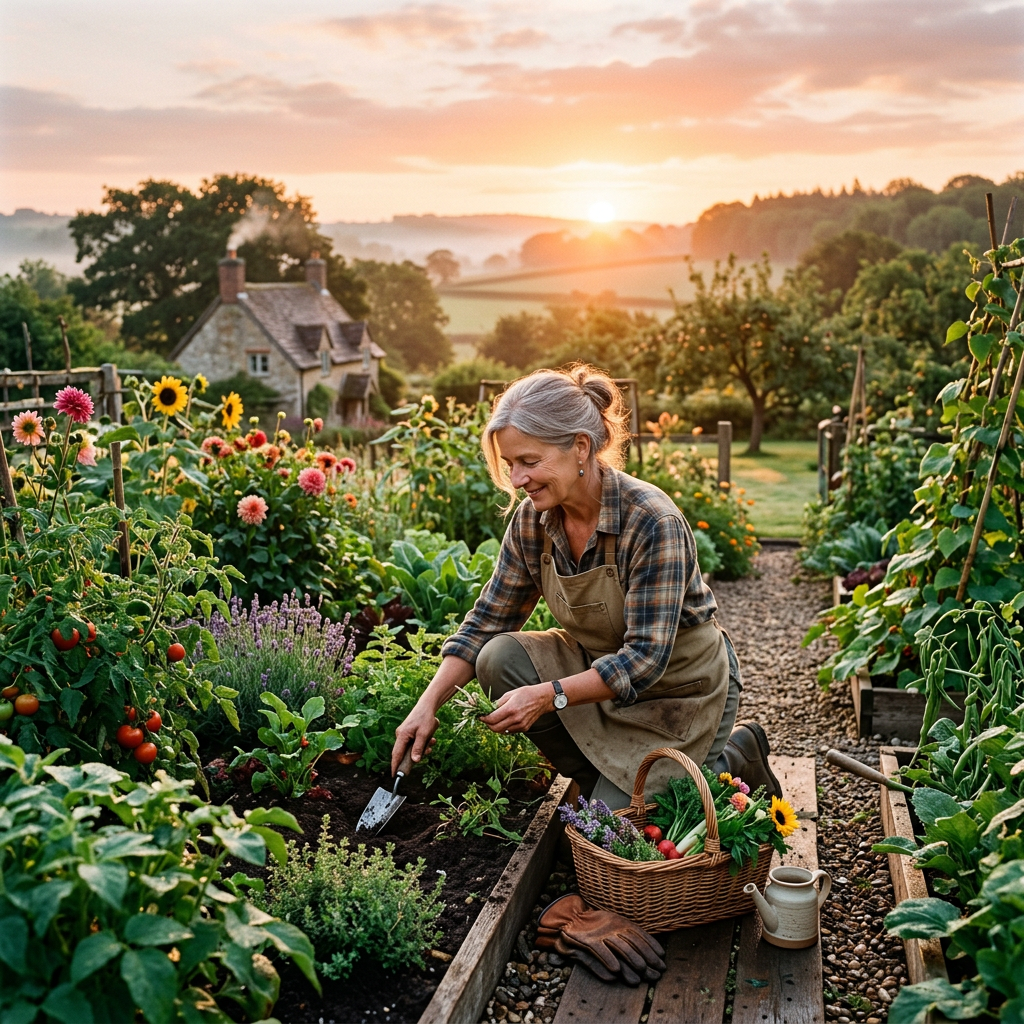
Woman tending to plants in a vegetable garden with flowers and a basket of fresh produce

Ordinary Day, Sacred Maintenance

Good morning, Unplugged Pagans.

Today feels like one of those ordinary days that does not announce itself as important.

Nothing dramatic is jumping out. The garden is still waiting. The weather is still making up its mind. The bills need attention. The course books have not arrived yet. The candles are lit. The incense is lit. The mood is set.

And maybe that is the point.

Not every reading arrives with thunder. Some arrive with a broom, a bill folder, a half-finished cup of coffee, and a quiet reminder that maintenance is sacred too.

Today we call in Brigid, Skadi, Ratatoskr, the fir tree, the landvættir, and the land spirits to bear witness and offer what wisdom they can. We also bring in the Cancer child, the Moonchild, whose emotional waters are being pulled toward structure, patience, and responsibility today.

Today’s Cards

Past: Nine of Wands reversed

Present: Ten of Pentacles reversed

Future: Five of Wands

The Querent: The Fool

The Past: Nine of Wands Reversed

The Nine of Wands reversed feels like the tired guard at the gate.

Upright, this card says, “I have been hit, but I am still standing.” Reversed, it says something quieter and more honest: “I am still standing, but I am tired of standing like this.”

This is defensive fatigue.

It is the body and spirit that have spent too long bracing for impact. It is the part of us that hears a small problem and prepares for a large one. A bill becomes a threat. A delay becomes a warning sign. A normal inconvenience starts sounding like the first drumbeat of collapse.

Brigid’s counsel here is gentle but firm:

Do not confuse your flame with your emergency signal.

The candle does not have to become a bonfire today. The sacred work may simply be tending the hearth without setting the whole field on fire.

The Present: Ten of Pentacles Reversed

The Ten of Pentacles reversed brings the focus down into the practical world: home, money, structure, bills, family systems, long-term stability, and the things that hold a life together.

This does not have to mean disaster. It often means the structure needs attention before it can carry more weight.

That feels right for today.

There are bills to look at. There are numbers to face. There are ordinary tasks that do not feel spiritual until we realize they are part of keeping the roof over the altar.

For the Cancer child, today’s energy asks for care around money, obligations, and emotional overextension. The Moonchild can feel financial pressure in the body before the mind has fully named it. That does not make the fear true. It makes it information.

Skadi stands at the edge of this card with snow in her hair and says:

Look at the terrain as it is, not as fear describes it.

The mountain does not care if we panic. It cares where we place the next foot.

So today’s practice is simple:

Make the bills visible, but do not let them become a verdict.

One list.

One reality check.

One next action.

No shame court at 2 a.m.

The Future: Five of Wands

The Five of Wands suggests friction ahead, but not necessarily failure.

This is not usually a catastrophe card. It is the card of competing energies. Too many sticks in the air. Too many voices. Too many little pressures trying to become one big argument.

This may show up as schedule pressure, money pressure, course delays, garden impatience, work obligations, or small frustrations that want to grow teeth.

The warning is not “something terrible is coming.”

The warning is:

Do not turn every friction point into a battlefield.

Ratatoskr has strong advice here.

Be careful what message you carry up and down the tree.

Do not carry panic from one branch to another. Do not turn one delay into a prophecy. Do not let one bill become “everything is falling apart.” Do not let one ordinary annoyance become a battle cry.

Some friction may come. Let it be friction, not identity.

The Querent: The Fool

And representing the querent, we have The Fool.

Not foolish.

Beginning.

The Fool stands at the edge of the path with very little guarantee and just enough trust to take the next step anyway.

This is a fitting card for a morning like this. Waiting for the books. Waiting for the garden. Waiting for the weather. Waiting for the next course. Waiting for the next stage of life to open fully.

But The Fool is not empty-handed.

The Fool carries experience, even if the road is new. The Fool carries tools, scars, candles, questions, and enough lived evidence to know that ordinary days are where rebuilds actually happen.

This is not being back at zero.

This is standing at a threshold.

The Fir Tree’s Counsel

The fir tree gives the deepest advice of the reading:

Stay green while waiting.

The fir does not bloom on command. It does not panic because spring is late. It does not tear itself apart because the soil is not ready.

It holds its needles.

It keeps its structure.

It survives by continuity, not spectacle.

That may be the medicine today.

Do the ordinary work. Pay attention to the numbers. Wait for the weather. Let the books arrive when they arrive. Let the garden wait until the land is ready. Let the body be a signal, not a sentence.

The Reading as a Whole

The past says: you are tired of being braced.

The present says: the household structure needs calm attention.

The future says: friction may rise, but it does not need to become war.

The querent says: you are still beginning, still moving, still allowed to step forward without the whole map.

Today’s reading is not dramatic. It is not glamorous. It is not a lightning strike from the gods.

It is something more useful.

It is a reminder that ordinary maintenance is part of sacred living.

Brigid tends the flame.

Skadi reads the terrain.

Ratatoskr guards the message.

The fir tree teaches endurance.

The land spirits remind us that nothing grows faster because we glare at the soil.

So today, the work is simple:

Stay green.

Stay steady.

Do the next honest thing.

Godspeed.

Broken, Still Trying: Light, Shadow, and the Ones Who Had Our Back

Some days, “still trying” is the whole victory.

Good evening. Standing on the Ledge.

I’m not sure yet whether this belongs on Unplugged Pagan or Standing on the Ledge. Maybe it belongs in both places — because some truths don’t care what label we put on them. They just show up when we need them.

Something crossed my feed today — a meme that was titled “Broken but Still Trying.” It hit that familiar nerve: the quiet kind of tired, the private kind of pain, the kind you carry without putting it on display.

I’m not going to repost it word-for-word here. But the heart of it was simple: some days I feel broken… and still I wake up and try again. Small steps. Easy steps. Breathing through the ache. Not giving up.

And that brought me back to an old friend — someone I’ve mentioned before. He’s not with us anymore. I miss him. And I want to share something he wrote that once steadied me:

When you are on your path and are walking towards that which lights your way, there will be a shadow behind you. If you don’t see the shadow, but trust that it is with you, then you’re going in the right direction. Keep moving forward, and we will have your back.

There was another line that circled this same idea — sometimes attributed as a Māori proverb, sometimes shared without a clear source:

Turn your face to the sun, and the shadows will fall behind you.

My friend went further in that post, and it stuck with me:

I like the idea that there are always lights, and where there are lights, there are shadows. If we are the shadows, we can keep the bad things away.

Knowing him, it’s a little haunting and a little perfect. He dressed in black. He lived near the edges of rooms. He had that way of “lurking” that wasn’t menace — it was watchfulness. Protective. Like he was taking the seat nobody else wanted, because he believed someone had to.

And it makes me wonder what he meant by “bad things.” What was he chasing off? What was he guarding against?

I don’t know. But I recognize the shape of it.

Sociologically, people like that often become unofficial keepers of the perimeter. Every group has them — the ones who notice what others ignore, who absorb tension so others can laugh, who stand between the fragile and the sharp. Sometimes they do it because they’ve learned the world can turn fast. Sometimes because nobody protected them when it mattered. So they choose to be the shadow on purpose.

Psychologically, this is what meaning-making can look like when life has left dents. If you can’t erase pain, you try to give it a job. You turn it into vigilance, loyalty, guardianship. You make a story strong enough to carry what you’ve survived.

Someone else commented on that same thread: “It is in the darkest shadows that the work is done for the brightest lights.” And another: “The brighter the flames, the darker the shadows.”

Light and dark. Flame and shadow. Trying and breaking and trying again.

Here’s what I’m taking from all this tonight:

If you’re still moving — even badly, even slowly, even with tears in your throat — you’re not finished. If you’re facing the light, the shadow behind you isn’t proof that something is wrong. It can be proof that you’re walking forward.

And if you can’t see who has your back right now — if the grief is loud, if the room feels empty — you can still trust this: the people who mattered leave their fingerprints on how we keep going. Sometimes that’s the only kind of “afterlife” we can prove. A sentence that steadies you. A memory that stands watch. A shadow that says, keep moving.

That’s all for today. Godspeed.

From Lugh to Kevin: My Evolving Identity Story

Today, I was looking through some old autobiographical notes, trying to figure out when Lugh Sulian first appeared. Thanks to Facebook, I found the date: February 5, 2012. The story behind Lugh’s creation is interesting on its own. Back then, I was living with someone, and as our relationship was ending, I wanted a private online space where I could post without feeling watched. I spent a lot of time choosing the name: Lugh, after the Celtic god of war, and Sulian, for the Sun. That’s a bit funny, since my astrological sign is linked to the moon. There were other reasons for creating Lugh, too. I was getting more involved in the Pagan community and wanted to keep my public and private lives separate. Lugh became my identity in Pagan spaces, while I stayed Kevin in other parts of my life. When I needed a break from the Pagan world, I used the name Lugh; otherwise, I was Kevin. I lived as Lugh for quite a while. That chapter ended when that world fell apart, and I went back to being Kevin. Still, Kevin was always there when I needed him.

Around October 2018, I left a job I’d had for seven years and started moving away from the Pagan community. I began living a quieter, more private life. This was my second or maybe third big personal change. During that time, I called myself Lugh Sulian, the Unplugged Pagan. It took about a year to fully step away from my Pagan-focused life, and since then, I haven’t felt completely comfortable going back.

Heathen Bedtime Prayer

My Day is done, it’s time for bed

Odin bless my sleepy head

Earth and Water, Air and Fire

Bring gentle dreams as I retire

When the evening moon does rise

May Thor bless my open eyes

And if I should die before I wake

I pray to Hel my soul to take

Written by Kevin McLaughlin (AKA Lugh Sulian) March 24 2013.