Leaving Home in the Spirit of Hávamál 127

Man walking on cobblestone path outside stone cottage with lit entrance at dusk

There are places we call home because they shelter us.

There are places we call home because they shaped us.

There are places we call home because part of who we became was born there, around a fire, under certain trees, beside certain people, during a season of life when the word belonging still felt simple.

But not every home remains home.

That is a hard sentence to write.

It is harder still when the place was once sacred.

Unplugged Pagan did not come to that sentence quickly. It did not come to it cleanly. It did not come to it without memory, grief, anger, gratitude, and the strange ache that comes when something that once held you no longer does.

But there comes a point where staying attached to a dead bond is no longer loyalty.

It is silence.

And Hávamál 127 has something to say about silence.

The Verse at the Door

Declaration 127 takes its name from stanza 127 of the Hávamál, commonly rendered in modern Heathen circles as:

“When you see misdeeds, speak out against them, and give your enemies no frið.”

Frith, or frið, is often understood as peace, safety, right relationship, and the bond that allows a community to exist without tearing itself apart.

That is why the line matters.

It does not say, “When you see misdeeds, keep quiet for the sake of peace.”

It does not say, “When you see misdeeds, preserve the appearance of harmony.”

It does not say, “When you see misdeeds, maintain the old relationship at all costs because it used to mean something.”

It says to speak.

It says to name the wrong.

It says not to give frith where frith has already been broken.

That is the piece I keep circling back to.

Because the deeper lesson of Hávamál 127 is not only about enemies outside the gate. It is also about what happens when the problem is already near the hearth.

Declaration 127 and False Peace

Declaration 127 was originally written as a response to folkism and racial exclusion in modern Heathenry, especially in opposition to the Ásatrú Folk Assembly and its claims about who Heathenry was for.

That history matters. Folkism tries to turn ancestry into ownership. It tries to turn roots into border fences. It tries to turn the gods, ancestors, runes, and stories into racial property.

Declaration 127 said no.

But if Declaration 127 is only treated as an anti-folkish sticker, then we miss part of its power.

At its core, Declaration 127 also rejects the idea that silence should be maintained in the name of frith when harm is being justified through sacred language, tradition, ancestry, or community reputation.

That is where it becomes useful beyond the narrow question of folkism.

Not because every broken community is folkish.

Not because every failed home is racist.

Not because every wound is the same wound.

But because the spiritual principle is larger than the original occasion:

False peace is not frith.

That is the line.

Peace that requires silence is not frith.

Belonging that requires self-erasure is not frith.

Hospitality that protects the powerful while ignoring the wounded is not frith.

Community that remembers your labour but forgets your humanity is not frith.

Home that only remains home if you stop telling the truth is not home.

When Home Was Real

To be clear, this is not a post about pretending the old home never mattered.

It did.

That is part of what makes leaving it difficult.

There are old Unplugged Pagan writings that carry that truth plainly. The Vé remembers sacred work at Raven’s Knoll, the creation of sacred space, the carrying of poles, the marking of place, the building of something that mattered. That memory was not fake. The bond was not imagined. The sense of sacred place was real.

That matters.

If a place never mattered, leaving it would mean very little.

If a community never held meaning, there would be no grief in releasing it.

If the fire never warmed us, there would be no ache when it became ash.

So no, this is not bitterness dressed up as theology.

This is not a denial of the past.

This is not an attempt to rewrite memory so that leaving becomes easier.

The old home mattered.

That is exactly why leaving it had to be done honestly.

Roots, Hoards, and What We Refuse to Cut

Unplugged Pagan has been wrestling with roots for a long time.

Roots are not always pretty. They are hidden. Tangled. Muddy. Difficult to display. But they are what feed the tree.

In earlier reflections, I wrote about the danger of cutting off roots while expecting the branches to remain healthy. A tree can look strong from the outside while damage is already happening beneath the surface.

That image still holds.

A community can have events, names, land, symbols, buildings, programs, schedules, banners, and public language. It can still look alive from the outside.

But appearance is not health.

The roots are older than the poster.

The roots are the first fires, the old labour, the forgotten volunteers, the awkward conversations, the hands that carried wood, the people who showed up before there was applause, the ones who helped build something and later found themselves standing outside of it.

When those roots are ignored, starved, severed, or treated as disposable, something important has already gone wrong.

And when gold and silver begin to matter more than kith and kin, the hearth has shifted.

That does not mean money does not matter. Money keeps roofs standing. It pays bills. It buys tools, fuel, food, insurance, repairs, and all the practical things that keep a place functioning.

But gold and silver are not kin.

They do not sit beside you when your spirit is tired.

They do not remember the first fire.

They do not carry the old stories.

They do not make a hall sacred.

They only make it affordable.

There is a difference.

The Moment the Header Came Down

When the old Unplugged Pagan header came down, that was not just a design choice.

It was a small funeral.

The old image was taken at Raven’s Knoll. For a long time, that mattered in a good way. It carried memory. It carried place. It carried old hopes, old gatherings, old people, and an older version of Unplugged Pagan that still believed itself rooted there.

But places change.

Or more honestly, our connection to them changes.

A grove can shelter us for a season and later become somewhere we no longer belong.

A fire can warm us once and later become ash.

A home can form us and still not hold us forever.

That does not make the warmth false.

It means time moved, people changed, and the bond reached its ending.

The header had to come down because Unplugged Pagan needed its own ground.

Not borrowed ground.

Not someone else’s grove.

Not a shrine to an old connection.

Its own ground.

That was not an act of hatred.

It was an act of boundary.

And sometimes boundary is the only honest ritual left.

Leaving Is Not Always Betrayal

People often treat leaving as betrayal.

Sometimes it is.

Sometimes people abandon what they should have tended. Sometimes people walk away because repair is harder than resentment. Sometimes leaving is cowardice with cleaner shoes.

But not always.

Sometimes leaving is what happens after every inner warning has already spoken.

Sometimes leaving is what happens when the bond has died but everyone keeps asking you to behave as though it lives.

Sometimes leaving is what happens when “home” becomes a word used to keep you quiet.

Sometimes leaving is the first truthful thing a person has done in years.

That is where Hávamál 127 matters.

It gives no blessing to false peace.

It does not tell us to remain politely attached to what has already broken frith.

It does not ask us to keep handing warmth to a place that no longer shelters us.

It says misdeeds should be named.

It says enemies should not be given frith.

And sometimes the enemy is not a person.

Sometimes the enemy is the lie that a dead bond is still alive.

Not Folkism, But the Same Warning

This needs to be said carefully.

This post is not claiming that the old home was folkish.

That is not the argument.

The argument is that Declaration 127 carries a principle that reaches beyond the original fight against folkism:

Sacred language must not be used to demand silence in the face of harm.

Folkism is one form of that harm. It uses ancestry, gods, and tradition to exclude people and claim ownership over the sacred.

But there are other ways sacred language can be misused.

“Community” can be used to silence people.

“Frith” can be used to avoid accountability.

“Home” can be used to shame people for leaving.

“Kith and kin” can be used as decoration while actual bonds are neglected.

“Hospitality” can be used to protect the host while ignoring the guest.

“The good of the place” can be used to excuse the cost to the people who helped make the place good.

That is why 127 still applies.

Not as an accusation of folkism.

As a warning against false frith.

The Hearth Test

The real test of a hearth is not how it looks when the festival is full.

The real test is what happens when someone is wounded.

Who notices?

Who checks in?

Who listens?

Who protects the relationship?

Who chooses repair over reputation?

Who remembers that people are not disposable once their labour is no longer needed?

Who carries wood when no one is watching?

Who remains when the ash has to be dealt with?

That is the hearth test.

Not the banner.

Not the website language.

Not the number of people gathered around the fire.

The hearth is revealed by the treatment of the living.

If the living must become silent to preserve the image of home, then home has already failed the hearth test.

Why Unplugged Pagan Left

So why did Unplugged Pagan choose to leave home?

Because memory is not obligation.

Because gratitude is not captivity.

Because a sacred place can matter deeply and still no longer be ours.

Because roots matter, but roots are not chains.

Because frith is not maintained by pretending the wound is not there.

Because Hávamál 127 does not permit silence in the face of misdeeds.

Because Declaration 127 reminds us that keeping peace with what harms others is not peace.

Because the path does not end when one grove is left behind.

Because the land is larger than one campfire.

Because the gods are not trapped on someone else’s property.

Because the fire can be carried.

Because Unplugged Pagan needed its own ground.

The Road Behind and the Road Ahead

There is grief in this.

There should be.

Leaving home without grief usually means it was never home to begin with.

But grief is not a command to return.

Grief is the price of having once loved something honestly.

The old home shaped this path. That can be honoured.

The old fire warmed this path. That can be remembered.

The old grove held meaning. That can be spoken without shame.

But none of that requires Unplugged Pagan to keep standing under a roof that no longer shelters it.

There is a line from the Hávamál, in spirit, that cattle die, kinsmen die, and we ourselves die. What remains is reputation, deeds, and the truth of how we carried ourselves.

Places can die to us too.

Connections can die.

Communities can die.

The stories we told ourselves about belonging can die.

And when they do, the Pagan path should not require us to pretend otherwise.

Ancestor work is not dragging a corpse around.

Memory is not a leash.

Gratitude is not a prison.

Sometimes the most honest Pagan act is to stand at the edge of the old place and say:

I remember.

I honour.

I release what is no longer mine to carry.

Closing Thought

Hávamál 127 does not only belong at protests.

Declaration 127 does not only belong on organization lists.

The lesson belongs at the actual hearth.

It belongs in the difficult moment when a person has to decide whether peace is still peace, or whether peace has become silence.

For Unplugged Pagan, the answer has become clear.

Home was real.

The memory mattered.

The work mattered.

The fire mattered.

But the bond reached its ending.

And when the bond is dead, pretending it still lives is not frith.

It is false peace.

So Unplugged Pagan leaves home in the spirit of Hávamál 127.

Not with hatred.

Not with denial.

Not by pretending the old place was never sacred.

But by refusing to let sacred memory become a chain.

The road remains.

The fire can be carried.

The roots can be honoured without living under the old tree.

And sometimes the only way to keep faith with the hearth is to walk away from the hall.


Sources and Further Reading

Declaration 127, Hávamál 127, and the Actual Hearth

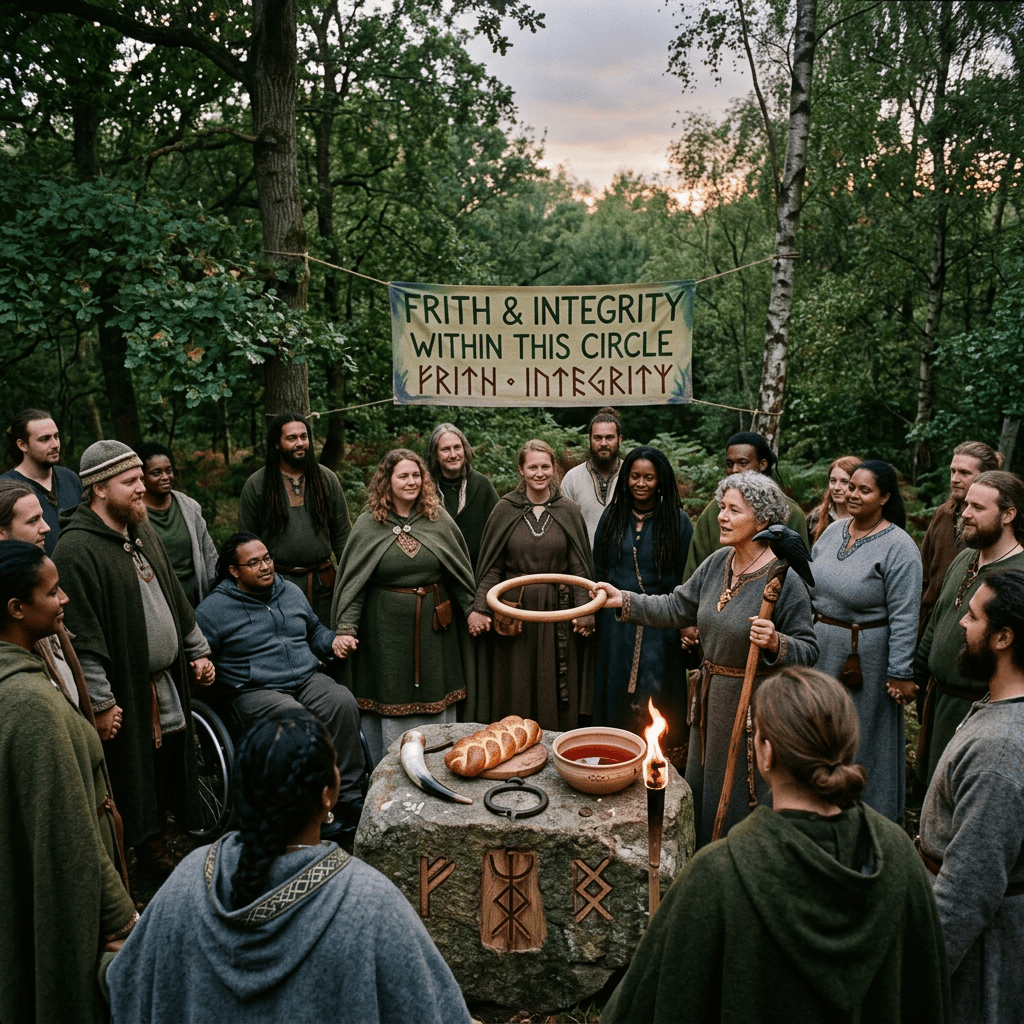
Inclusive Heathen ritual emphasizing frith and integrity

There is a danger in letting institutions do all of our thinking for us.

That is not a knock against institutions. Sometimes they are needed. Sometimes they hold the line when loose communities cannot. Sometimes they preserve documents, organize clergy, publish resources, and provide a public answer when the wider world asks, “Where do you stand?”

In modern Heathenry, The Troth is one of those institutions.

It gives an organizational example of inclusive Heathenry. It stands against folkism, racialism, and the use of Germanic religion as a costume for white supremacy. It now also carries formal stewardship of Declaration 127, one of the most important anti-folkish statements in modern Heathen history.

That matters.

But Unplugged Pagan is not The Troth.

Unplugged Pagan is not a clergy program, a committee, a declaration archive, or an institutional hall with bylaws and officers. It is something rougher than that. It is more like a fire at the edge of the woods, where the questions are less polished but sometimes more honest.

So the question for this place is not simply, “What does The Troth say?”

The better question is this:

What does Declaration 127 mean at the actual hearth?

The Line Between Institution and Hearth

The bigger conclusion, at least for Unplugged Pagan, is this:

The Troth gives an organizational example.

Declaration 127 gives the public boundary.

Hávamál 127 gives the old poetic command.

Unplugged Pagan asks what that means at the actual hearth.

That is the angle that matters here.

Not “The Troth says this, therefore we obey.”

That would be too institutional and too neat.

Unplugged Pagan has always been more interested in the place where the clean statement meets the dirty ground. The fire pit. The broken friendship. The old gift-bond. The kinship that failed. The boundary that had to be drawn. The guest who became a threat to the hall. The moment when keeping peace becomes complicity.

That is where Hávamál 127 stops being a quotation and becomes a test.

What Declaration 127 Is

Declaration 127 first appeared in 2016 through Huginn’s Heathen Hof. It was written as a response to the Ásatrú Folk Assembly and the wider problem of folkish rhetoric in Heathenry.

The AFA has been widely criticized because of its folkish and racialized approach to Ásatrú. The Southern Poverty Law Center describes it as a neo-Völkisch hate group, and the Anti-Defamation League describes it as a modern Norse Pagan group with a white supremacist slant.

That is the problem Declaration 127 tried to answer.

Not ancestry itself.

Not remembering the dead.

Not honouring one’s roots.

The problem is when ancestry gets turned into ownership. When roots become border fences. When honouring the ancestors becomes an excuse to lock sincere seekers out of the hall because of race, ethnicity, sexuality, gender, ability, family structure, or bloodline.

That is folkism’s poison.

It takes something sacred and turns it into a gate.

Hávamál 127

Declaration 127 takes its name from stanza 127 of the Hávamál, commonly rendered in this form:

“When you see misdeeds, speak out against them, and give your enemies no frith.”

That line has teeth.

It does not say, “When you see misdeeds, quietly hope the situation improves.”

It does not say, “When you see misdeeds, avoid conflict so everyone stays comfortable.”

It does not say, “When you see misdeeds, keep inviting the poisoner back to the well because hospitality is sacred.”

It says to speak.

It says to name the wrong.

It says not to give frith to enemies.

That is a hard teaching, especially in Pagan spaces where many people are allergic to direct conflict. We often prefer circles, soft language, consensus, healing words, and the illusion that everyone can be included if we just stretch the tent wide enough.

But no tent can remain standing if you invite people in who are cutting the ropes.

Frith Is Not Blind Peace

Frith is often spoken of as peace, safety, right relationship, and the bonds that hold a community together.

That makes it sacred.

But sacred does not mean unlimited.

Frith is not blind peace.

Frith is not conflict avoidance.

Frith is not letting someone remain at the hearth while they deny the humanity, dignity, or belonging of others who sit there.

That is where “no frith with folkism” becomes more than a slogan.

If folkism says only certain blood belongs, then folkism has already broken frith.

If folkism says the gods are racial property, then folkism has already broken frith.

If folkism uses sacred symbols to shelter white supremacy, then folkism has already broken frith.

Refusing it a seat is not the first act of hostility.

It is the recognition that hostility was already brought through the door.

The Actual Hearth

The actual hearth is where this becomes personal.

It is easy to sign a declaration online.

It is harder to live one when the person crossing the line is someone you know.

It is harder when they once shared your fire.

It is harder when they gave you gifts.

It is harder when there is history, memory, laughter, old ritual, old loyalty, or old kinship tangled around the problem.

But that is exactly where Hávamál 127 matters most.

The real test is not whether we can denounce a stranger with a bad logo.

The real test is whether we can name misdeeds when they happen close enough to cost us something.

Unplugged Pagan has circled this fire before. Gift-bonds. Betrayal. Frith. Kinship. Hospitality. Land. Roots. The painful knowledge that some bonds die, and when they die, pretending they still live becomes its own kind of lie.

That is why this subject fits here.

Because Declaration 127 is not only about public statements and organization lists. It is about the moment when a person has to decide whether peace is still peace, or whether peace has become silence.

Remembering Roots Is Not Worshipping Blood

There is also a difference between remembering roots and worshipping blood.

That distinction matters deeply to me.

I can honour where I come from.

I can honour my ancestors.

I can honour the old stories, the land, the dead, the language fragments, the hearth practices, the gods, the spirits, the old roads, and the strange pull that brings a person back toward Pagan soil.

But ancestry is not a weapon.

Ancestry is not a deed to the gods.

Ancestry is not a lock on the hall door.

Ancestry may explain part of the road that brought me here.

It does not give me permission to lock the road behind me.

That is the sentence I keep coming back to.

Because folkism takes the memory of roots and turns it into blood worship. It takes the dead and makes them border guards. It takes heritage and turns it into spiritual property law.

I cannot accept that.

Not as Paganism.

Not as Heathenry.

Not as honour.

The Troth, Declaration 127, and Unplugged Pagan

The Troth matters here because it gives one institutional example of a different road.

It says Heathenry does not have to be folkish.

Declaration 127 matters because it gives a public boundary.

It says discriminatory organizations and exclusionary ideologies do not represent the wider Heathen community.

Hávamál 127 matters because it gives the old poetic command.

It says that when we see misdeeds, we speak against them, and we do not give enemies frith.

But Unplugged Pagan’s work is smaller and closer to the ground.

It asks what that means in the actual living of it.

What does it mean when the person at the hearth is the one poisoning the well?

What does it mean when hospitality becomes a shield for harm?

What does it mean when kinship is used to demand silence?

What does it mean when “keeping the peace” only protects the person breaking it?

Those are not institutional questions.

Those are firekeeper questions.

The Firekeeper’s Answer

A firekeeper does not only feed the flame.

A firekeeper also watches what comes near it.

Too little fuel and the fire dies.

Too much fuel and the fire becomes dangerous.

The wrong thing thrown into it can poison the air.

That is how I understand this issue.

Hospitality is sacred, yes.

But so is protection.

Kinship is sacred, yes.

But so is truth.

Ancestry is sacred, yes.

But so are deeds.

Frith is sacred, yes.

But frith cannot be built with those who deny frith to others.

That is the line at the hearth.

Not hatred.

Not purity.

Not moral performance.

A boundary.

A necessary one.

Closing Thought

The Troth can hold the archive.

Declaration 127 can mark the public boundary.

Hávamál 127 can give the old command.

But each hearth still has to decide what it will allow beside the fire.

For Unplugged Pagan, the answer is simple enough:

Remember your roots.

Honour your dead.

Keep the fire.

Welcome the sincere traveller.

But do not confuse hospitality with surrender.

Do not confuse ancestry with ownership.

Do not confuse silence with peace.

And do not give frith to those who would use the sacred to deny it to others.

The fire is lit.

The road is open.

But folkism does not get a seat by the hearth.


Sources and Further Reading

The Troth, Declaration 127, and the Line at the Hearth

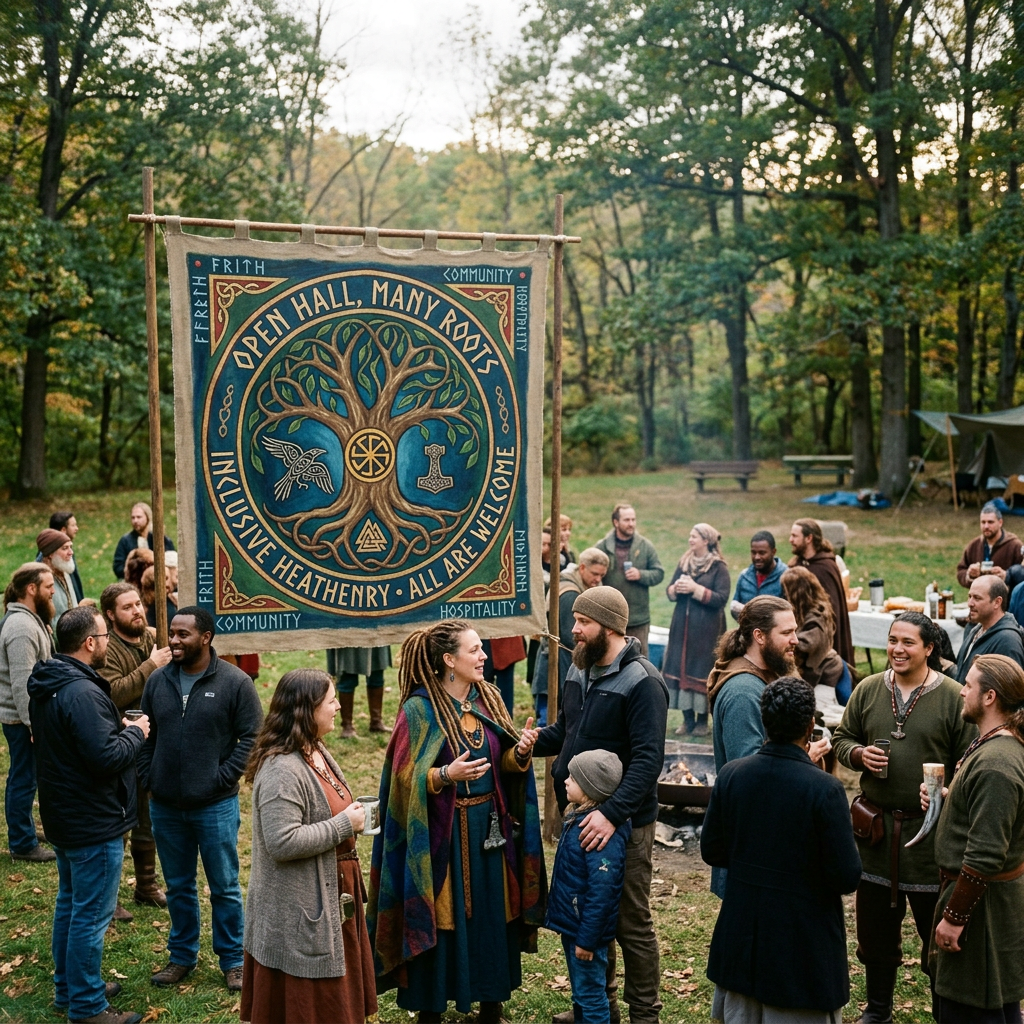
Group of people socializing outdoors around a banner reading 'Open Hall, Many Roots Inclusive Heathenry All Are Welcome'

Every so often in modern Heathenry, a name comes up that is bigger than the name itself.

The Troth is one of those names.

On the surface, The Troth is an organization. It has memberships, officers, clergy training, educational programs, policies, publications, committees, and all the ordinary machinery that comes with a long-running religious body. But beneath that administrative layer is something more important: The Troth is one of the major inclusive Heathen organizations that has tried to stand against folkism, racialism, and the use of Germanic religion as cover for white supremacy.

That matters because modern Heathenry has never been free from that fight.

The gods, myths, runes, symbols, ancestors, sagas, and old Germanic language have been repeatedly grabbed by people who want to turn a spiritual path into bloodline politics. The result is a constant argument over who gets to define Heathenry: those who see it as a living religious path open to sincere seekers, or those who want to turn it into a racial gate.

The Troth stands on the inclusive side of that argument.

According to its own organizational statement, The Troth is open to people who seek to know and worship the gods, honour the ancestors, and live by Germanic Heathen values, regardless of tradition, race, ethnicity, sexual orientation, ability, gender, or family structure. It also states plainly that it stands against the use of Germanic religion or symbols to advance racism, sexism, transphobia, homophobia, ableism, or white supremacy.

That is not vague language.

That is a line.

What Is The Troth?

The Troth began as The Ring of Troth, founded in 1987 by Edred Thorsson, also known as Stephen Flowers, and James Chisholm. Its early history has baggage, as nearly all modern Pagan institutions do. There were occult influences, personality conflicts, internal controversies, and leadership struggles. No serious reading of modern Heathen history should pretend otherwise.

But The Troth also became known as one of the major non-racialist, inclusive Heathen organizations. That distinction is important. It was not built as a folkish gatekeeping body. It was built around education, publication, community, religious training, and the idea that Heathenry could be practiced without racial exclusion.

The Troth currently describes its mission as building and supporting a diverse, inclusive spiritual community that provides education, clergy training, pastoral care, and publications for the many faiths within Heathenry. Its current values are listed as Integrity, Hospitality, Courage, Reverence, and Sustainability.

Those values are worth looking at carefully.

The Troth defines courage as anti-racism, active resistance to white supremacy, and confronting injustice and bigotry. That is a long way from the watered-down “honour, courage, loyalty” boilerplate that gets passed around in some Heathen spaces as if it were ancient law carved into a stone somewhere.

It is not.

Modern Heathenry is full of reconstruction, interpretation, invention, recovery, and correction. The honest practitioner needs to admit that. We are not walking out of an untouched Iron Age temple. We are rebuilding from fragments: poems, sagas, archaeology, folklore, comparative religion, devotional experience, and modern community work.

That means the question is not whether an organization is modern.

They all are.

The better question is this: what kind of modern thing is it trying to build?

The Problem Declaration 127 Tried to Answer

To understand why The Troth matters, we have to talk about Declaration 127.

Declaration 127 first appeared in 2016 through Huginn’s Heathen Hof. It was written as a response to escalating folkish rhetoric and, more specifically, to the Ásatrú Folk Assembly, commonly shortened to AFA.

The AFA is a folkish Heathen organization. The Southern Poverty Law Center describes it as a neo-Völkisch hate group and states that its members subscribe to the belief that pre-Christian Norse and Germanic religions can only properly be practiced by people with Northern European ancestral roots, especially white people.

That is the core problem.

Folkism tries to turn ancestry into spiritual ownership. It takes the honouring of ancestors, which can be meaningful and sacred, and twists it into a locked gate. It says, in effect, that blood decides belonging.

Declaration 127 said no.

The name comes from Hávamál stanza 127, often rendered in English along these lines:

“When you see misdeeds, speak out against them, and give your enemies no frið.”

That line is the spine of the matter.

Frith is often discussed as peace, safety, social harmony, sacred order, and the bonds that hold a community together. But Declaration 127 forces a harder question: is frith owed to those who are actively poisoning the well?

That is not a small question.

Modern Pagan spaces often love the language of tolerance. Everyone gets a seat. Everyone gets a voice. Everyone gets to speak their truth. That sounds noble right up until someone uses that openness to normalize exclusion, bigotry, and racial gatekeeping.

At that point, unlimited tolerance becomes cowardice dressed as hospitality.

Declaration 127 was important because it said, publicly and collectively, that Heathen groups should not maintain silence simply to keep peace with those who use the gods, ancestors, and traditions to justify prejudice.

The Original Declaration: A Necessary First Line

The original Declaration 127 was powerful because it gave inclusive Heathens a shared public statement. It allowed kindreds, groups, and organizations to say: we do not stand with the AFA; we do not accept racial exclusion as Heathenry; we do not grant folkism the cover of religious diversity.

That may sound obvious now, but at the time it was not always treated as obvious.

According to The Troth’s own later summary, before Declaration 127 there had been a habit in some Heathen spaces of tolerating white nationalists and folkish actors as if their presence were simply an unpleasant cost of growing the religion. The hope seemed to be that if inclusive Heathens offered enough hospitality, the folkish element might eventually soften.

That did not happen.

Because folkism does not enter the hall looking for hospitality. It enters looking for legitimacy.

That is the real lesson.

If a group built on exclusion is allowed to sit beside everyone else as merely “another kind of Heathenry,” then the wider public sees two equal options: inclusive Heathenry and racialized Heathenry. That is exactly the trap. It makes white supremacy look like a valid theological position instead of a corruption of the sacred.

The original Declaration 127 disrupted that.

It was not perfect. It was not complete. It was not a magic spell. But it gave people language. It gave people a public marker. It gave people a way to say, “No, that does not represent us.”

Sometimes the first act of rebuilding a community is not writing a complete constitution.

Sometimes it is simply pointing at the fire and saying, “That does not belong in the hall.”

The Criticism: Did Declaration 127 Go Far Enough?

Declaration 127 also drew criticism from inclusive Heathens who supported its general purpose but believed it did not go far enough.

A 2019 article in The Wild Hunt summarized one of the key concerns: because the original Declaration focused heavily on the AFA, some felt it weakened the broader statement that needed to be made. The real issue was not only one organization. The issue was folkism, racial exclusion, and opposition to inclusivity across Heathen spaces.

That criticism is fair.

There is a danger in making one group the entire target. If one organization is named as the problem, then others can dodge the issue by saying, “We are not them.” But the rot can exist under different names, different logos, and different tones of voice.

A person does not have to wear an AFA patch to carry folkish ideas.

A kindred does not have to use open slurs to create an exclusionary space.

A group does not have to shout “white supremacy” to quietly build its membership around blood, ancestry, ethnicity, gender conformity, and suspicion of outsiders.

That is why Declaration 127 had to evolve.

Declaration 127 2.0 and Declaration of Deeds

By 2021, Declaration 127 2.0 had emerged as a broader non-discrimination statement. The Troth explains the difference this way: the original Declaration gave people something to stand against, while Declaration 127 2.0 set a broader standard of conduct for people and organizations to follow.

That distinction matters.

Standing against something is necessary. But eventually, a community has to say what it stands for.

“We are not folkish” is a beginning.

It is not the whole path.

Around the same period, another statement called the Declaration of Deeds was also written and circulated. It framed the matter through a simple but deeply Heathen idea: we are our deeds. We are not made worthy or unworthy by the circumstances of birth. We are judged by what we do.

That may be one of the cleanest anti-folkish arguments available.

Folkism says blood matters most.

Declaration of Deeds says deeds matter most.

That is a direct collision of worldviews.

The Troth signed both Declaration 127 2.0 and the Declaration of Deeds in 2022. In its announcement, The Troth stated that simply saying “we will not associate with white nationalists” was not enough, because Heathens also had to declare what they were for.

That is the mature stage of the argument.

Not just “no frith with folkism,” but also: what kind of frith are we building instead?

The Collapse and Stewardship of Declaration 127

Declaration 127 did not remain stable forever.

According to The Troth’s current Declaration 127 page, after Declaration 127 2.0 was approved and released during the COVID-19 pandemic period, the structure around it began to unravel. By the end of 2021, the committee had burned out and the website had gone down. The statement still existed, but its home, signatory process, and active stewardship had weakened.

That is not surprising.

Volunteer-driven Pagan work burns people out. That is not an insult. It is a reality. People build something important, hold it together with unpaid labour, fight the same fights repeatedly, get attacked from multiple sides, and eventually run out of fuel.

Movements often fail not because the idea was wrong, but because the people carrying it were exhausted.

In April 2024, Rob Schreiwer turned over stewardship and ownership of Declaration 127 and its associated assets to The Troth at Frith Forge. The Troth then became the official steward of Declaration 127, with the stated goal of preserving it, updating it, and forming committees to vet signatories and guide its future.

That is where The Troth becomes more than just another signatory.

It becomes part of the infrastructure carrying Declaration 127 forward.

That does not mean The Troth owns inclusive Heathenry.

It does not mean The Troth speaks for every Heathen.

It does not mean The Troth is beyond criticism.

But it does mean that The Troth has taken formal responsibility for one of the major anti-folkish documents in modern Heathen history.

Did Declaration 127 Defeat Folkism?

No.

And it is important to say that plainly.

Declaration 127 did not destroy folkism. It did not erase white nationalism. It did not stop bad actors from using runes, gods, ancestors, and Germanic symbols for racial politics.

The Troth itself admits this. Its Declaration 127 page notes that folkish Paganism and white nationalism surged during the rise of the far right between 2015 and 2021, and that less than a year after Declaration 127 was written, Charlottesville happened.

That should sober everyone up.

Declarations are not wards.

They are not spells.

They are not substitutes for action.

A declaration is a line written down. Its worth depends on whether anyone is willing to stand on that line when pressure comes.

This is where modern Pagan communities often fail. We write beautiful statements. We share them. We pin them. We put them in bylaws. Then, when conflict arrives, we suddenly rediscover our fear of confrontation.

But Hávamál 127 is not passive.

It does not say, “When you see misdeeds, quietly hope things improve.”

It does not say, “When you see misdeeds, maintain neutrality so everyone feels welcome.”

It says to speak out against wrong and give no frith to enemies.

That is a hard teaching.

Hard teachings are usually the ones communities need most.

The Troth as the Inn

The Troth uses a useful image for itself: the inn on the roadside of Heathenry.

I like that image.

Not a throne.

Not a fortress.

Not a blood gate.

An inn.

An inn offers hospitality. An inn has a hearth. An inn gives travellers a place to rest, learn, eat, speak, and continue on their road. Not everyone who comes to the inn stays forever. Some people warm their hands by the fire and move on. Some become regulars. Some become innkeepers.

But an inn also has a door.

That is the part people forget.

Hospitality does not mean surrendering the house to those who would burn it down.

Frith does not mean smiling politely while someone poisons the well.

Inclusivity does not mean including exclusion.

The innkeeper has a duty to guests, yes. But the innkeeper also has a duty to the hearth, the house, and everyone already sheltering inside.

That is why “no frith with folkism” is not a contradiction of hospitality. It is a defence of hospitality.

You cannot build a welcoming hall while giving honoured seats to those who want some of the guests removed by blood, race, sexuality, gender, ancestry, or ability.

At that point, the issue is no longer politeness.

It is protection.

The Nine Noble Virtues Problem

This also matters when we talk about the Nine Noble Virtues.

Many people encounter Heathenry through simplified virtue lists: courage, truth, honour, fidelity, discipline, hospitality, self-reliance, industriousness, perseverance. These are often presented as if they are ancient Heathen doctrine.

They are not.

They are modern constructions.

That does not automatically make every word on the list worthless. Hospitality, courage, truth, and perseverance can all be good things. But the problem is not whether a virtue sounds nice. The problem is who framed it, why they framed it, and what kind of community it trains people to accept.

A virtue list can become a mask.

“Honour” can become obedience.

“Loyalty” can become silence.

“Discipline” can become authoritarianism.

“Folk” can become race.

That is why The Troth’s current values are worth noting. It does not center the Nine Noble Virtues as its defining ethical framework. Instead, it names integrity, hospitality, courage, reverence, and sustainability, and it defines courage in terms of anti-racism and active resistance to white supremacy.

That is not accidental.

That is a corrective.

No Frith with Folkism

The phrase “no frith with folkism” works because it goes straight to the heart of the issue.

Folkism wants the benefits of Heathen language without the obligations of Heathen ethics.

It wants ancestry without humility.

It wants tradition without hospitality.

It wants gods without accountability.

It wants symbols without responsibility.

It wants frith while denying frith to others.

That cannot stand.

Frith is not a decorative word. It is not a warm fuzzy feeling. It is a bond of peace, trust, and right relationship. If someone’s ideology is built on excluding sincere seekers because of race, gender, sexuality, ancestry, or ability, then that person has already broken frith.

Refusing them a seat at the hearth is not the first act of hostility.

It is the recognition that hostility was already brought in with them.

The Useful Lesson of The Troth

The Troth is not perfect.

No institution is.

Its history has conflict. Its founders were human. Its leadership has changed. Its roof has leaked. Its hearth has burned low at times. There are people who will criticize it from inside and outside Heathenry, and some of those criticisms may be worth hearing.

But perfection is not the test.

The better test is this:

When the line had to be drawn, where did the organization stand?

On the question of folkism, racial exclusion, and white supremacy in Heathenry, The Troth has placed itself on the inclusive side of the line. Its current mission, values, Declaration 127 stewardship, and signing of Declaration 127 2.0 and the Declaration of Deeds all point in that direction.

That does not make The Troth the final authority on Heathenry.

It does not make membership mandatory.

It does not mean everyone must agree with its structure, leadership, theology, or institutional choices.

But it does make The Troth a useful landmark.

When someone claims Heathenry must be folkish, The Troth proves otherwise.

When someone claims the gods belong only to bloodlines, Declaration 127 answers otherwise.

When someone claims peace requires tolerating white supremacy, Hávamál 127 answers otherwise.

When someone asks whether there can be frith with folkism, the answer should be plain.

No.

Not at this hearth.

Closing Thought

Modern Heathenry is not ancient Heathenry resurrected whole.

It is a reconstruction. A rebuilding. A difficult act of memory, scholarship, devotion, community, and correction.

That means we have choices to make.

We can rebuild the hall as a blood gate.

Or we can rebuild it as a hearth.

We can use ancestry as a weapon.

Or we can honour ancestors without turning them into border guards.

We can mistake silence for peace.

Or we can remember that sometimes peace is protected by speaking plainly against what would destroy it.

The Troth, at its best, is the inn on the roadside.

Declaration 127 is the sign by the door.

The fire is lit.

But folkism does not get a seat by the hearth.


Sources and Further Reading

No Frith with Folkism Means Reckoning with the Nine Noble Virtues

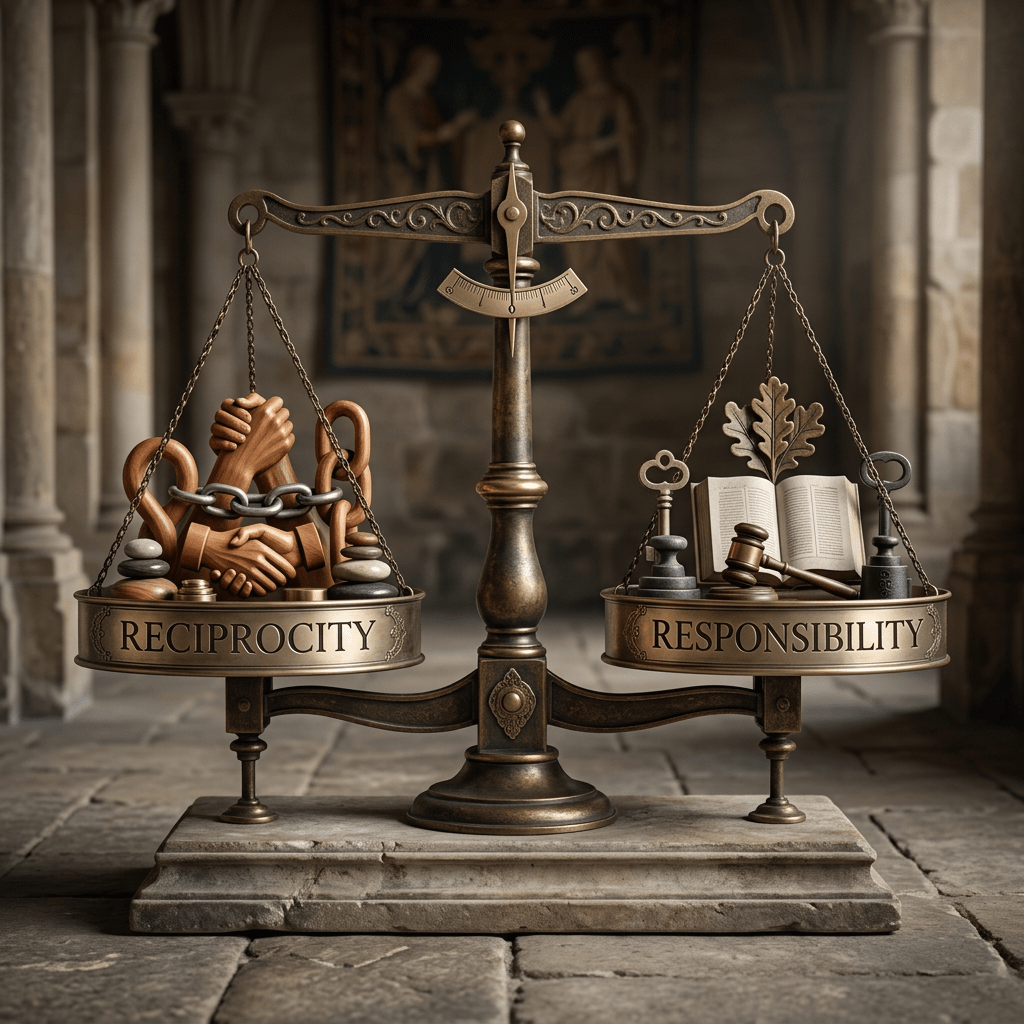
A vintage scale balancing symbols of reciprocity on one side and responsibility on the other

After reading The Wild Hunt’s recent opinion piece, “No Frith with Folkism,” I found myself agreeing with the surface statement while still feeling that something deeper needed to be said.

Yes, Folkism has no rightful place in Heathenry.

Yes, racism, white supremacy, blood-gatekeeping, and ancestry-as-spiritual-ownership need to be rejected.

But that led me to the harder question:

What happens when parts of modern Heathenry were built, shaped, repeated, or popularized inside the same ideological weather system that inclusive Heathens now say they reject?

That question brought me back to the Nine Noble Virtues.

The Nine Noble Virtues are often presented as if they are ancient Heathen ethics. They are not. They are a modern construction. The Wild Hunt has previously reported that the Nine Noble Virtues were created by John Yeowell and John Gibbs-Bailey of the Odinic Rite in 1974, and that Yeowell had ties to white supremacist and fascist movements. The Troth also states plainly that the Nine Noble Virtues are neither authentically from the Viking Age nor really ethics in the ancient sense, and that they were originally developed by the Odinic Rite.

That matters.

Not because courage is racist.

Not because truth is racist.

Not because honour, fidelity, discipline, hospitality, self-reliance, industriousness, or perseverance are bad words.

But because the package matters. The origin matters. The framework matters. The assumptions matter.

Modern Heathenry, especially in North America, has had to wrestle for years with white supremacist appropriation of its symbols and language. The Wild Hunt itself has reported Heathen voices saying that the tie between white supremacy and Heathenry in America goes back to the beginning of organized modern movements, and that modern Heathens have had to keep fighting the misuse of their symbols by extremists.

So I submitted an opinion piece to The Wild Hunt for consideration.

Partly because I think the question deserves to be asked.

Partly because “no frith with Folkism” cannot stop at rejecting obvious racism. It also has to examine inherited structures, moral frameworks, beginner materials, and community assumptions that may have been normalized through Folkish or far-right-adjacent spaces.

And partly, yes, to see whether this kind of internal critique will be given room.

It is one thing to say “we reject Folkism” when the target is safely outside the door.

It is harder to ask whether the floorboards inside the hall were cut from the same forest.

We shall see.

Below is the opinion piece submitted to The Wild Hunt for consideration.


No Frith with Folkism Means Reckoning with the Nine Noble Virtues

By Kevin McLaughlin
writing as Lugh Sulian

The recent Wild Hunt opinion piece “No Frith with Folkism” says something that needed saying clearly: Folkism has no rightful place in Heathenry.

I agree.

But I also think the statement opens a harder and more uncomfortable question. If there is no frith with Folkism, then what do we do with the parts of modern Heathenry that were shaped inside the same ideological weather system?

The Nine Noble Virtues are the obvious example.

Courage. Truth. Honour. Fidelity. Discipline. Hospitality. Self-reliance. Industriousness. Perseverance.

To many modern Heathens, these are treated almost like a sacred ethical foundation. They appear on websites, beginner guides, social media graphics, teaching materials, kindred pages, and personal practice statements. They are often presented as if they are ancient Heathen ethics handed down from the Viking Age.

They are not.

The Nine Noble Virtues are a modern construction. They were codified in the twentieth century, not preserved as a formal moral code from pre-Christian Germanic religion. The Wild Hunt has previously reported that the Nine Noble Virtues were created by John Yeowell and John Gibbs-Bailey of the Odinic Rite in 1974, and that Yeowell had ties to white supremacist and fascist movements. The Troth has also described the Nine Noble Virtues as the most famous modern attempt at creating a Heathen ethical code, originally developed by the Odinic Rite, while making clear that they are not Viking Age ethics.

That history matters.

It does not mean that courage is racist.

It does not mean truth is racist.

It does not mean honour, fidelity, discipline, hospitality, self-reliance, industriousness, or perseverance are bad things.

But it does mean the package deserves scrutiny.

When modern Heathen communities say “no frith with Folkism” while continuing to treat the Nine Noble Virtues as a central moral framework, they risk rejecting the visible racism while preserving some of the architecture that racism helped popularize.

That is the uncomfortable part.

The problem is not only who wrote the list. If that were the only issue, the solution would be simple: acknowledge the source, strip away the bad actors, and reclaim the useful pieces.

But the deeper issue is the shape of the code itself.

Why these nine virtues?

Why this emphasis?

Why courage, discipline, self-reliance, industriousness, perseverance, fidelity, and honour as the central moral vocabulary?

Where are compassion, humility, repair, interdependence, care for the vulnerable, accountability after harm, ecological responsibility, or the hard work of restoring broken relationship?

Hospitality is there, yes. But even hospitality can be flattened into a performance of courtesy if it is not tied to genuine openness, protection, and obligation toward the stranger.

The Nine Noble Virtues produce a particular moral atmosphere. It is hard-edged. It favours strength, endurance, self-mastery, loyalty, labour, and personal toughness. Those can be meaningful values. They can also sit very comfortably inside authoritarian, exclusionary, and Folkish ideas of struggle, hierarchy, purity, and worth.

That does not make every person who uses the Nine Noble Virtues a Folkist. It does not make every kindred that references them racist. Many inclusive Heathens have used them sincerely, often because they were presented as standard beginner material.

But sincerity does not erase origin.

And use does not make a thing ancient.

A community serious about rejecting Folkism should be willing to ask whether its inherited ethics still carry Folkish assumptions, even after the racial language has been removed.

That is where “no frith with Folkism” must become more than a slogan.

Frith is not merely the absence of conflict. It is right relationship. It is trust, order, obligation, and peace maintained through honesty and accountability. If Folkism has distorted modern Heathenry, then restoring frith requires more than disavowing explicitly racist organizations. It requires examining the ideas, habits, symbols, and teaching tools that were normalized through those same networks.

The Nine Noble Virtues should not be treated as Heathen scripture.

They should not be treated as the Ten Commandments in Viking clothing.

They should not be placed at the centre of beginner Heathen education without context.

At most, they should be taught historically: as a modern ethical construction, emerging from specific twentieth-century Odinist and Folkish-adjacent environments, later adopted and adapted by many people who often did not know or fully examine that history.

That is a very different thing from treating them as the moral backbone of the faith.

If inclusive Heathenry wants to build something healthier, it needs more than a cleaned-up version of inherited Folkish-era ethics. It needs an ethic rooted in reciprocity, hospitality, responsibility, and repair. It needs to honour ancestors without turning ancestry into ownership. It needs to value courage without glorifying domination. It needs to value honour without turning honour into ego armour. It needs to value kinship without narrowing kinship into blood purity. It needs to value frith without confusing frith with silence.

There is an old temptation in modern Paganism to fill gaps quickly. When reconstructing broken traditions, we reach for lists, codes, symbols, slogans, and simplified teaching tools. That is understandable. People want something solid under their feet.

But not everything solid is sacred.

Sometimes the thing that feels like foundation is just old scaffolding from someone else’s project.

The Nine Noble Virtues may have helped some people articulate discipline, courage, and responsibility. That personal meaning does not have to be denied. But personal usefulness is not the same as communal legitimacy. A tool can be useful and still require retirement when its history and limitations become clear.

Inclusive Heathenry does not need to reclaim the Nine Noble Virtues.

It needs to demote them.

Study them. Contextualize them. Critique them. Understand why they spread. Understand why they appealed to people. Understand why they still appeal to people. But stop pretending they are ancient. Stop pretending they are neutral. Stop pretending they are the natural ethical centre of Heathen practice.

No frith with Folkism means no unexamined inheritance from Folkism either.

If the hall is to be rebuilt, we have to inspect the beams.

Not just the banner over the door.


References

When the Absent Command the Living

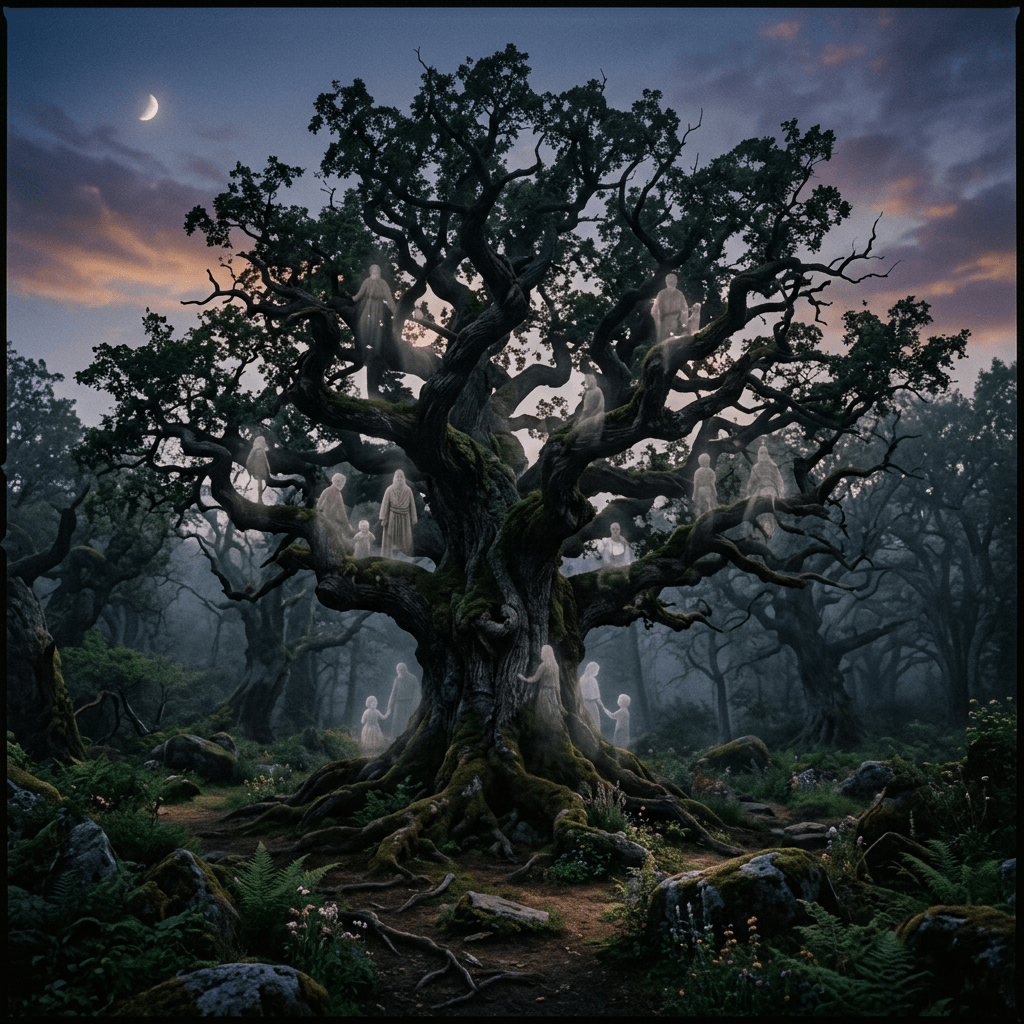
Large ancient tree with multiple glowing ghostly human figures on branches in a misty forest at twilight

There is a strange thought that has been sitting with me:

At some point, the absent began commanding the living.

By absent, I mean the dead first and foremost. The ancestors. The ones no longer sitting at the table. The ones whose boots no longer touch the floor, whose hands no longer open the door, whose voices no longer call down the hallway.

And yet, somehow, they still speak.

Not always as ghosts in the Hollywood sense. Not always as whispers in the dark or footsteps in an empty room. Sometimes the dead speak through habit. Through guilt. Through family sayings. Through inherited land. Through old wounds. Through recipes, tools, songs, photographs, names, graves, and promises made long before we understood the weight of making them.

The dead do not need to be alive to shape the living.

That may be one of the oldest truths mankind ever discovered.

The Human World Is Full of Absence

Animals live close to what is present. Hunger. Weather. Danger. Mating. Offspring. Territory. Pain. Sleep. The immediate world presses against them, and they respond.

Humans do something stranger.

We obey things that are not here.

A dead father’s expectation. A grandmother’s warning. A family name. A god unseen. A vow spoken years ago. A homeland we left. A betrayal we still carry. A grave we still visit. A future child not yet born. A people long gone. A story older than our blood.

That is not weakness. That is part of what makes us human.

But it is also dangerous.

Because once absence gains authority, mankind becomes capable of both reverence and madness.

We build shrines for the dead. We also fight wars over ancient wounds. We honour ancestors. We also inherit their grudges. We keep tradition alive. We also let dead hands steer living lives into the ditch.

So perhaps one of the great pagan questions is not, “Do the dead speak?”

Perhaps the better question is:

Which absent voices deserve obedience?

The Dead as the First Gods

I have often wondered whether the first gods were not gods in the way we later imagined them. Perhaps the first sacred powers were the dead.

The mother who knew the herbs.

The hunter who knew the trail.

The elder who remembered the flood.

The child who died too soon and left a wound in the camp that no one could name.

The founder. The warrior. The midwife. The singer. The one who crossed the river and did not return.

Before temples, before scriptures, before priesthoods, before doctrine, there would have been grief. There would have been memory. There would have been burial. There would have been the terrifying sense that the person was gone, and yet somehow not gone.

The body returns to the earth. The breath leaves. But the name remains.

And the name has power.

Say the name of someone dead and watch what happens inside the living. The room changes. The past steps forward. The absent arrives.

That is sacred territory.

Paganism and the Living Presence of Absence

For a pagan, this idea does not feel foreign.

We already live in a world where the visible and invisible overlap. The tree is a tree, yes, but it is not only lumber. The fire is heat, yes, but it is not only combustion. The river is water, yes, but it is not only a resource. The land is land, yes, but it is not only property.

There is presence in things.

There is memory in places.

There is spirit in land.

There is weight in oath.

There is a difference between walking through a forest and walking through a forest that knows your name.

This is where the modern world often fails. It tries to flatten everything into material use. Land becomes real estate. Fire becomes utility. Water becomes infrastructure. The dead become records. Religion becomes opinion. Memory becomes nostalgia.

But paganism, at its best, refuses that flattening.

It says the world is alive with relationship.

Not everything is human. Not everything is friendly. Not everything is there to serve us. But everything has place. Everything has consequence. Everything belongs to a web older than our convenience.

The absent are part of that web.

The Ancestors Are Not Automatically Wise

Here is where we need to be careful.

Ancestor honour does not mean ancestor worship without judgment.

The dead were human.

That means some were kind, some were cruel, some were broken, some were brave, some were foolish, some were trapped by the limits of their time, and some passed their damage forward like an unwanted inheritance.

Not every ancestor deserves a throne in the soul.

Some deserve honour.

Some deserve understanding.

Some deserve pity.

Some deserve to be laid down.

And some need to be told, firmly and without apology:

Your pain stops here.

That, too, is sacred work.

Breaking a harmful pattern is not betrayal. Sometimes it is the first honest offering ever made to the bloodline.

To honour the dead does not mean becoming their prisoner. It means knowing what they carried, what they gave, what they broke, what they survived, and what must not be repeated.

The Gods as Great Absences

The gods, too, live partly in this mystery of absence.

Brigid is not standing in the room like a neighbour dropping by for tea, and yet her presence can be felt in flame, craft, healing, poetry, and the stubborn will to keep the hearth alive.

Skadi does not need to appear at the door with snow on her shoulders for winter to carry her lesson: endurance, distance, silence, clean judgment, and the hard beauty of survival.

Ratatoskr does not need to chatter from a branch above us for us to understand the sacred danger of messages, gossip, movement, and the words that travel between worlds.

The fir tree does not speak English. It does not have to. It speaks in endurance. In green through winter. In rootedness. In the refusal to become empty simply because the season has turned against it.

The land spirits do not need our permission to exist. They were not born from our belief. At most, belief gives us the humility to notice them.

That is paganism to me: not blind belief, but relationship with a world that does not require human approval to be sacred.

When Memory Becomes Law

The danger comes when the absent stop being honoured and start being weaponized.

A dead founder becomes an excuse.

A tradition becomes a cage.

A god becomes a banner for cruelty.

An old wound becomes a permanent war.

A family name becomes a chain around the neck.

A sacred place becomes private possession.

A memory becomes a tool for control.

This is where humans go wrong again and again. We take the sacred force of absence and turn it into authority without accountability.

“This is what the ancestors wanted.”

“This is how it has always been.”

“This is what God commands.”

“This is what the old ways demand.”

Maybe.

Or maybe the living are hiding behind the dead because the dead cannot correct the quote.

That is why discernment matters.

The absent may command the living, but the living still have responsibility.

The Unborn Are Also Absent

There is another side to this.

The absent are not only behind us.

They are ahead of us.

The unborn also command the living, or they should.

When we care for land we may never fully enjoy, we are obeying the unborn.

When we refuse to poison water for short-term gain, we are obeying the unborn.

When we plant trees under whose shade we may never sit, we are obeying the unborn.

When we preserve stories, skills, rituals, songs, names, tools, and sacred places, we are making offerings forward.

That may be one of the most pagan acts possible: to live as though the future has a claim upon us.

Not because of guilt.

Because of kinship.

Kith and kin do not only stretch backward into graves. They stretch forward into cradles not yet built.

Choosing the Right Ghosts

So maybe the human question is not whether we are ruled by ghosts.

We are.

Every one of us carries absent voices.

The question is whether we know which ones we are obeying.

Are we obeying the dead who loved us, or the dead who wounded us?

Are we honouring tradition, or are we hiding inside it?

Are we listening to the gods, or only to our own fear wearing a divine mask?

Are we serving the land, or using sacred language to justify ownership?

Are we carrying memory, or are we being dragged by it?

Are we making offerings to the future, or stealing from it?

These are not small questions.

They are the questions that decide whether a person becomes rooted or haunted.

A Small Ritual Thought

Perhaps this is worth doing sometime.

Light a candle.

Name the dead who still shape you.

Name the places that still call you.

Name the promises that still bind you.

Name the fears that are not yours but were handed down.

Name the future that deserves better from you.

Then ask, plainly:

Which of these am I willing to obey?

Not every voice gets a seat at the fire.

Not every ghost gets the keys to the house.

Not every ancestor gets to steer the bloodline.

Not every tradition deserves another generation.

But some do.

Some dead are worth feeding.

Some stories are worth carrying.

Some vows are worth keeping.

Some gods are worth kneeling to.

Some fires are worth tending until your hands are ash.

The Living Must Answer

The absent command the living.

That is true.

But the living are not helpless.

We are the hinge between grave and cradle. Between what was done and what may yet be done. Between old wound and new choice. Between inherited story and deliberate action.

The dead hand us memory.

The gods hand us mystery.

The land hands us consequence.

The unborn hand us obligation.

What we do with those things is on us.

That may be the real sacred work of being human.

Not escaping the absent.

Not blindly obeying them.

But learning which unseen powers deserve a place at the hearth, and which ones need to be thanked, named, and finally buried.

Because the dead may speak.

The gods may call.

The land may remember.

The future may wait.

But the living must answer.

The Nine Noble Virtues: Ancient Heathen Wisdom or Modern Viking Wallpaper?

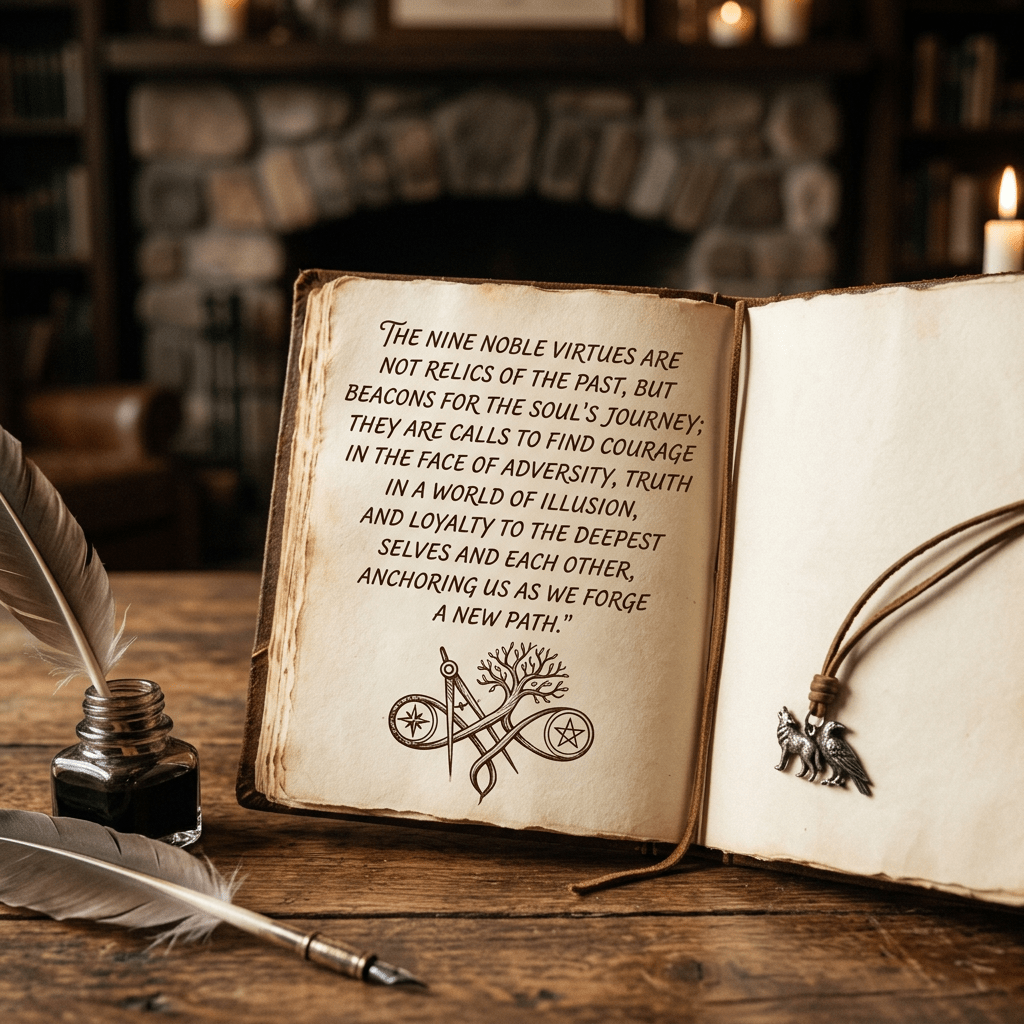
Open aged book with a quote about the Nine Noble Virtues and symbols, feather quill in ink pot, and pendant on wooden table
THIS IS AN OPINION PIECE BUILT FOR REFLECTION, CAUTION THIS MAY UPSET SOME

Ásatrú. Heathenry. Norse Paganism. Odinism. Northern Tradition.

The names are not always interchangeable, and some carry considerably more political baggage than others, but sooner or later almost everyone exploring a Norse-based spiritual path encounters something called the Nine Noble Virtues.

They are frequently presented on posters surrounded by runes, ravens, axes and stern-looking Vikings. Sometimes they are described as the ancient moral code of the Norse. Occasionally they are treated almost like the Heathen equivalent of the Ten Commandments.

That raises a fairly simple question:

Are the Nine Noble Virtues actually ancient Heathen teachings, or are they modern reconstructionist crap dressed in a bearskin?

The honest answer is that they are modern—but that does not necessarily make every idea within them worthless.

What Are the Nine Noble Virtues?

The standard list is:

  1. Courage — facing danger, hardship and uncomfortable truths rather than always choosing the safest path.
  2. Truth — speaking honestly and refusing deliberate deception.
  3. Honour — living in a manner worthy of respect and accepting responsibility for one’s actions.
  4. Fidelity — remaining loyal to family, friends, community, commitments and chosen principles.
  5. Discipline — controlling one’s impulses and doing what must be done even when motivation disappears.
  6. Hospitality — welcoming and caring for guests while respecting the responsibilities between host and visitor.
  7. Self-reliance — developing the ability to support oneself and not placing every burden upon others.
  8. Industriousness — working productively, developing skills and contributing something useful.
  9. Perseverance — continuing through hardship rather than abandoning every difficult undertaking.

As a collection of personal qualities, there is nothing immediately outrageous about them. Most would look perfectly respectable printed in a workplace handbook, a Scout manual or on the wall of somebody’s home gym.

The problem is not necessarily what they say.

The problem is what people claim they are.

No, They Are Not an Ancient Viking Code

There is no surviving Viking Age document called The Nine Noble Virtues. They do not appear together in the Poetic Edda, the Prose Edda, the Icelandic sagas, a rune inscription or an ancient law code.

The code was formulated during the modern revival of Germanic Pagan religion in the twentieth century. It is generally associated with the British Odinic Rite and with John Yeowell and John Gibbs-Bailey during the early 1970s.

Its creators drew inspiration from texts such as the Hávamál and the Sigrdrífumál, but the nine-part list itself is modern.

That settles the basic historical question.

The Nine Noble Virtues are not an ancient Viking moral code.

They are a modern interpretation of values that modern Heathens believed could be extracted from the surviving Norse literature.

Strictly speaking, the word is reconstructionist, not recreationist—although considering how often modern inventions are marketed as secret Viking wisdom, the accidental wording sometimes feels appropriate.

But Are They Based on Anything Real?

Here the answer becomes more complicated.

The Hávamál is not merely a modern fantasy text. It is an Old Norse wisdom poem preserved in the thirteenth-century Codex Regius. Parts of it are believed to preserve ideas and oral material that may be considerably older than the surviving manuscript.

The poem contains advice about hospitality, generosity, friendship, reputation, caution, moderation, preparation, drinking, speaking wisely and knowing when it is time to leave someone else’s home.

It praises courage in some circumstances, but it also praises silence, observation and good judgment. It warns against pride, greed, drunkenness, foolish talk and trusting too easily.

So yes, several of the Nine Noble Virtues resemble values found in the surviving literature.

Hospitality is undeniably present. Courage is present. Loyalty between friends is present. Personal reputation matters enormously. Wisdom, preparation and productive effort are praised. The importance of continuing through hardship appears throughout the heroic literature.

But the ancient sources never gather those ideas into this particular list.

The Nine Noble Virtues are therefore not completely invented from nothing. They are better understood as nine modern labels selectively extracted from a much larger, messier and more contradictory body of literature.

That distinction matters.

What Was Left Out?

Whenever someone distils hundreds of verses and generations of stories into nine words, choices are being made.

Why courage but not caution?

Why self-reliance but not reciprocity?

Why industriousness but not wisdom?

Why fidelity but not justice?

Why perseverance but not knowing when to stop?

Why honour but not humility?

The Hávamál spends considerable time discussing moderation, restraint, friendship, mutual gift-giving, measured speech and the responsibilities created by relationships.

Its world is not populated entirely by isolated warriors proving their personal toughness. People survive through households, kinship, friendship, reputation and reciprocal obligation.

Even hospitality is more complicated than simply opening the door to everyone. The guest has obligations too. A guest should behave properly, avoid creating conflict and leave before becoming a burden.

Hospitality is a relationship—not endless submission by the host.

There are also uncomfortable passages. The old poems contain mistrust, manipulation, sexism, violence and stories in which Odin himself acts deceptively.

That does not fit neatly onto a poster declaring TRUTH and FIDELITY in large runic letters.

The old stories are rarely that simple. They present choices, consequences and contradictions. They ask the listener to exercise judgment rather than merely obey a checklist.

The Political Baggage Cannot Be Ignored

There is another uncomfortable part of the story.

Some of the people and organizations involved in the early development of modern Odinism and the Nine Noble Virtues had connections to far-right politics, ethnic nationalism and racial ideology.

That does not mean everyone who has ever used the Nine Noble Virtues is a fascist, racist or white supremacist.

Plenty of ordinary Heathens encountered the list in a book, on a website or through another practitioner without knowing anything about its origins.

Guilt by accidental association accomplishes very little.

However, knowing the origin should make us ask why these particular qualities were selected.

Courage, discipline, fidelity, industriousness, self-reliance and honour can easily be arranged into a romantic image of the obedient, self-sufficient tribal warrior.

Generosity, compassion, curiosity, stewardship, mutual care and responsibility toward outsiders do not fit quite as comfortably into that image.

Modern Heathens themselves disagree about what to do with the list. Some continue to use the virtues as a practical ethical guide. Others reject them as historically misleading, politically tainted or inadequate as a complete moral system.

There is no universal Heathen position because there has never been one central Heathen church capable of declaring one.

So—Fact, Fiction or Reconstructionist Crap?

Here is my verdict.

Fact: The Nine Noble Virtues are genuinely used by parts of modern Heathenry.

Fiction: They are not an ancient Viking moral code handed down intact from the pre-Christian past.

Reconstruction: They were assembled by modern people who selected certain ideas from medieval Norse literature and arranged them into a convenient ethical package.

Crap: Only when someone lies about their origins, presents them as divine commandments or uses them to avoid reading the actual sources.

A modern spiritual teaching does not become worthless merely because it is modern. Every living religion interprets, adapts and creates.

The dishonesty begins when reconstruction is presented as archaeology and personal interpretation is presented as ancient law.

Putting the Virtues to Work

The virtues may still be useful when treated as questions rather than commandments:

  • Is this courage, or am I being reckless?
  • Is this truth, or am I using honesty as a weapon?
  • Is this honour, or merely wounded pride?
  • Is this fidelity, or loyalty to someone who no longer deserves it?
  • Is this discipline, or needless self-punishment?
  • Is this hospitality, or failure to maintain boundaries?
  • Is this self-reliance, or fear of accepting help?
  • Is this industriousness, or exploitation disguised as virtue?
  • Is this perseverance, or refusal to admit that the road is leading nowhere?

That is where a list of words begins to become an ethical practice.

I would not throw the Nine Noble Virtues entirely into the fire. There is wisdom within them.

But neither would I carve them into stone and pretend Odin delivered them to the Vikings on a mountaintop.

They are a modern map drawn from fragments of an older landscape.

A map can still be useful.

Just do not mistake it for the land.

The Measure of Progress: A Pagan Thought on the Value of Life

People hiking hand in hand on a forested mountain trail with wildflowers and sunrise

A random thought to ponder:

“Human progress isn’t measured by industry. It’s measured by the value you place on a life.”

— The Twelfth Doctor, Doctor Who, “Thin Ice”

That line wandered across my path recently, and it decided to stay for a while.

On the surface, it is a fairly simple statement. We should value life more than wealth, machinery, production, or economic growth. Most of us would probably nod our heads at that and carry on with our day.

But the more I sit with it as a Pagan, the less simple it becomes.

What do we actually mean by progress?

How do we decide that humanity is moving forward?

Is progress measured by what we can build, how quickly we can build it, or how much wealth we can create from it? Is it measured by taller buildings, faster machines, expanding cities, instant communication, artificial intelligence, or the ability to place almost anything we desire on our doorstep within a few days?

Those things certainly demonstrate ability.

They show what human beings are capable of creating.

But capability and wisdom are not the same thing.

A people can become very skilled without becoming particularly wise. We can learn how to reshape the world without first learning whether the world should be reshaped. We can discover how to produce more without asking whether more is actually making life better.

From a Pagan perspective, that distinction matters.

Progress Is Not Always a Straight Road

Modern culture often imagines progress as a straight line.

We begin somewhere primitive and march steadily toward something more advanced. Each generation is supposed to produce more, know more, travel faster, work more efficiently, and exercise greater control over the world around it.

Nature does not move that way.

The seasons turn in circles. The moon waxes and wanes. Forests grow, fall, decay, and rise again. Rivers wander. Fire consumes, transforms, and returns what it has taken to the soil as ash.

The natural world does not seem embarrassed by repetition.

Winter is not considered a failure because the leaves have fallen. The dark moon is not defective because it gives us no light. A field lying fallow is not useless because it is not producing a crop.

Each has its place.

Each has value within the larger turning.

Perhaps one of the Pagan challenges to the modern idea of progress is the recognition that forward is not always the only sacred direction.

Sometimes progress means returning.

Sometimes it means resting.

Sometimes it means remembering something our ancestors understood and we, in our cleverness, forgot.

Sometimes progress is not acquiring another thing. It is learning that we already have enough.

The Sacred Is Not Measured by Usefulness

One of the questions hidden inside that Doctor Who quotation is this:

Does a life have to be useful in order to possess value?

Industry tends to measure usefulness.

How much can be produced? How much labour can be performed? How much profit can be generated? How quickly can a task be completed? What is gained, and what does it cost?

Those questions have their place. A household must prepare for winter. A craftsperson must know the value of their materials. A farmer must understand the yield of the field. A firekeeper must know how much wood remains before the night grows cold.

Practical thinking is not the enemy.

Our ancestors were practical people because survival required them to be.

But practical value is not the only kind of value.

An ancient tree may produce no fruit for us, yet still shelter birds, hold the soil, cast shade, carry memory, and stand as a living presence upon the land.

An elder may no longer perform the physical work they once did, yet still carry stories that cannot be replaced once they are gone.

A child may contribute nothing to the wealth of a household, yet the entire household may arrange itself around keeping that child warm, fed, protected, and loved.

A grieving person may not be productive. A sick person may need more than they can currently give. A tired person may have no offering beyond their presence beside the fire.

None of these lives becomes less sacred because it is temporarily—or permanently—unable to produce.

Life does not need to earn its right to exist.

A Pagan Measure of Progress

So how might a Pagan measure human progress?

Perhaps we begin with relationship.

Paganism, in its many forms, repeatedly reminds us that we do not exist alone. We live among ancestors, descendants, gods, spirits, animals, plants, waters, winds, stones, and unseen forces whose lives intersect with our own.

Whether we understand these beings literally, spiritually, symbolically, or through some mixture of all three, the lesson remains similar:

We are part of something.

We are not owners standing outside the world.

We are participants living within it.

Progress, then, cannot be measured only by how much control we gain over everything around us. It must also be measured by whether we become better relatives to the beings with whom we share existence.

Do we take without returning?

Do we consume without gratitude?

Do we speak of sacred land while treating the living world as nothing more than raw material?

Do we honour our ancestors while creating a world our descendants will struggle to survive in?

Do we praise hospitality while allowing loneliness to become normal?

Do we call the gods generous while becoming increasingly unwilling to be generous ourselves?

These are uncomfortable questions.

They should be.

A spiritual path should occasionally make us uncomfortable. Otherwise, it risks becoming decoration.

The Hearth as a Measure

I keep returning to the image of the hearth.

The hearth was not only a place where food was cooked. It was warmth, protection, light, story, memory, and gathering. It was often the centre around which the household organized itself.

A strong hearth was not judged only by the size of its flame.

A fire that burns too fiercely can consume all its fuel and leave everyone cold before morning.

A good fire is tended.

It is fed according to need. It is watched. It is respected. Space is made around it. Those who approach it are offered warmth.

Perhaps that gives us another way to measure progress.

Not by asking how large a fire we can build, but by asking how many lives are warmed by it.

Not by asking how brightly we can make it blaze for a moment, but whether anyone has remembered to preserve an ember for the morning.

Not by asking who owns the flame, but who is left standing outside it in the cold.

Industry often celebrates the blaze.

Pagan wisdom may be more concerned with the tending.

Industry Is Not the Enemy

I do not think this thought requires us to reject industry, craft, technology, or human invention.

There is something deeply sacred in creation.

The smith at the forge, the weaver at the loom, the carpenter shaping wood, the potter working clay, and the farmer tending a field all transform the world through knowledge and skill.

Human beings have always created tools. We have always experimented. We have always looked at a problem and asked whether there might be another way.

That curiosity is part of us.

The problem begins when the tool becomes the measure of the person.

It begins when efficiency becomes more important than dignity.

It begins when production becomes more sacred than the producer.

It begins when we become so impressed by what we have built that we stop noticing what the building has cost.

There is nothing wrong with a sharper tool, a warmer home, a safer road, or a medicine that preserves life.

Those things can be genuine progress because they serve life.

But when life is sacrificed merely to keep the machinery moving, something has been reversed.

The tool is supposed to serve the living.

The living were never meant to become fuel for the tool.

What Do We Protect?

We often discover what we truly value by watching what we protect.

It is easy to speak about the sacredness of life when nothing is being asked of us.

The harder test comes when protecting life requires patience, sacrifice, inconvenience, restraint, or compassion.

What do we do when someone cannot keep pace?

What do we do when a person has nothing obvious to offer?

What do we do when another life interrupts our plans?

What do we do when mercy costs more than indifference?

That may be where our real spiritual beliefs are revealed.

Not in the names we give the gods.

Not in the jewellery we wear.

Not in how carefully we decorate an altar.

Those things may be meaningful, but they are not the final measure.

The measure may be found in how we treat the frightened, the tired, the grieving, the elderly, the ill, the forgotten, and the person whose name we may never know.

It may be found in whether we recognize a sacred presence even when that presence has no power, wealth, title, or usefulness to offer us.

The Worth of One Life

Pagan traditions do not give us one universal answer about what happens after death. We have many stories, many gods, many ancestors, and many ideas about the journey beyond this life.

But whatever waits beyond the veil, this life remains immediate.

This breath matters.

This body matters.

This brief moment beneath the sun, moon, and stars matters.

Every human life carries a world within it: memories, fears, loves, stories, failures, hopes, and connections invisible to anyone looking from the outside.

When a life is lost, more disappears than one body.

A voice disappears.

A particular way of seeing the world disappears.

Future conversations disappear.

Stories that might have been told are silenced.

Possibilities vanish with them.

Perhaps that is why the value of a life cannot be calculated like the value of a machine.

A machine can often be replaced.

A person cannot.

So, Are We Progressing?

I do not have a grand answer.

This began as a random thought, and perhaps that is how it should remain: something to carry for a while rather than something to solve.

But I think the question is worth asking.

Are we progressing because we can produce more than those who came before us?

Or are we progressing only when fewer lives are treated as disposable?

Are we progressing because information moves faster?

Or only when wisdom, compassion, and responsibility move with it?

Are we progressing because our fires burn brighter?

Or only when more people are welcomed into their warmth?

Perhaps a Pagan measure of progress is not how far we have separated ourselves from nature, vulnerability, age, illness, dependency, and death.

Perhaps it is how honestly we learn to live in relationship with them.

Perhaps progress is measured by how carefully we tend the living world, how faithfully we remember the dead, and how responsibly we prepare a place for those who will come after us.

Industry can tell us what we have built.

Wealth can tell us what we have gathered.

Power can tell us what we are capable of controlling.

But none of those things can tell us whether we have become better human beings.

For that, we may need to look elsewhere.

We may need to look at the life standing before us.

We may need to ask whether we see something sacred there—not because of what that life produces, owns, believes, or offers, but simply because it lives.

And perhaps that is the measure worth carrying forward.

Not how much we have made.

Not how quickly we have moved.

Not how powerful we have become.

But how much value we have finally learned to place upon a life.

Just a random thought to ponder.

Godspeed.

Lugh Sulian

The First Altar was Fire

Group of prehistoric people sitting around a campfire in a cave with animal paintings on walls

Before there was a temple, there was a fire.

Before there was a priesthood, there was someone awake in the darkness, watching the coals.

Before there were written prayers, there were hands held toward warmth, faces glowing in the light, and human beings looking into a flame as though something on the other side might be looking back.

That may be where religion began.

Not necessarily with a god descending from the sky. Not with a book. Not with a building. Perhaps it began with a small circle of frightened, hungry people gathered around something they did not completely understand.

Fire gave warmth, but it also burned.

Fire protected, but it could also escape.

Fire cooked food, hardened tools, frightened predators and pushed back the darkness. Yet it demanded attention. It could not simply be possessed. It had to be fed, watched and respected.

In other words, fire entered into a relationship with us.

And we have never been the same.

Before Fire Belonged to Us

We will never know the name of the first human ancestor who carried a living ember away from a natural fire.

I sometimes wonder what that moment looked like.

Was it a branch still burning after lightning struck a tree? Was it a smouldering root dug from the edge of a grass fire? Did one person recognize that the glowing thing could be carried while everyone else backed away from it?

There is no written history of that moment. There could not be. It happened long before writing, long before cities and possibly long before our own species appeared.

In June 2026, researchers studying South Africa’s Wonderwerk Cave published evidence of repeated burning deep inside the cave in deposits that may be between approximately 1.07 and 1.79 million years old. Burned small-animal bones were found far enough inside the cave that an ordinary grass fire could not reasonably have reached them. The researchers were careful with their language: this suggests that early human ancestors were bringing or using fire inside the cave, but it does not necessarily prove that they could make fire whenever they wanted.[1]

That distinction matters.

There may have been a long period when humans could use fire but could not reliably create it.

Imagine the responsibility that would place upon the person tending the coals.

If the fire went out, there was no match. There was no lighter. There was no propane torch tucked into a shed. Someone might have to find another natural fire, travel to another group or wait for the sky to provide lightning.

The firekeeper was not performing a decorative role.

The firekeeper was keeping warmth alive.

The firekeeper was keeping cooked food possible.

The firekeeper was maintaining a wall between the people and whatever moved beyond the edge of the light.

Archaeological evidence for recognizable hearths becomes clearer later. The Smithsonian Human Origins Program notes hearths at least 790,000 years old and describes how fire allowed early humans to cook, gather, share food, exchange information and seek safety together.[2]

That gathering may be one of the most important parts of the story.

Fire did not only change what humans ate. It changed where humans looked.

Without a fire, everyone watches the darkness.

With a fire, people begin looking at one another.

Fire did not make us human by itself. But learning to live beside it may have taught us how to become human together.

The First Circle

We Pagans talk a great deal about circles.

We cast circles. We sit in circles. We speak of sacred circles, ritual circles and the turning circle of the year.

But the first sacred circle may simply have been the edge of firelight.

Inside the circle was warmth, food, kinship and relative safety.

Outside it was cold, uncertainty and the eyes of animals that could see better in the darkness than we could.

The fire became a centre.

People arranged themselves around it. Food was passed across it. Stories were told beside it. Children fell asleep within its protection. The dead were remembered there. Arguments were settled there—or perhaps started there. Plans were made there. Warnings were given there.

Long before humans built temples for their gods, they built places for their fires.

Eventually the fire pit became the hearth. The hearth became the centre of the home. The home became the centre of the family. From there, the sacred fire could become the symbolic centre of an entire settlement, city or people.

This is why hearth deities are rarely concerned with flashy displays of divine power.

The hearth is not spectacle.

The hearth is continuity.

It is the meal that is cooked again tomorrow. It is the lamp that remains lit when someone comes home late. It is the place where a traveller is warmed before being questioned. It is the promise that there will still be something here when the darkness passes.

Why So Many Myths Say Fire Was Stolen

One of the strangest things about the mythology of fire is how often humanity was not originally meant to have it.

Fire is stolen, hidden, guarded, bargained for or won through trickery.

In Greek myth, Prometheus steals fire from the divine realm and gives it to humanity. For this act he suffers a terrible punishment. The story is often reduced to a simple tale about human progress, but there is more going on than that. Prometheus does not merely give people warmth. He gives them access to craft, technology and the power to alter the world.[3]

Once humanity has fire, it can no longer return to complete innocence.

Fire makes civilization possible, but it also makes weapons possible.

It bakes bread and burns cities.

It warms the child and powers the forge that makes the sword.

Prometheus gives humanity a gift that carries consequences.

Across Polynesian traditions, the culture hero Māui is also connected with obtaining fire. In one Māori account, Māui receives or seizes the secret of fire from his ancestress Mahuika and causes fire to be hidden within certain trees, explaining why friction between pieces of wood can release it.[4]

Different cultures tell these stories in their own ways, and those differences should be respected. They are not interchangeable pieces of a single generic mythology.

Yet there is a pattern worth noticing.

Fire is not usually presented as a toy handed casually to humanity.

It has to be sought.

It has to be carried.

It has to be earned.

And once obtained, it creates an obligation.

That may be the deeper message behind the old fire myths: power without responsibility becomes destruction.

The Gods Within the Flame

There is no single Pagan god of fire.

There are many divine beings associated with different kinds of fire because fire itself has many personalities.

There is the cooking fire.

There is the forge.

There is lightning.

There is wildfire.

There is the sacrificial flame.

There is the lamp kept burning for the dead.

There is the fire of poetry, anger, passion, fever, courage and inspiration.

These are not all the same fire.

Brigid: The Fire That Creates

For me, any discussion of sacred fire eventually arrives at Brigid.

The historical sources do not hand us the tidy modern description of Brigid that appears on many websites and devotional cards. Ancient religion was rarely that tidy.

Brigit appears in Irish tradition as a goddess of poetry, wisdom, craft, prophecy and divination. Other figures bearing her name are connected with healing and smithcraft.[5]

That gives us three fires.

The fire in the head is inspiration.

The fire in the hearth is healing and nourishment.

The fire in the forge is transformation through work.

I am not claiming that an ancient Irish manuscript lays those exact three phrases out for us. That is a modern devotional way of understanding the pattern. But it is a pattern that makes sense.

The poet takes experience and turns it into words.

The healer takes suffering and works toward restoration.

The smith takes raw metal, places it into unbearable heat and reshapes it into something useful.

All three are acts of transformation.

All three require discipline.

All three can fail when rushed.

All three demand that someone remain close to the heat.

The long association between Brigid and sacred flame is also preserved in the traditions of Kildare. Stories tell of a perpetual flame tended there by women. The history of the goddess, the saint and the Kildare flame has become intertwined over the centuries, making it difficult to draw a clean line between pre-Christian practice, Christian devotion and later reconstruction. The flame has nevertheless remained a powerful symbol of continuity, hospitality and spiritual light.[6]

That blending does not weaken Brigid.

If anything, it demonstrates her endurance.

Empires changed. Religions changed. Languages changed. Yet someone continued carrying the name, tending the stories and, eventually, relighting the flame.

That is what sacred fire does.

It survives by being passed from hand to hand.

Hestia and Vesta: The Fire That Holds the Home Together

In Greek religion, Hestia is the goddess of the hearth. She is not usually portrayed charging across battlefields or hurling thunderbolts. Her place is at the centre.

She presides over the hearth and receives honour in sacrifice. Her apparent quietness should not be mistaken for insignificance. The centre does not need to shout to remain the centre.[7]

The Romans knew a related sacred presence as Vesta.

In Rome, the public flame of Vesta was tended by the Vestal Virgins. Its continued burning represented more than one household. It was tied to the well-being and continuity of Rome itself. If the flame went out unexpectedly, it was treated as a serious warning.[8]

There is something here worth remembering.

A community can have armies, walls, politicians and wealth, but still understand that its true life is represented by a tended hearth.

Not by the biggest fire.

By the fire that does not go out.

Agni: The Fire That Carries the Offering

In the Vedic tradition, Agni is not merely a god who happens to be associated with fire. Agni is the divine fire of sacrifice, the fire of the hearth, the fire of lightning and the fire of the sun.

Agni receives offerings and carries them between the human and divine worlds. He is described as a messenger and as the mouth through which the gods receive what is offered.[9]

This expresses something many fire rituals understand intuitively.

What enters a flame does not remain what it was.

Wood becomes heat, light, smoke and ash.

An offering disappears from the hand but does not simply vanish. It changes form.

Fire therefore becomes a messenger because transformation is its language.

I can honour what the Vedic tradition teaches about sacred fire without pretending that its ceremonies belong to me. Respect does not require imitation.

Sometimes respect means standing at the edge of another tradition and saying, “I see the wisdom here, but I will not claim its rites as my own.”

Hephaestus and the Forge

Hephaestus represents another face of fire: fire under discipline.

A wildfire consumes whatever it reaches. A forge concentrates heat toward a purpose.

The smith does not defeat fire. The smith learns its temperament.

Too little heat and the metal will not move.

Too much heat and the work may be ruined.

Strike too early and nothing happens.

Strike carelessly and the material may crack.

This is spiritual work as much as metalwork.

Transformation is not accomplished by heat alone. It requires timing, tools, patience and a willingness to return the unfinished piece to the flame.

Fire as Sacred Presence, Not a Simplistic “Fire God”

Not every tradition that treats fire as sacred believes the fire itself is a god.

Zoroastrianism, for example, has often been inaccurately described as “fire worship.” Sacred fire instead serves as a focus for prayer and contemplation and as a visible expression of purity, truth, light and the presence of Ahura Mazda. The flame is deeply honoured, but it is not simply worshipped as though the physical fire were the totality of God.[10]

This is an important distinction for Pagans as well.

A flame may be a deity.

It may represent a deity.

It may carry an offering.

It may open a ritual.

It may serve as a witness.

It may simply be a fire around which sacred things happen.

We do not need to force every flame into the same theology.

Fire as Purification

People often say that fire purifies.

That statement sounds pleasant until we remember how fire actually purifies.

It does not gently explain why something should change.

It burns away what cannot withstand it.

That is why I am cautious when people romanticize the idea of being “forged in fire.”

The forge is not comfortable.

It is not supposed to be.

Fire can remove contamination. It can sterilize tools, boil unsafe water and reduce the dead to ash. Symbolically, it can represent the destruction of falsehood, corruption, illness or an old identity.

But purification can become a dangerous idea when people use it against others.

History is filled with those who decided that another person, another faith or another community needed to be “cleansed.” Sacred language was then used to justify cruelty.

A healthy fire practice begins with oneself.

What within me is ready to be released?

What resentment am I feeding because I enjoy the heat?

What belief has become dead wood?

What am I trying to burn in someone else because I refuse to confront it within myself?

Fire is a poor excuse for vengeance.

It is an excellent mirror.

Fire as Protection

Fire has long stood between human beings and danger.

That physical protection naturally became spiritual protection.

Bonfires were lit at seasonal turning points. Hearths were renewed. Livestock, homes and communities were blessed or protected through proximity to sacred flames.

At Beltane, historical accounts describe cattle being driven between two fires before entering summer pastures. The rite was associated with protection from disease and harm.[11]

Whether one interprets that spiritually, practically or as a mixture of both, the symbolism is clear.

To pass between fires is to cross a threshold.

You enter in one condition and emerge in another.

But we should not confuse protection with aggression.

A protective fire does not need to burn the whole forest.

It only needs to maintain a boundary.

The strongest boundaries are often like a well-kept hearth: visible, warm to those welcomed near it and dangerous only when deliberately violated.

Fire as Witness

Fire has also been called upon to witness promises.

This makes sense to me.

A flame does not care how impressive your words sound.

It responds to what you actually feed it.

You may promise to tend a fire forever, but if you stop bringing wood, the truth becomes visible.

There is no public relations strategy for a cold hearth.

This may be why fire belongs beside vows, marriages, initiations and oaths. It reminds everyone present that words must eventually become action.

A promise is not kept because it was spoken beautifully.

It is kept because someone returns tomorrow.

And the day after that.

And the day after that.

Fire and the Dead

Fire stands at both ends of life.

It warms the newborn and consumes the funeral pyre.

In cremation, the body passes rapidly through the transformation that burial performs slowly. Flesh becomes ash. Form becomes memory. What could once be touched becomes something that must be carried differently.

Even in traditions that bury their dead, candles, lamps and vigil fires often remain part of mourning.

We light a flame because grief needs somewhere to look.

We light a flame because darkness feels too complete without it.

We light a flame because the small persistence of light resembles memory.

The person is gone, but something remains.

The flame is not the person.

Yet it gives our love a temporary body.

Now, About the Word “Shamanism”

This is where I need to slow down.

The word shamanism gets used far too casually in modern Pagan spaces.

Someone drums, enters a meditation or looks into a fire and suddenly the practice is advertised as “ancient shamanism.” That may sound mystical, but it can flatten many distinct cultures into one spiritual marketplace.

Historically, the word shaman is particularly associated with the religious traditions of northern Asia, although scholars have also used it more broadly when discussing practitioners who enter trance or communicate with spirits for purposes such as healing or divination.[12]

Not every spirit worker is a shaman.

Not every trance is shamanic.

Not every Indigenous fire ceremony is available for public adoption.

That does not mean fire has no place in trance, spirit work or altered states of awareness. Quite the opposite.

Sit beside a fire long enough and ordinary attention begins to change.

The repeated movement of the flame draws the eyes.

The crackling creates an irregular rhythm.

The heat pushes against the skin while the night remains cool behind you.

The world beyond the fire becomes less distinct.

Conversation slows.

Thoughts that were hiding beneath the day’s noise begin rising toward the surface.

Some people experience images in the coals. Some receive memories. Some feel the presence of ancestors, land spirits or gods. Some simply become quiet for the first time in weeks.

We do not need to exaggerate that experience.

The fire does not have to produce a vision to be sacred.

Silence is enough.

Attention is enough.

Being fully present beside one living flame is enough.

Fire as a Threshold

In spiritual practice, fire often functions as a threshold.

It is matter becoming energy.

It is darkness becoming visibility.

It is cold becoming warmth.

It is an offering becoming smoke.

It is wood becoming ash.

Fire exists while changing everything that sustains it.

That makes it a natural companion when we ourselves are changing.

When a life has ended but the next one has not fully begun.

When an old identity no longer fits.

When grief has burned away the future we expected.

When we are standing between who we were and who we may become.

Fire understands thresholds because fire is never still.

Even when it appears steady, it is consuming, releasing, rising and transforming.

What a Firekeeper Actually Does

There is a romantic image of the firekeeper sitting dramatically beside a roaring blaze while everyone admires the flames.

That is usually not the work.

The work is gathering wood before anyone else arrives.

The work is checking the wind.

The work is clearing dry grass from the perimeter.

The work is noticing when a log has rolled too close to the edge.

The work is remaining sober enough to make decisions.

The work is staying after everyone else has gone to make certain the coals are dead.

Many people want to dance around the fire.

Far fewer want to deal with the ash bucket the next morning.

That is true spiritually as well.

People enjoy inspiration. They enjoy the brilliant idea, the powerful ritual, the emotional declaration and the great moment of revelation.

Firekeeping begins after the revelation.

It asks what you will do with the light you received.

Will you feed it?

Will you use it to warm others?

Will you turn it into craft, healing or honest words?

Or will you keep demanding another dramatic experience while neglecting the ember already placed in your care?

The Firekeeper Does Not Own the Fire

This may be the most important lesson.

The firekeeper is not the owner of the fire.

The firekeeper is its temporary steward.

A sacred flame is not a throne. It is not proof that the person tending it is more important than everyone else.

The firekeeper does not become sacred by standing closest to the flames.

The role becomes sacred through service.

A good firekeeper makes warmth possible without demanding ownership of everyone who gathers near it.

A good firekeeper does not use access to the hearth as a tool of control.

A good firekeeper remembers that the wood came from the land, the oxygen came from the air, the spark came from somewhere else and the stories carried away from the circle belong to those who lived them.

Firekeeping is authority, but it is authority bound to responsibility.

The moment the keeper believes the fire exists solely because of them, the fire has already begun to teach a harsher lesson.

A Pagan Fire Without Performance

Modern Paganism sometimes suffers from the belief that ritual must look impressive to be real.

The robes must be right. The words must be archaic. The fire must be enormous. Everyone must know where to stand. Someone must sound as though they have been speaking with the gods since breakfast.

I no longer believe any of that is necessary.

A ritual fire can be a candle on a kitchen table.

It can be a wood stove opened for a moment while another log is added.

It can be a small outdoor fire tended carefully beneath the stars.

It can even be an electric candle during a fire ban, in a hospital room, in rented housing or anywhere an open flame would be unsafe.

The sacred part is not the size of the flame.

The sacred part is the relationship.

Are you paying attention?

Are you honest about why you lit it?

Are you prepared to remain with it?

Will you close the ritual as carefully as you opened it?

A Simple Unplugged Pagan Firekeeping Rite

This is not an ancient ceremony. It is not borrowed from an Indigenous sacred fire, a Vedic fire rite or any closed tradition.

It is simply a framework for approaching fire with respect.

Prepare the Place

Before lighting anything, check the law, local fire restrictions, weather, wind and condition of the land.

Keep water nearby. Use a proper fire pit or fireproof container. Do not burn during a fire ban. Do not assume that spiritual intention makes unsafe behaviour acceptable.

Never burn plastic, garbage, pressure-treated wood, painted wood or anything that releases toxic fumes.

Do not pour gasoline, alcohol, essential oils or other accelerants into a living flame.

A sober and attentive person should remain responsible for the fire from lighting to final extinguishing.

Ask Permission

Stand quietly for a moment.

Acknowledge the land beneath you and the beings—human and otherwise—who may be affected by what you are about to do.

You might say:

Spirits of this place, landvættir and good neighbours seen and unseen, I ask leave to kindle this fire. May it cause no harm. May it bring warmth, clarity and right relationship.

Then listen.

Permission is not always a booming voice from the forest. Sometimes permission looks like noticing that the wind has become too strong and deciding not to light the fire.

Name the Purpose

Do not light a ritual fire without knowing why you are lighting it.

The purpose can be simple.

Gratitude.

Mourning.

Healing.

Welcoming a season.

Releasing something that has ended.

Sitting with a question.

Honouring Brigid.

Remembering kith, kin or ancestors.

You do not need to make a speech. One honest sentence is better than twenty impressive ones.

Light the Flame

As the flame catches, you might say:

From spark to flame, from flame to light, from light to understanding. May this fire be tended in honour and closed in safety.

If Brigid is part of your practice, you might add:

Brigid of the inspired word, Brigid of the healing hand, Brigid of the shaping forge, be welcome beside this flame. Teach me what must be warmed, what must be healed and what must be remade.

Feed the Fire Carefully

Add one piece of wood at a time.

Let each piece represent something you are willing to contribute.

Patience.

Work.

Honesty.

Courage.

Restraint.

Do not make promises you have no intention of keeping.

Fire has heard enough dramatic declarations.

Sit and Listen

This is the part many people rush past.

Stop talking.

Watch the flame without demanding an omen.

Let thoughts rise and pass.

Notice where your mind resists silence.

If words come, speak them.

If grief comes, let it sit beside you.

If nothing comes, tend the fire.

Nothing more may be required.

Offer Without Polluting

A physical offering is not necessary.

Your attention, labour and honest words may already be the offering.

Do not throw coins, glass, plastic, large amounts of food or unknown substances into a fire.

If you use a small symbolic offering, make certain it is safe, natural, locally appropriate and unlikely to create sparks, toxic smoke or harm wildlife.

The gods do not require us to poison the land in their honour.

Close the Fire

Thank the deity, spirits, ancestors and land you addressed.

You might say:

The words have been spoken. The warmth has been received. What was carried here may now return in peace. The rite is closed, but the lesson remains.

Then extinguish the fire completely.

Pour water over the coals. Stir them. Add more water. Continue until everything is cold enough to touch.

A fire ritual is not complete while a hidden coal can still escape into dry grass.

The Inner Fire

Not every fire burns outside us.

We speak of burning desire, burning anger, the fire of inspiration and the fire in the belly.

These are not accidental expressions.

Emotion produces heat. Creativity can feel like pressure seeking release. Anger can illuminate an injustice or consume every relationship around it.

The inner fire needs tending just as surely as an outdoor flame.

Starve it completely and something within us grows cold.

Feed it recklessly and it begins consuming things we never intended to sacrifice.

The goal is not to extinguish passion.

The goal is to give it a hearth.

Anger needs boundaries.

Creativity needs craft.

Desire needs wisdom.

Grief needs somewhere safe to burn without taking the whole house with it.

This may be one of Brigid’s greatest lessons.

The inspired word, the healing hand and the disciplined forge belong together.

Inspiration without healing can become cruelty dressed as truth.

Healing without fire can become avoidance.

Fire without craft becomes destruction.

The Firekeeper Without a Community

I have described myself before as a Pagan firekeeper without a Pagan community.

There is loneliness in that sentence, but perhaps there is also a lesson.

A firekeeper does not stop being a firekeeper because the crowd has gone home.

In fact, that may be when the real work begins.

Anyone can stand near a fire when the drums are playing, the stories are flowing and the night feels magical.

Who remains when the wood is wet?

Who protects the ember through the coldest hours?

Who returns in daylight to clean the site?

Who remembers what the fire was originally lit to serve?

Community is not measured only by the number of bodies gathered around a blaze.

Community is revealed by who helps carry the wood, who shares the warmth, who respects the boundary and who remains responsible when the spectacle is over.

Sometimes keeping the fire means holding a small flame alone until others find their way back.

Sometimes it means recognizing that the old gathering has ended and carrying one clean ember elsewhere.

Sometimes it means refusing to let bitterness become the only fire left inside you.

Fire, Kith and Kin

A hearth was never meant to be merely decorative.

It fed people.

It warmed wet clothing.

It made space for travellers.

It allowed elders to speak and children to listen.

It belonged to relationship.

Gold and silver may purchase wood, land or an elaborate fire pit.

They cannot purchase the trust that allows people to sit together without fear.

They cannot purchase the story told at the right moment.

They cannot purchase the hand that quietly adds another log while someone else is grieving.

A wealthy house can still have a cold hearth.

A poor camp can still contain sacred warmth.

The worth of a fire is not measured by how high the flames rise.

It is measured by what survives because someone tended it.

What Fire Finally Teaches

Fire teaches that everything requires fuel.

Fire teaches that warmth must be shared carefully.

Fire teaches that light creates shadows as surely as it pushes back darkness.

Fire teaches that destruction and creation are sometimes separated only by discipline.

Fire teaches that power needs a boundary.

Fire teaches that a small ember, protected properly, can outlive a roaring blaze.

Fire teaches that no keeper tends the same flame forever.

Eventually the responsibility passes to another pair of hands.

Perhaps this is why fire feels older than any one religion.

Gods have been named within it. Offerings have passed through it. Empires have guarded it. Families have gathered around it. The living have warmed themselves beside it, and the dead have been entrusted to it.

Yet the flame itself continues its simple work.

It consumes.

It changes.

It rises.

It gives light.

It leaves ash.

And then it waits for someone to begin again.

A Firekeeper’s Prayer

Brigid of the bright word,
keep the fire in my mind clear enough to speak truth without cruelty.

Brigid of the healing hearth,
keep the fire in my home warm enough to welcome what comes in peace.

Brigid of the ringing forge,
keep the fire in my hands disciplined enough to shape rather than destroy.

Spirits of the land,
teach me to take no more wood than I require
and to leave no living coal behind me.

Ancestors who carried flame through darker nights than mine,
remind me that I did not kindle this light alone.

May I know when to feed the fire.

May I know when to let it settle.

May I know what belongs within the flame
and what must never be burned.

May those who approach in peace find warmth.

May those who approach in grief find room.

May those who approach in honesty find light.

And when my own watch is finished,
may I pass one clean ember into trustworthy hands.

So may the fire be tended.

Godspeed, and tend the fire.


Sources and Further Reading

  1. Marin-Monfort, M. D., et al. “New Evidence for Early Pleistocene Use of Fire at Wonderwerk Cave (South Africa).” PLOS ONE, June 1, 2026. Read the study.
  2. Smithsonian Human Origins Program. “Hearths and Shelters.” Smithsonian Institution.
  3. Encyclopaedia Britannica. “Prometheus.” Read the reference.
  4. Encyclopaedia Britannica. “Maui.” Read the reference.
  5. Encyclopaedia Britannica. “Brigit.” Read the reference.
  6. Solas Bhríde Centre and Hermitages. “The Perpetual Flame.” Read about the Kildare flame.
  7. Encyclopaedia Britannica. “Hestia.” Read the reference.
  8. Encyclopaedia Britannica. “Vesta.” Read the reference.
  9. Encyclopaedia Britannica. “Agni.” Read the reference.
  10. The Long Now Foundation. “The Fire That Never Goes Out.” Read the article.
  11. Encyclopaedia Britannica. “Beltane.” Read the reference.
  12. Encyclopaedia Britannica. “Shamanism: Rituals, Beliefs and Practices.” Read the reference.

No Gift Binds me to Silence

Two bearded Viking men exchanging a carved wooden box in a hall with onlookers

A gift given in friendship carries honour. In the Hávamál, friendship is tied to reciprocity: friends gladden one another with gifts, and gift-givers’ friendships endure when things go well.1

But when the giver betrays the receiver, the giver breaks the gift-bond. The Hávamál also teaches that a person should be a friend to a friend, exchange gifts with one who is trusted, and treat the untrustworthy differently from the trusted friend.2

I return the obligation, end the exchange, and withdraw frith. In modern Heathen understanding, frith refers to the maintenance of peace and friendship within a social group, while gift-giving and hospitality are bounded by reciprocity.3

No gift binds me to silence in the face of betrayal.


Sources

  1. Hávamál, Larrington translation, stanzas on friendship and gift exchange.
  2. Hávamál, Bellows translation, stanzas 42–46.
  3. Asatru UK, “Wyrd & Ethics,” on frith, hospitality, gift-giving, and reciprocity.