Dark snow-covered evergreen path through winter woods

Leaving Home in the Spirit of Hávamál 127

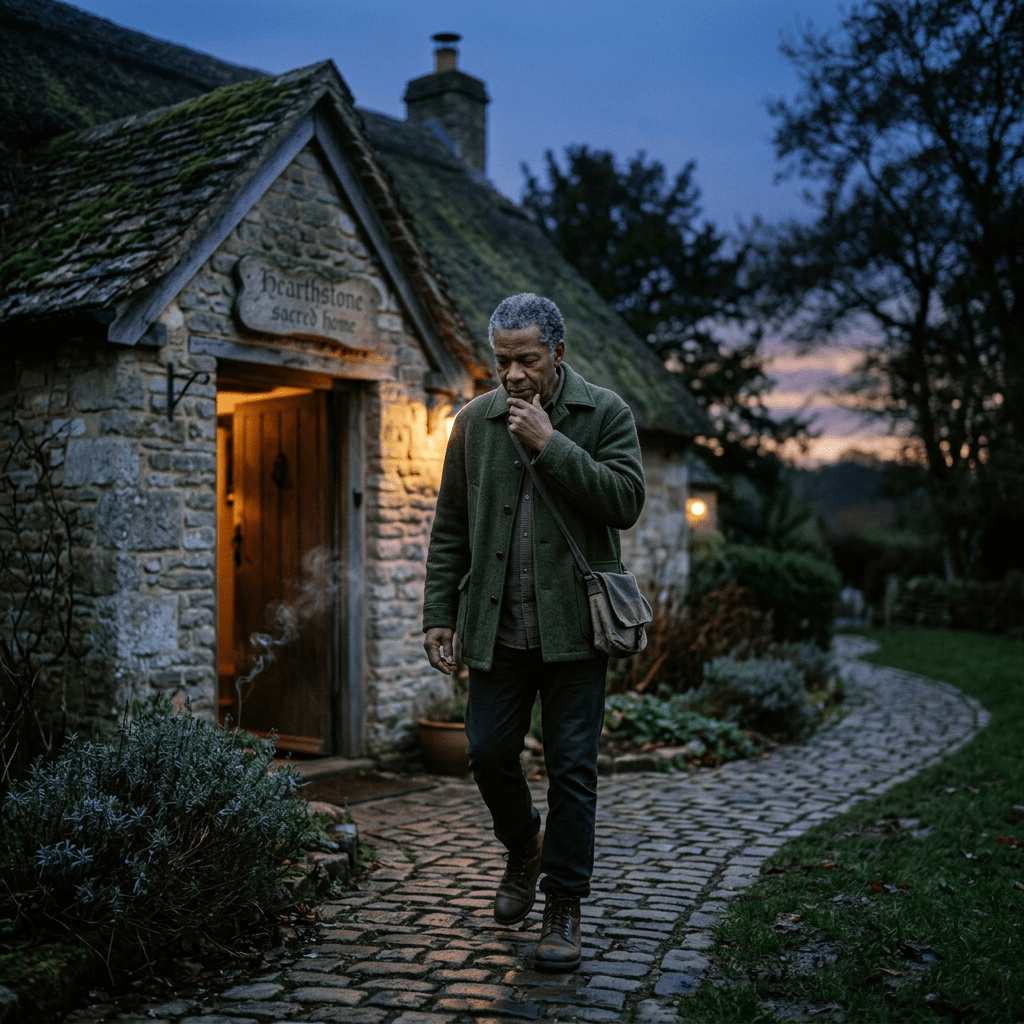
Man walking on cobblestone path outside stone cottage with lit entrance at dusk

There are places we call home because they shelter us.

There are places we call home because they shaped us.

There are places we call home because part of who we became was born there, around a fire, under certain trees, beside certain people, during a season of life when the word belonging still felt simple.

But not every home remains home.

That is a hard sentence to write.

It is harder still when the place was once sacred.

Unplugged Pagan did not come to that sentence quickly. It did not come to it cleanly. It did not come to it without memory, grief, anger, gratitude, and the strange ache that comes when something that once held you no longer does.

But there comes a point where staying attached to a dead bond is no longer loyalty.

It is silence.

And Hávamál 127 has something to say about silence.

The Verse at the Door

Declaration 127 takes its name from stanza 127 of the Hávamál, commonly rendered in modern Heathen circles as:

“When you see misdeeds, speak out against them, and give your enemies no frið.”

Frith, or frið, is often understood as peace, safety, right relationship, and the bond that allows a community to exist without tearing itself apart.

That is why the line matters.

It does not say, “When you see misdeeds, keep quiet for the sake of peace.”

It does not say, “When you see misdeeds, preserve the appearance of harmony.”

It does not say, “When you see misdeeds, maintain the old relationship at all costs because it used to mean something.”

It says to speak.

It says to name the wrong.

It says not to give frith where frith has already been broken.

That is the piece I keep circling back to.

Because the deeper lesson of Hávamál 127 is not only about enemies outside the gate. It is also about what happens when the problem is already near the hearth.

Declaration 127 and False Peace

Declaration 127 was originally written as a response to folkism and racial exclusion in modern Heathenry, especially in opposition to the Ásatrú Folk Assembly and its claims about who Heathenry was for.

That history matters. Folkism tries to turn ancestry into ownership. It tries to turn roots into border fences. It tries to turn the gods, ancestors, runes, and stories into racial property.

Declaration 127 said no.

But if Declaration 127 is only treated as an anti-folkish sticker, then we miss part of its power.

At its core, Declaration 127 also rejects the idea that silence should be maintained in the name of frith when harm is being justified through sacred language, tradition, ancestry, or community reputation.

That is where it becomes useful beyond the narrow question of folkism.

Not because every broken community is folkish.

Not because every failed home is racist.

Not because every wound is the same wound.

But because the spiritual principle is larger than the original occasion:

False peace is not frith.

That is the line.

Peace that requires silence is not frith.

Belonging that requires self-erasure is not frith.

Hospitality that protects the powerful while ignoring the wounded is not frith.

Community that remembers your labour but forgets your humanity is not frith.

Home that only remains home if you stop telling the truth is not home.

When Home Was Real

To be clear, this is not a post about pretending the old home never mattered.

It did.

That is part of what makes leaving it difficult.

There are old Unplugged Pagan writings that carry that truth plainly. The Vé remembers sacred work at Raven’s Knoll, the creation of sacred space, the carrying of poles, the marking of place, the building of something that mattered. That memory was not fake. The bond was not imagined. The sense of sacred place was real.

That matters.

If a place never mattered, leaving it would mean very little.

If a community never held meaning, there would be no grief in releasing it.

If the fire never warmed us, there would be no ache when it became ash.

So no, this is not bitterness dressed up as theology.

This is not a denial of the past.

This is not an attempt to rewrite memory so that leaving becomes easier.

The old home mattered.

That is exactly why leaving it had to be done honestly.

Roots, Hoards, and What We Refuse to Cut

Unplugged Pagan has been wrestling with roots for a long time.

Roots are not always pretty. They are hidden. Tangled. Muddy. Difficult to display. But they are what feed the tree.

In earlier reflections, I wrote about the danger of cutting off roots while expecting the branches to remain healthy. A tree can look strong from the outside while damage is already happening beneath the surface.

That image still holds.

A community can have events, names, land, symbols, buildings, programs, schedules, banners, and public language. It can still look alive from the outside.

But appearance is not health.

The roots are older than the poster.

The roots are the first fires, the old labour, the forgotten volunteers, the awkward conversations, the hands that carried wood, the people who showed up before there was applause, the ones who helped build something and later found themselves standing outside of it.

When those roots are ignored, starved, severed, or treated as disposable, something important has already gone wrong.

And when gold and silver begin to matter more than kith and kin, the hearth has shifted.

That does not mean money does not matter. Money keeps roofs standing. It pays bills. It buys tools, fuel, food, insurance, repairs, and all the practical things that keep a place functioning.

But gold and silver are not kin.

They do not sit beside you when your spirit is tired.

They do not remember the first fire.

They do not carry the old stories.

They do not make a hall sacred.

They only make it affordable.

There is a difference.

The Moment the Header Came Down

When the old Unplugged Pagan header came down, that was not just a design choice.

It was a small funeral.

The old image was taken at Raven’s Knoll. For a long time, that mattered in a good way. It carried memory. It carried place. It carried old hopes, old gatherings, old people, and an older version of Unplugged Pagan that still believed itself rooted there.

But places change.

Or more honestly, our connection to them changes.

A grove can shelter us for a season and later become somewhere we no longer belong.

A fire can warm us once and later become ash.

A home can form us and still not hold us forever.

That does not make the warmth false.

It means time moved, people changed, and the bond reached its ending.

The header had to come down because Unplugged Pagan needed its own ground.

Not borrowed ground.

Not someone else’s grove.

Not a shrine to an old connection.

Its own ground.

That was not an act of hatred.

It was an act of boundary.

And sometimes boundary is the only honest ritual left.

Leaving Is Not Always Betrayal

People often treat leaving as betrayal.

Sometimes it is.

Sometimes people abandon what they should have tended. Sometimes people walk away because repair is harder than resentment. Sometimes leaving is cowardice with cleaner shoes.

But not always.

Sometimes leaving is what happens after every inner warning has already spoken.

Sometimes leaving is what happens when the bond has died but everyone keeps asking you to behave as though it lives.

Sometimes leaving is what happens when “home” becomes a word used to keep you quiet.

Sometimes leaving is the first truthful thing a person has done in years.

That is where Hávamál 127 matters.

It gives no blessing to false peace.

It does not tell us to remain politely attached to what has already broken frith.

It does not ask us to keep handing warmth to a place that no longer shelters us.

It says misdeeds should be named.

It says enemies should not be given frith.

And sometimes the enemy is not a person.

Sometimes the enemy is the lie that a dead bond is still alive.

Not Folkism, But the Same Warning

This needs to be said carefully.

This post is not claiming that the old home was folkish.

That is not the argument.

The argument is that Declaration 127 carries a principle that reaches beyond the original fight against folkism:

Sacred language must not be used to demand silence in the face of harm.

Folkism is one form of that harm. It uses ancestry, gods, and tradition to exclude people and claim ownership over the sacred.

But there are other ways sacred language can be misused.

“Community” can be used to silence people.

“Frith” can be used to avoid accountability.

“Home” can be used to shame people for leaving.

“Kith and kin” can be used as decoration while actual bonds are neglected.

“Hospitality” can be used to protect the host while ignoring the guest.

“The good of the place” can be used to excuse the cost to the people who helped make the place good.

That is why 127 still applies.

Not as an accusation of folkism.

As a warning against false frith.

The Hearth Test

The real test of a hearth is not how it looks when the festival is full.

The real test is what happens when someone is wounded.

Who notices?

Who checks in?

Who listens?

Who protects the relationship?

Who chooses repair over reputation?

Who remembers that people are not disposable once their labour is no longer needed?

Who carries wood when no one is watching?

Who remains when the ash has to be dealt with?

That is the hearth test.

Not the banner.

Not the website language.

Not the number of people gathered around the fire.

The hearth is revealed by the treatment of the living.

If the living must become silent to preserve the image of home, then home has already failed the hearth test.

Why Unplugged Pagan Left

So why did Unplugged Pagan choose to leave home?

Because memory is not obligation.

Because gratitude is not captivity.

Because a sacred place can matter deeply and still no longer be ours.

Because roots matter, but roots are not chains.

Because frith is not maintained by pretending the wound is not there.

Because Hávamál 127 does not permit silence in the face of misdeeds.

Because Declaration 127 reminds us that keeping peace with what harms others is not peace.

Because the path does not end when one grove is left behind.

Because the land is larger than one campfire.

Because the gods are not trapped on someone else’s property.

Because the fire can be carried.

Because Unplugged Pagan needed its own ground.

The Road Behind and the Road Ahead

There is grief in this.

There should be.

Leaving home without grief usually means it was never home to begin with.

But grief is not a command to return.

Grief is the price of having once loved something honestly.

The old home shaped this path. That can be honoured.

The old fire warmed this path. That can be remembered.

The old grove held meaning. That can be spoken without shame.

But none of that requires Unplugged Pagan to keep standing under a roof that no longer shelters it.

There is a line from the Hávamál, in spirit, that cattle die, kinsmen die, and we ourselves die. What remains is reputation, deeds, and the truth of how we carried ourselves.

Places can die to us too.

Connections can die.

Communities can die.

The stories we told ourselves about belonging can die.

And when they do, the Pagan path should not require us to pretend otherwise.

Ancestor work is not dragging a corpse around.

Memory is not a leash.

Gratitude is not a prison.

Sometimes the most honest Pagan act is to stand at the edge of the old place and say:

I remember.

I honour.

I release what is no longer mine to carry.

Closing Thought

Hávamál 127 does not only belong at protests.

Declaration 127 does not only belong on organization lists.

The lesson belongs at the actual hearth.

It belongs in the difficult moment when a person has to decide whether peace is still peace, or whether peace has become silence.

For Unplugged Pagan, the answer has become clear.

Home was real.

The memory mattered.

The work mattered.

The fire mattered.

But the bond reached its ending.

And when the bond is dead, pretending it still lives is not frith.

It is false peace.

So Unplugged Pagan leaves home in the spirit of Hávamál 127.

Not with hatred.

Not with denial.

Not by pretending the old place was never sacred.

But by refusing to let sacred memory become a chain.

The road remains.

The fire can be carried.

The roots can be honoured without living under the old tree.

And sometimes the only way to keep faith with the hearth is to walk away from the hall.

Sources and Further Reading

When the Absent Command the Living

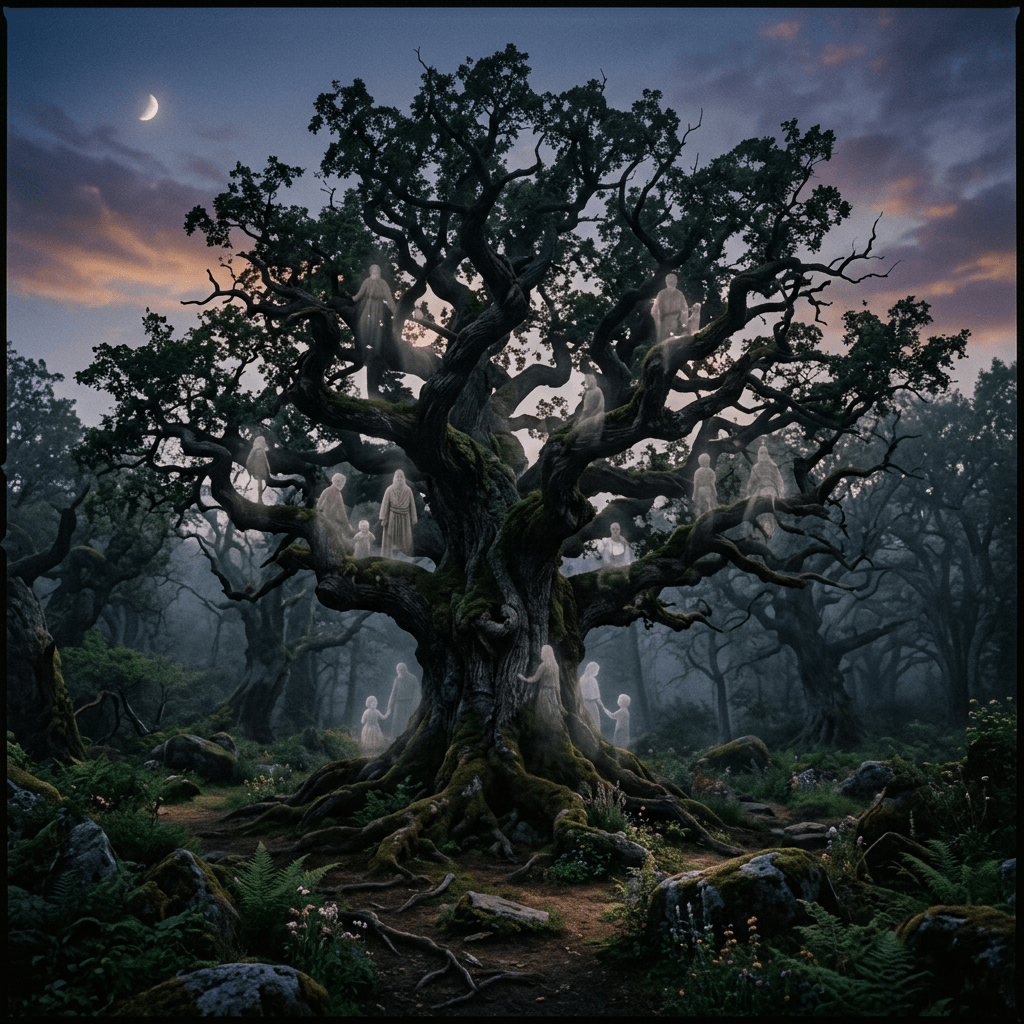
Large ancient tree with multiple glowing ghostly human figures on branches in a misty forest at twilight

There is a strange thought that has been sitting with me:

At some point, the absent began commanding the living.

By absent, I mean the dead first and foremost. The ancestors. The ones no longer sitting at the table. The ones whose boots no longer touch the floor, whose hands no longer open the door, whose voices no longer call down the hallway.

And yet, somehow, they still speak.

Not always as ghosts in the Hollywood sense. Not always as whispers in the dark or footsteps in an empty room. Sometimes the dead speak through habit. Through guilt. Through family sayings. Through inherited land. Through old wounds. Through recipes, tools, songs, photographs, names, graves, and promises made long before we understood the weight of making them.

The dead do not need to be alive to shape the living.

That may be one of the oldest truths mankind ever discovered.

The Human World Is Full of Absence

Animals live close to what is present. Hunger. Weather. Danger. Mating. Offspring. Territory. Pain. Sleep. The immediate world presses against them, and they respond.

Humans do something stranger.

We obey things that are not here.

A dead father’s expectation. A grandmother’s warning. A family name. A god unseen. A vow spoken years ago. A homeland we left. A betrayal we still carry. A grave we still visit. A future child not yet born. A people long gone. A story older than our blood.

That is not weakness. That is part of what makes us human.

But it is also dangerous.

Because once absence gains authority, mankind becomes capable of both reverence and madness.

We build shrines for the dead. We also fight wars over ancient wounds. We honour ancestors. We also inherit their grudges. We keep tradition alive. We also let dead hands steer living lives into the ditch.

So perhaps one of the great pagan questions is not, “Do the dead speak?”

Perhaps the better question is:

Which absent voices deserve obedience?

The Dead as the First Gods

I have often wondered whether the first gods were not gods in the way we later imagined them. Perhaps the first sacred powers were the dead.

The mother who knew the herbs.

The hunter who knew the trail.

The elder who remembered the flood.

The child who died too soon and left a wound in the camp that no one could name.

The founder. The warrior. The midwife. The singer. The one who crossed the river and did not return.

Before temples, before scriptures, before priesthoods, before doctrine, there would have been grief. There would have been memory. There would have been burial. There would have been the terrifying sense that the person was gone, and yet somehow not gone.

The body returns to the earth. The breath leaves. But the name remains.

And the name has power.

Say the name of someone dead and watch what happens inside the living. The room changes. The past steps forward. The absent arrives.

That is sacred territory.

Paganism and the Living Presence of Absence

For a pagan, this idea does not feel foreign.

We already live in a world where the visible and invisible overlap. The tree is a tree, yes, but it is not only lumber. The fire is heat, yes, but it is not only combustion. The river is water, yes, but it is not only a resource. The land is land, yes, but it is not only property.

There is presence in things.

There is memory in places.

There is spirit in land.

There is weight in oath.

There is a difference between walking through a forest and walking through a forest that knows your name.

This is where the modern world often fails. It tries to flatten everything into material use. Land becomes real estate. Fire becomes utility. Water becomes infrastructure. The dead become records. Religion becomes opinion. Memory becomes nostalgia.

But paganism, at its best, refuses that flattening.

It says the world is alive with relationship.

Not everything is human. Not everything is friendly. Not everything is there to serve us. But everything has place. Everything has consequence. Everything belongs to a web older than our convenience.

The absent are part of that web.

The Ancestors Are Not Automatically Wise

Here is where we need to be careful.

Ancestor honour does not mean ancestor worship without judgment.

The dead were human.

That means some were kind, some were cruel, some were broken, some were brave, some were foolish, some were trapped by the limits of their time, and some passed their damage forward like an unwanted inheritance.

Not every ancestor deserves a throne in the soul.

Some deserve honour.

Some deserve understanding.

Some deserve pity.

Some deserve to be laid down.

And some need to be told, firmly and without apology:

Your pain stops here.

That, too, is sacred work.

Breaking a harmful pattern is not betrayal. Sometimes it is the first honest offering ever made to the bloodline.

To honour the dead does not mean becoming their prisoner. It means knowing what they carried, what they gave, what they broke, what they survived, and what must not be repeated.

The Gods as Great Absences

The gods, too, live partly in this mystery of absence.

Brigid is not standing in the room like a neighbour dropping by for tea, and yet her presence can be felt in flame, craft, healing, poetry, and the stubborn will to keep the hearth alive.

Skadi does not need to appear at the door with snow on her shoulders for winter to carry her lesson: endurance, distance, silence, clean judgment, and the hard beauty of survival.

Ratatoskr does not need to chatter from a branch above us for us to understand the sacred danger of messages, gossip, movement, and the words that travel between worlds.

The fir tree does not speak English. It does not have to. It speaks in endurance. In green through winter. In rootedness. In the refusal to become empty simply because the season has turned against it.

The land spirits do not need our permission to exist. They were not born from our belief. At most, belief gives us the humility to notice them.

That is paganism to me: not blind belief, but relationship with a world that does not require human approval to be sacred.

When Memory Becomes Law

The danger comes when the absent stop being honoured and start being weaponized.

A dead founder becomes an excuse.

A tradition becomes a cage.

A god becomes a banner for cruelty.

An old wound becomes a permanent war.

A family name becomes a chain around the neck.

A sacred place becomes private possession.

A memory becomes a tool for control.

This is where humans go wrong again and again. We take the sacred force of absence and turn it into authority without accountability.

“This is what the ancestors wanted.”

“This is how it has always been.”

“This is what God commands.”

“This is what the old ways demand.”

Maybe.

Or maybe the living are hiding behind the dead because the dead cannot correct the quote.

That is why discernment matters.

The absent may command the living, but the living still have responsibility.

The Unborn Are Also Absent

There is another side to this.

The absent are not only behind us.

They are ahead of us.

The unborn also command the living, or they should.

When we care for land we may never fully enjoy, we are obeying the unborn.

When we refuse to poison water for short-term gain, we are obeying the unborn.

When we plant trees under whose shade we may never sit, we are obeying the unborn.

When we preserve stories, skills, rituals, songs, names, tools, and sacred places, we are making offerings forward.

That may be one of the most pagan acts possible: to live as though the future has a claim upon us.

Not because of guilt.

Because of kinship.

Kith and kin do not only stretch backward into graves. They stretch forward into cradles not yet built.

Choosing the Right Ghosts

So maybe the human question is not whether we are ruled by ghosts.

We are.

Every one of us carries absent voices.

The question is whether we know which ones we are obeying.

Are we obeying the dead who loved us, or the dead who wounded us?

Are we honouring tradition, or are we hiding inside it?

Are we listening to the gods, or only to our own fear wearing a divine mask?

Are we serving the land, or using sacred language to justify ownership?

Are we carrying memory, or are we being dragged by it?

Are we making offerings to the future, or stealing from it?

These are not small questions.

They are the questions that decide whether a person becomes rooted or haunted.

A Small Ritual Thought

Perhaps this is worth doing sometime.

Light a candle.

Name the dead who still shape you.

Name the places that still call you.

Name the promises that still bind you.

Name the fears that are not yours but were handed down.

Name the future that deserves better from you.

Then ask, plainly:

Which of these am I willing to obey?

Not every voice gets a seat at the fire.

Not every ghost gets the keys to the house.

Not every ancestor gets to steer the bloodline.

Not every tradition deserves another generation.

But some do.

Some dead are worth feeding.

Some stories are worth carrying.

Some vows are worth keeping.

Some gods are worth kneeling to.

Some fires are worth tending until your hands are ash.

The Living Must Answer

The absent command the living.

That is true.

But the living are not helpless.

We are the hinge between grave and cradle. Between what was done and what may yet be done. Between old wound and new choice. Between inherited story and deliberate action.

The dead hand us memory.

The gods hand us mystery.

The land hands us consequence.

The unborn hand us obligation.

What we do with those things is on us.

That may be the real sacred work of being human.

Not escaping the absent.

Not blindly obeying them.

But learning which unseen powers deserve a place at the hearth, and which ones need to be thanked, named, and finally buried.

Because the dead may speak.

The gods may call.

The land may remember.

The future may wait.

But the living must answer.

Where Gael and Norse Once Met

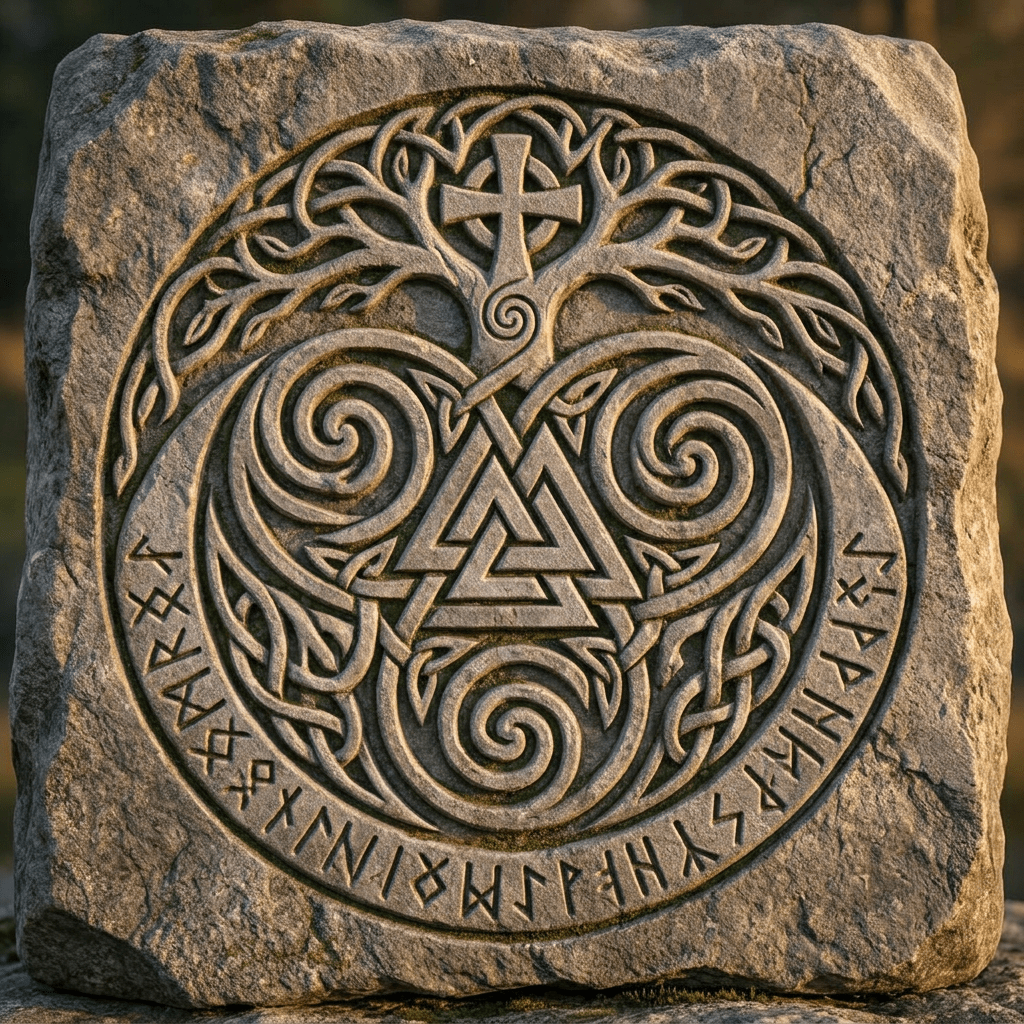
Stone carving with Norse symbols including a Valknut, tree, cross, and runes

A McLaughlin of Clan Lachlan: Celtic Root, Norse Echo, Modern Path

As a McLaughlin of Clan Lachlan, I do not need to pretend there is an unbroken line of ancient Druids or Viking priests standing behind me. That would be more than the historical record can honestly support. The stronger truth is also the cleaner truth:

I am a McLaughlin of Clan Lachlan. My roots are Gaelic and Celtic, but my name carries the old Norse shadow of Lochlann. I do not need to pretend there is an unbroken Druidic or Ásatrú bloodline to honour both. The honest path is stronger: I stand where Gael and Norse once met — with clan, land, ancestors, honour, frith, story, and the old ways reinterpreted for today.

The Celtic Root

Clan MacLachlan, also known as Clan Lachlan, is historically rooted in the Highlands of Scotland, especially around Strathlachlan on Loch Fyne in Argyll. Clan history connects the line to Lachlan Mór, a 13th-century chieftain, and to older Gaelic traditions through Irish-Scottish ancestry. 1

That gives the clan its strongest foundation: Gaelic, Highland, Celtic, and west-coast Scottish. The land, the kinship structure, the clan identity, and the older cultural memory are Celtic in character.

The Norse Echo

The Norse connection comes through the name itself. MacLachlan comes from the Gaelic Mac Lachlainn, meaning “son of Lachlann.” The name Lachlann is connected with Lochlann, a Gaelic term associated with the Norse or Scandinavian world. 2

This does not mean Clan Lachlan should be simplified into “a Viking clan.” That would flatten the truth. The better reading is that the name carries a memory of the old meeting place between Gael and Norse. Western Scotland, the Isles, Ireland, and the Norse world did not exist in sealed boxes. They traded, fought, married, settled, raided, converted, blended, and remembered each other.

Clan Lachlan gives me the Celtic root. The name Lachlan gives me the Norse echo.

The Druidic Connection Today

The Druidic connection is best understood as a modern spiritual alignment, not a proven bloodline. Modern Druidry draws from Celtic mythology, bardic tradition, nature reverence, seasonal observance, story, poetry, and relationship with land, sea, sky, plants, animals, ancestors, and spirit. 3

For a McLaughlin of Clan Lachlan, that makes sense. A Gaelic-Celtic clan identity naturally speaks the language of land, kin, memory, place, and ancestral continuity. Druidry gives that inheritance a modern spiritual vocabulary.

But honesty matters. I do not need to claim that Clan Lachlan preserved a secret Druidic priesthood. I do not need to pretend that every McLaughlin carries some provable ancient religious office. The living truth is enough: Celtic land, Celtic memory, and a modern Druidic path rooted in reverence for nature, ancestors, story, and sacred place.

The Ásatrú and Heathen Connection Today

The Ásatrú connection is also modern rather than a direct medieval label. The National Museum of Denmark notes that Ásatrú, or Asatro, is a modern term. People of the Viking Age did not call their religion by that name; later, in contrast to Christianity, it was remembered as the “old way.” 4

That matters because it keeps the claim clean. I am not saying Clan Lachlan was secretly an Ásatrú clan. I am saying the name Lachlan carries a Norse resonance through Lochlann, and that resonance gives a modern McLaughlin a meaningful bridge into Heathen language: honour, oaths, gift-bonds, frith, ancestors, land spirits, and the old stories.

The Modern Framing

The strongest modern framing is not about proving a pure ancient line. It is about standing honestly at the crossroads of inherited memory.

As a McLaughlin of Clan Lachlan, I stand in a Gaelic-Celtic line whose name carries a Norse echo. My clan identity is Highland Scottish and Celtic, rooted around Strathlachlan on Loch Fyne, but the name itself reaches back toward Lochlann — the Gaelic memory of the Norse world. Spiritually, that gives me a legitimate modern bridge: Celtic land, Gaelic kinship, Norse ancestral resonance, and a contemporary path that can honour both Druidic and Heathen ways without pretending the historical record proves more than it does.

That is the important distinction. This is not a false claim of direct descent from Druids. It is not a claim that Clan Lachlan was historically Ásatrú. It is a modern spiritual inheritance built from real cultural pieces: Gaelic clan identity, Celtic land memory, Norse linguistic echo, and a living personal path.

The Plain Truth

Clan Lachlan gives me the Celtic root. The name Lachlan gives me the Norse echo. Modern Druidry gives me a land-based Celtic spiritual language. Modern Ásatrú gives me a Heathen language of honour, kinship, ancestors, oath, and frith.

Together, they form a modern spiritual inheritance — not a fake ancient pedigree, but a real and meaningful bridge.

I do not have to choose between Celtic and Norse. My own name already remembers that those worlds once touched.


Sources

  1. Castle Lachlan, “History.” https://www.castlelachlan.com/history
  2. FamilySearch, “McLachlan Surname Meaning.” https://www.familysearch.org/en/surname?surname=mclachlan
  3. The Order of Bards, Ovates & Druids, “Druidry.” https://druidry.org/
  4. National Museum of Denmark, “The Old Nordic Religion Today.” https://en.natmus.dk/historical-knowledge/denmark/prehistoric-period-until-1050-ad/the-viking-age/religion-magic-death-and-rituals/the-old-nordic-religion-today/

Kevin and Lugh: Integration Without Performance

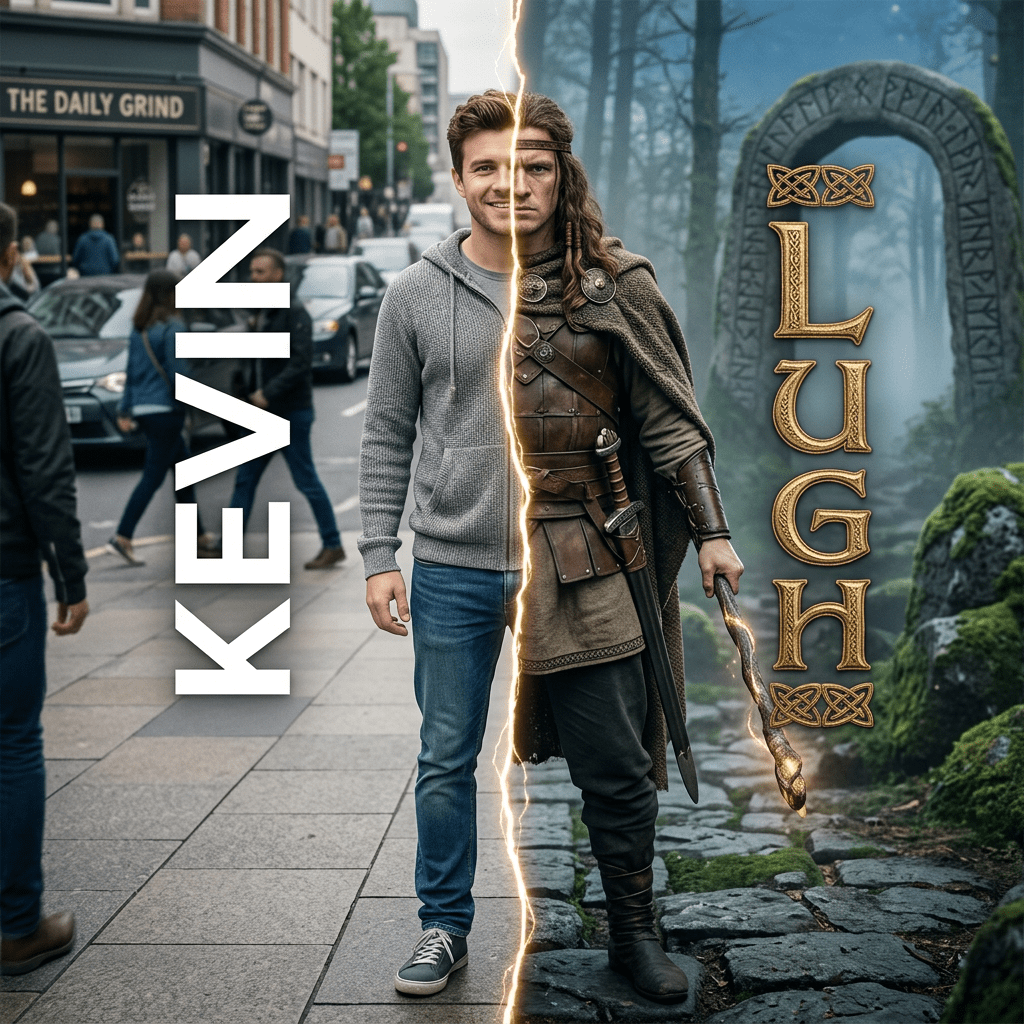
Man split into modern attire on left and druid warrior costume on right with contrasting backgrounds

Hey there, Standing on the Ledge.

And hey there, Unplugged Pagans.

This one belongs to both circles, because it sits in the doorway between them.

The paperwork name and the inner fire name.

Kevin and Lugh.

The question is simple enough on the surface:

How does a person live as both without turning either one into a costume?

That is not just a pagan question.

That is a human question.

Most of us have more than one name, even if only one of them appears on paper. We have the name the government knows. The name family uses. The name employers recognize. The name friends shorten. The name we answer to in public. The name we carry in private. The name we become when the world is not watching.

For me, that split had a shape.

Kevin was the legal name. The public name. The work name. The mundane name.

Lugh began as something else.

Why Lugh Began

Lugh did not begin as performance.

He began as separation.

Kevin dealt with the ordinary world. The paperwork. The jobs. The bills. The contracts. The appointments. The day-to-day machinery of life.

Lugh belonged somewhere more hidden at first.

He was the name I used in pagan circles. The name that gave me room to speak from the spiritual side of my life without dragging every part of my legal identity into every room I entered.

There were practical reasons for that.

Anonymity mattered. Boundaries mattered. Not every circle needs every name. Not every part of the self has to be handed to every audience.

So Lugh became the craft name. The pagan name. The name used around ritual, tarot, Brigid, firekeeping, and the conversations that belonged closer to the hearth than to the office.

Kevin dealt with the muggle world, if you want to put it that way.

Lugh tended the fire.

Two Names, Two Rooms

For a while, that separation made sense.

Kevin could go to work, pay bills, answer emails, handle responsibilities, and move through the practical world.

Lugh could read tarot, honour Brigid, listen for signs, sit with ritual, speak the language of gods and symbols, and move through pagan space without apology.

There was comfort in that division.

There was safety in it too.

But over time, something started to shift.

The pagan community around me grew. The circles became less distant from ordinary life. The same people might know me in more than one context. One room would call me Kevin. Another would know me as Lugh. Sometimes I had to shift between the two on the fly.

And eventually, the shift stopped feeling like a costume change.

It became obvious that these were not two separate men.

They were two doors into the same house.

Integration Is Not Erasure

Integration did not mean Kevin disappeared.

It did not mean Lugh took over.

That would have been another kind of performance.

Kevin still has his place.

Kevin is the name on the bills, the documents, the work schedules, the legal forms, the public responsibilities, the ordinary burdens that must be carried whether the moon is full or not.

Lugh still has his place too.

Lugh is the firekeeper. The spiritual voice. The one who remembers that ritual is not decoration. The one who understands that symbols matter, not because they are props, but because they carry meaning across difficult terrain.

The point was never to choose one and kill the other.

The point was to stop pretending they were enemies.

The SOTL Lens

Standing on the Ledge has always been about rebuilding without performative positivity.

Not pretending everything is fine.

Not hiding the rubble.

Not polishing collapse into a motivational poster.

So from the SOTL side, this matters because identity after collapse can become unstable.

When life breaks, you start asking hard questions:

Who am I without the old role?

Who am I when the work changes?

Who am I when the story I was living no longer holds?

Who am I when the public name carries wounds the private self still has to process?

That is where integration matters.

Because rebuilding is not just about money, work, bills, health, and structure. Those things matter. Deeply. But underneath them is another question:

Can I live as myself without splitting myself into survival compartments forever?

Stable-ish is part of that.

Life is moving. Work is happening. Bills are being paid. The floor is no longer falling out every morning.

But rebuilding also means asking which parts of the self are allowed to come forward now that the emergency sirens have quieted.

The Pagan Lens

From the Unplugged Pagan side, this matters because pagan practice can easily become costume if we are not careful.

The cloak, the cards, the hammer, the candle, the altar, the name, the symbol, the god, the myth — all of it can become theatre if it is only worn for effect.

But it can also become deeply real when it is lived honestly.

I do not need to pretend Lugh is older in my life than he is.

I do not need to pretend the name arrived fully formed with thunder and prophecy.

I do not need to make the story more dramatic than it was.

Lugh began as a boundary.

Then he became a voice.

Then he became part of the whole.

That is enough.

Not every sacred thing needs theatrical lighting.

Sometimes the sacred enters quietly and stays because it does useful work.

Without Turning Either Name Into a Mask

The danger with any chosen name is that it can become another mask.

A prettier mask, maybe.

A stronger mask.

A more mystical mask.

But still a mask.

If Kevin becomes only the tired worker, the bill payer, the man carrying the legal documents and practical burdens, then Kevin becomes too small.

If Lugh becomes only the mystical figure, the tarot reader, the firekeeper, the pagan voice, then Lugh becomes too polished.

Neither one is the whole truth alone.

Kevin has fire in him.

Lugh still has to live in the real world.

That is the integration.

The paperwork name must not be reduced to drudgery.

The inner fire name must not be reduced to performance.

Ritual Belongs in the Real World

This is why Lugh became part of Standing on the Ledge.

Because ritual does not belong only in hidden rooms.

It belongs in the real world too.

Not as an escape from bills, work, legal stress, health scares, grief, exhaustion, or ordinary responsibility.

As a way of standing inside them without becoming only them.

Lighting a candle does not pay the mortgage.

Pulling a tarot card does not replace action.

Calling on Brigid does not erase the need to make the phone call, take the medication, write the document, go to work, or face the hard conversation.

But ritual can steady the hand that does those things.

It can remind the body that there is more to life than crisis management.

It can give shape to the pause before the next necessary step.

That is not fantasy.

That is footing.

Why Continue With Both?

So why continue with both names?

Because both still tell the truth.

Kevin is not a discarded shell.

Lugh is not a costume pulled from a spiritual closet.

Kevin is the man who has to live the ordinary day.

Lugh is the name that remembers the fire inside that ordinary day.

One keeps the lights on.

One tends the flame.

And most days, if I am honest, both are doing both.

For the Ledge Walkers and the Firekeepers

Maybe you have your own version of this.

Maybe not a pagan name. Maybe not a craft name. Maybe not anything spiritual at all.

But maybe there is a self you use in public and a self you only let breathe in private.

Maybe there is the person who goes to work and the person who writes at midnight.

The person who handles the family and the person who falls apart in the car.

The person who signs the documents and the person who still talks to the dead.

The person who looks fine and the person who knows exactly where the cracks are.

The work is not always to choose one.

Sometimes the work is to stop making them strangers.

Integration Without Performance

Integration does not mean explaining yourself to everyone.

It does not mean making your private name public before you are ready.

It does not mean turning your spiritual life into content, branding, theatre, or proof.

It means living with less internal exile.

It means letting the different rooms of the self communicate.

It means the worker can pray.

It means the firekeeper can pay bills.

It means the public name and the inner name can sit at the same table without one mocking the other.

That is where I am now.

Kevin and Lugh.

Not two costumes.

Not two performances.

Not two separate lives.

Two names.

One road.

One fire.

Still walking.

Godspeed.

What the Art on Mjölnir Really Means

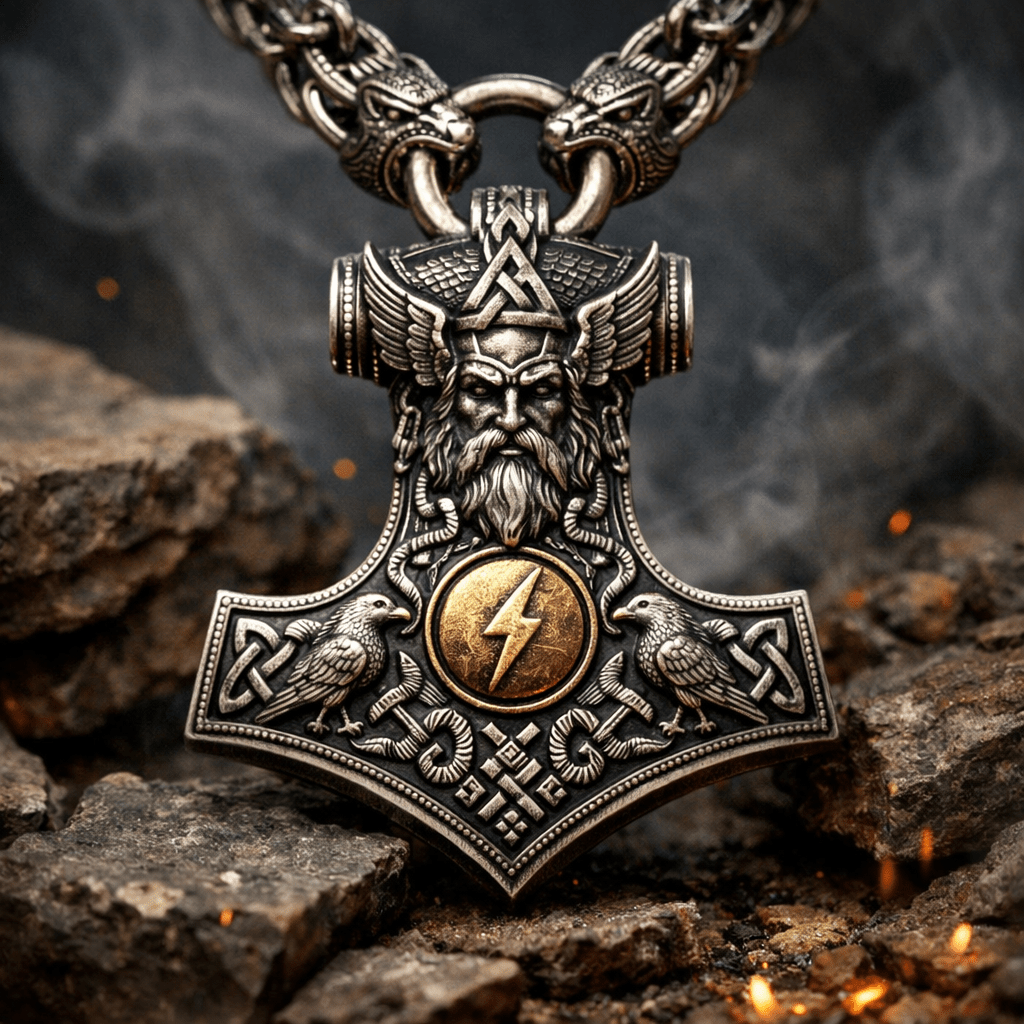
Viking Mjolnir pendant with Thor's face, ravens, and lightning symbol

Spend enough time around modern pagan spaces and you will hear ten different explanations for the art carved onto Mjölnir pendants. Every knot, curl, line, and beast-head gets treated like it carries some secret code.

Sometimes that makes for good storytelling. It does not always make for good history.

If we strip away the internet fog for a moment, the simplest answer is also the strongest one: the hammer itself carries most of the meaning.

Historically, Thor’s hammer was understood as a symbol of protection, power, blessing, and sacred force. That much is well grounded. What is much less certain is the idea that every decorative flourish on a Mjölnir pendant had one fixed, universal meaning that all Norse people would have recognized in exactly the same way.

That is where modern imagination often outruns the evidence.

The Hammer Is the Message

When you look at surviving Viking-age Thor’s hammer pendants, one thing becomes clear very quickly: some are quite plain, and some are richly ornamented. That alone should make us cautious about claiming that the artwork was always a rigid symbolic language.

What the archaeology supports most strongly is this: the shape says Thor. The amulet says protection. The ornament often says Norse style, not necessarily a separate theological sentence.

That does not make the artwork meaningless. It means we should be honest about what we can prove and what we are choosing to interpret.

So What Are We Actually Seeing?

On many Mjölnir pendants, especially the more elaborate ones, the decoration reflects the wider artistic language of the Viking Age: interlace, curled forms, dots, circles, filigree, stylized animal features, and flowing shapes that blur the line between tool, beast, and ornament.

One of the best-known examples is the famous Skåne hammer. Its loop is formed as a bird-of-prey face with a pronounced beak, raised eyes, and decorative filigree and swirl work. It is striking, intricate, and unmistakably rooted in Norse artistic tradition.

But here is the important part: that does not automatically mean every bird-like face, every S-curve, or every swirl came with one universally agreed symbolic translation.

Sometimes a hawk-like or beast-like form may have suggested sharpness, power, watchfulness, or otherworldly force. Sometimes it may simply have been the visual language of the craftsman and the culture that made it. Those two things are not enemies. They can both be true.

The Internet Wants a Dictionary. History Gives Us a Landscape.

A lot of modern people want a one-to-one key:

  • this knot means fate,
  • this curve means protection,
  • this face means Odin,
  • this pattern means a hidden doctrine.

That is usually more modern than medieval.

The surviving material gives us a symbolic landscape, not a neat little dictionary. Thor protects. Mjölnir hallows. The pendant functions as an amulet. The art belongs to a recognizable Norse world of design. Beyond that, caution is wisdom.

There Is Another Layer: Conversion-Era Crossover

One of the most interesting wrinkles is that not all Thor’s hammer imagery existed in a neatly sealed pagan bubble. During the conversion period, hammers and crosses sometimes lived side by side. Archaeological evidence even shows casting molds that could produce both Christian crosses and Thor’s hammers.

That matters.

It means some ornament on late-period pendants may reflect a world where spiritual identities were overlapping, colliding, blending, or simply hedging their bets. The old gods did not vanish in one clean stroke. Symbols did not always stay in separate boxes either.

What This Means for Modern Pagans

If you wear a Mjölnir today, the deepest historical symbolism is not hard to find.

It is a sign of Thor. It is a sign of strength. It is a sign of warding, blessing, and protection. It is a sign that says you are willing to stand under a power that defends what is worth defending.

The art upon it may deepen that meaning. It may connect the pendant to the wider visual world of Norse culture. It may carry personal meaning for the wearer. But we should be careful not to present modern interpretations as if they were proven Viking-age doctrine.

There is no shame in personal meaning. Just call it what it is.

Sometimes the most pagan thing we can do is refuse lazy certainty.

Sometimes reverence looks like honesty.

Image References and Further Reading

These are official museum or research pages, chosen because they are more stable than random reposts and they preserve the image context:

Blessed be, and may we have the courage to love both mystery and accuracy.