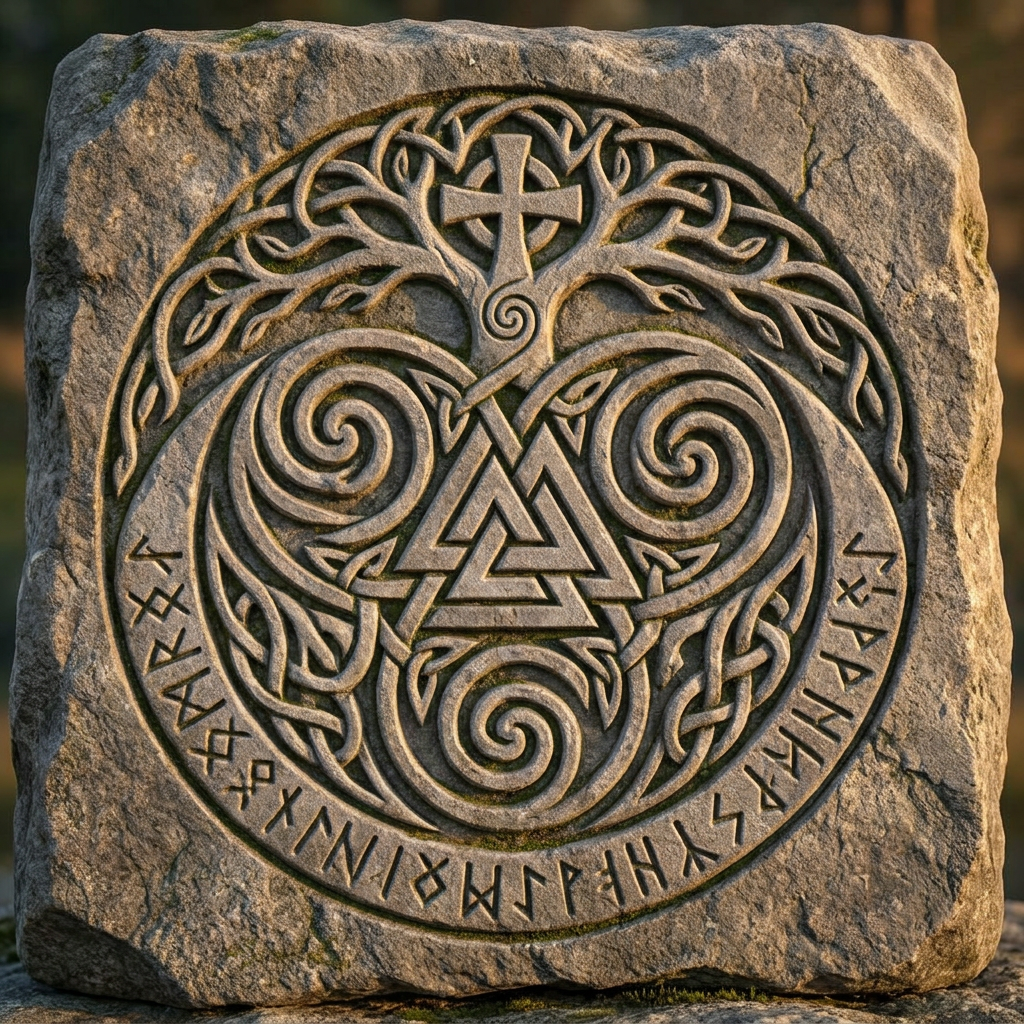

A McLaughlin of Clan Lachlan: Celtic Root, Norse Echo, Modern Path
As a McLaughlin of Clan Lachlan, I do not need to pretend there is an unbroken line of ancient Druids or Viking priests standing behind me. That would be more than the historical record can honestly support. The stronger truth is also the cleaner truth:
I am a McLaughlin of Clan Lachlan. My roots are Gaelic and Celtic, but my name carries the old Norse shadow of Lochlann. I do not need to pretend there is an unbroken Druidic or Ásatrú bloodline to honour both. The honest path is stronger: I stand where Gael and Norse once met — with clan, land, ancestors, honour, frith, story, and the old ways reinterpreted for today.
The Celtic Root
Clan MacLachlan, also known as Clan Lachlan, is historically rooted in the Highlands of Scotland, especially around Strathlachlan on Loch Fyne in Argyll. Clan history connects the line to Lachlan Mór, a 13th-century chieftain, and to older Gaelic traditions through Irish-Scottish ancestry. 1
That gives the clan its strongest foundation: Gaelic, Highland, Celtic, and west-coast Scottish. The land, the kinship structure, the clan identity, and the older cultural memory are Celtic in character.
The Norse Echo
The Norse connection comes through the name itself. MacLachlan comes from the Gaelic Mac Lachlainn, meaning “son of Lachlann.” The name Lachlann is connected with Lochlann, a Gaelic term associated with the Norse or Scandinavian world. 2
This does not mean Clan Lachlan should be simplified into “a Viking clan.” That would flatten the truth. The better reading is that the name carries a memory of the old meeting place between Gael and Norse. Western Scotland, the Isles, Ireland, and the Norse world did not exist in sealed boxes. They traded, fought, married, settled, raided, converted, blended, and remembered each other.
Clan Lachlan gives me the Celtic root. The name Lachlan gives me the Norse echo.
The Druidic Connection Today
The Druidic connection is best understood as a modern spiritual alignment, not a proven bloodline. Modern Druidry draws from Celtic mythology, bardic tradition, nature reverence, seasonal observance, story, poetry, and relationship with land, sea, sky, plants, animals, ancestors, and spirit. 3
For a McLaughlin of Clan Lachlan, that makes sense. A Gaelic-Celtic clan identity naturally speaks the language of land, kin, memory, place, and ancestral continuity. Druidry gives that inheritance a modern spiritual vocabulary.
But honesty matters. I do not need to claim that Clan Lachlan preserved a secret Druidic priesthood. I do not need to pretend that every McLaughlin carries some provable ancient religious office. The living truth is enough: Celtic land, Celtic memory, and a modern Druidic path rooted in reverence for nature, ancestors, story, and sacred place.
The Ásatrú and Heathen Connection Today
The Ásatrú connection is also modern rather than a direct medieval label. The National Museum of Denmark notes that Ásatrú, or Asatro, is a modern term. People of the Viking Age did not call their religion by that name; later, in contrast to Christianity, it was remembered as the “old way.” 4
That matters because it keeps the claim clean. I am not saying Clan Lachlan was secretly an Ásatrú clan. I am saying the name Lachlan carries a Norse resonance through Lochlann, and that resonance gives a modern McLaughlin a meaningful bridge into Heathen language: honour, oaths, gift-bonds, frith, ancestors, land spirits, and the old stories.
The Modern Framing
The strongest modern framing is not about proving a pure ancient line. It is about standing honestly at the crossroads of inherited memory.
As a McLaughlin of Clan Lachlan, I stand in a Gaelic-Celtic line whose name carries a Norse echo. My clan identity is Highland Scottish and Celtic, rooted around Strathlachlan on Loch Fyne, but the name itself reaches back toward Lochlann — the Gaelic memory of the Norse world. Spiritually, that gives me a legitimate modern bridge: Celtic land, Gaelic kinship, Norse ancestral resonance, and a contemporary path that can honour both Druidic and Heathen ways without pretending the historical record proves more than it does.
That is the important distinction. This is not a false claim of direct descent from Druids. It is not a claim that Clan Lachlan was historically Ásatrú. It is a modern spiritual inheritance built from real cultural pieces: Gaelic clan identity, Celtic land memory, Norse linguistic echo, and a living personal path.
The Plain Truth
Clan Lachlan gives me the Celtic root. The name Lachlan gives me the Norse echo. Modern Druidry gives me a land-based Celtic spiritual language. Modern Ásatrú gives me a Heathen language of honour, kinship, ancestors, oath, and frith.
Together, they form a modern spiritual inheritance — not a fake ancient pedigree, but a real and meaningful bridge.
I do not have to choose between Celtic and Norse. My own name already remembers that those worlds once touched.
Sources
- Castle Lachlan, “History.” https://www.castlelachlan.com/history
- FamilySearch, “McLachlan Surname Meaning.” https://www.familysearch.org/en/surname?surname=mclachlan
- The Order of Bards, Ovates & Druids, “Druidry.” https://druidry.org/
- National Museum of Denmark, “The Old Nordic Religion Today.” https://en.natmus.dk/historical-knowledge/denmark/prehistoric-period-until-1050-ad/the-viking-age/religion-magic-death-and-rituals/the-old-nordic-religion-today/
 Unplugged Pagan