
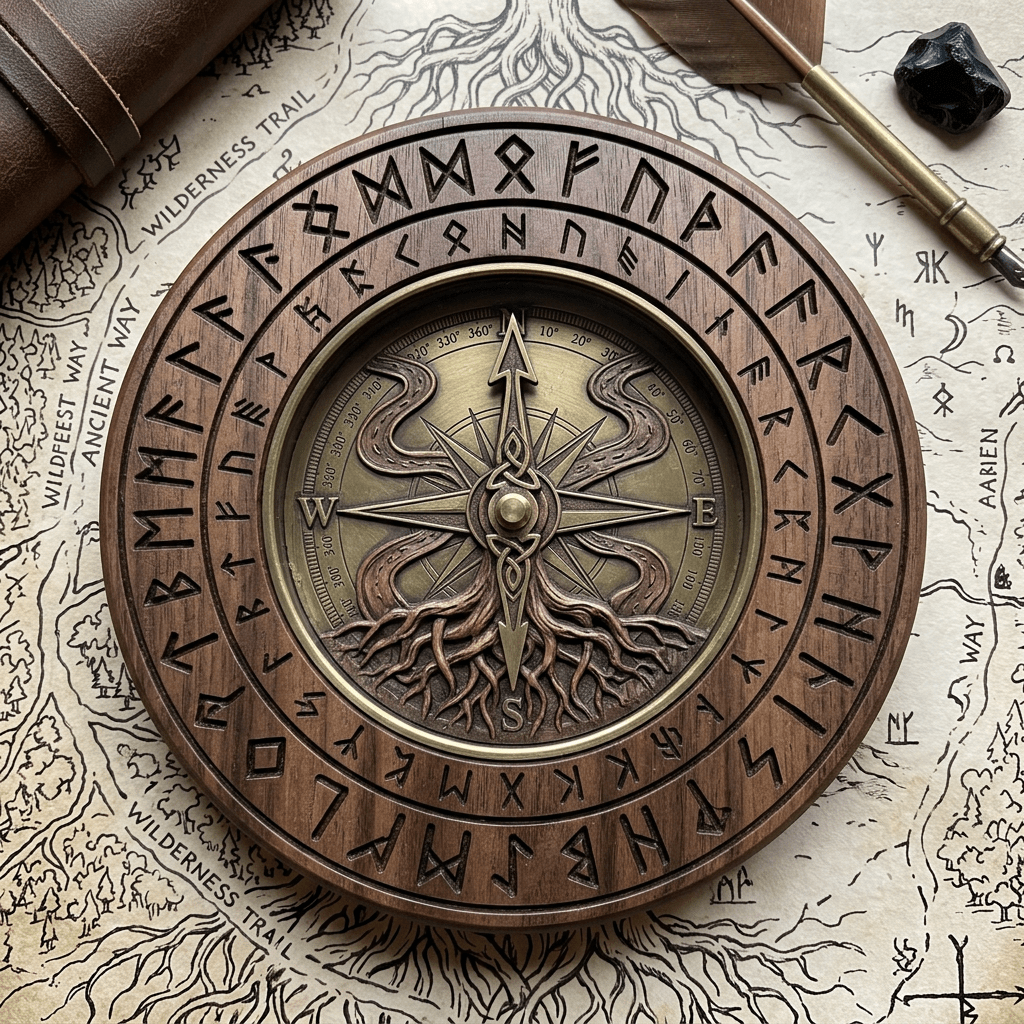
I have been sitting with the idea of the so-called Norse compass again. Not as a museum piece. Not as something I can honestly claim came straight out of the Viking Age. That part matters.
The symbol most people call the Norse compass is usually the Vegvísir, an Icelandic magical stave associated with finding one’s way through rough weather. It is powerful imagery, but it is not ancient Viking proof. It is a later symbol. That does not make it useless. It just means we should stop pretending it is something it is not.
And that is where this thought gets interesting.
What happens if we stop trying to prove ownership over the symbol and instead ask what it can become when placed beside older systems of marking, naming, and remembering?
What happens when Ogham meets Elder Futhark?
First, the honest line
This is not me claiming that the Celts and Norse sat down together and designed a secret compass. That would be a nice story, but nice stories are not the same thing as true stories.
What we are doing here is different.
We are building a modern pagan symbol honestly, using old materials without lying about them.
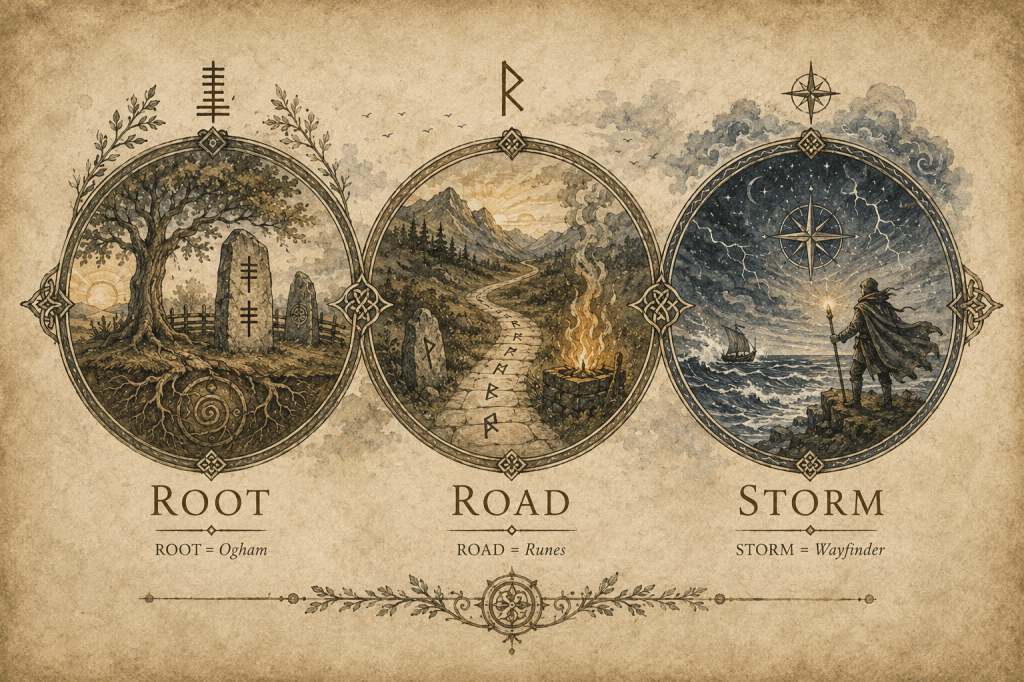
Ogham gives us the stemline. A central line. Marks crossing it. Names cut into edges. Boundary stones. Memory made physical. A way of saying: this person stood here, this name mattered, this place had meaning.
Elder Futhark gives us the roadline. Sound carved into wood, bone, stone, and metal. A row of forces. Wealth, need, ice, sun, journey, gift, day, inheritance. Not just letters, but a way of seeing pressure and movement.
The compass shape gives us the stormline. Not north on a map, necessarily, but the harder question: how do I keep from becoming lost when the weather turns?
Put those three together and we do not get an ancient artifact.
We get a modern wayfinder.
The three layers
That is the core of it for me.
Ogham is not just pretty scratch marks. It feels like root. It feels like the edge of a stone, the edge of a path, the edge between one holding and another. It is a language of boundary and memory.
Elder Futhark feels different. It moves. It bites. It carries conflict, need, gift, fire, ice, harvest, sun, and inheritance. The runes feel less like a fencepost and more like a road marker.
And then the compass shape asks the question that every spiritual system eventually has to answer:
Can this still guide me when things go bad?
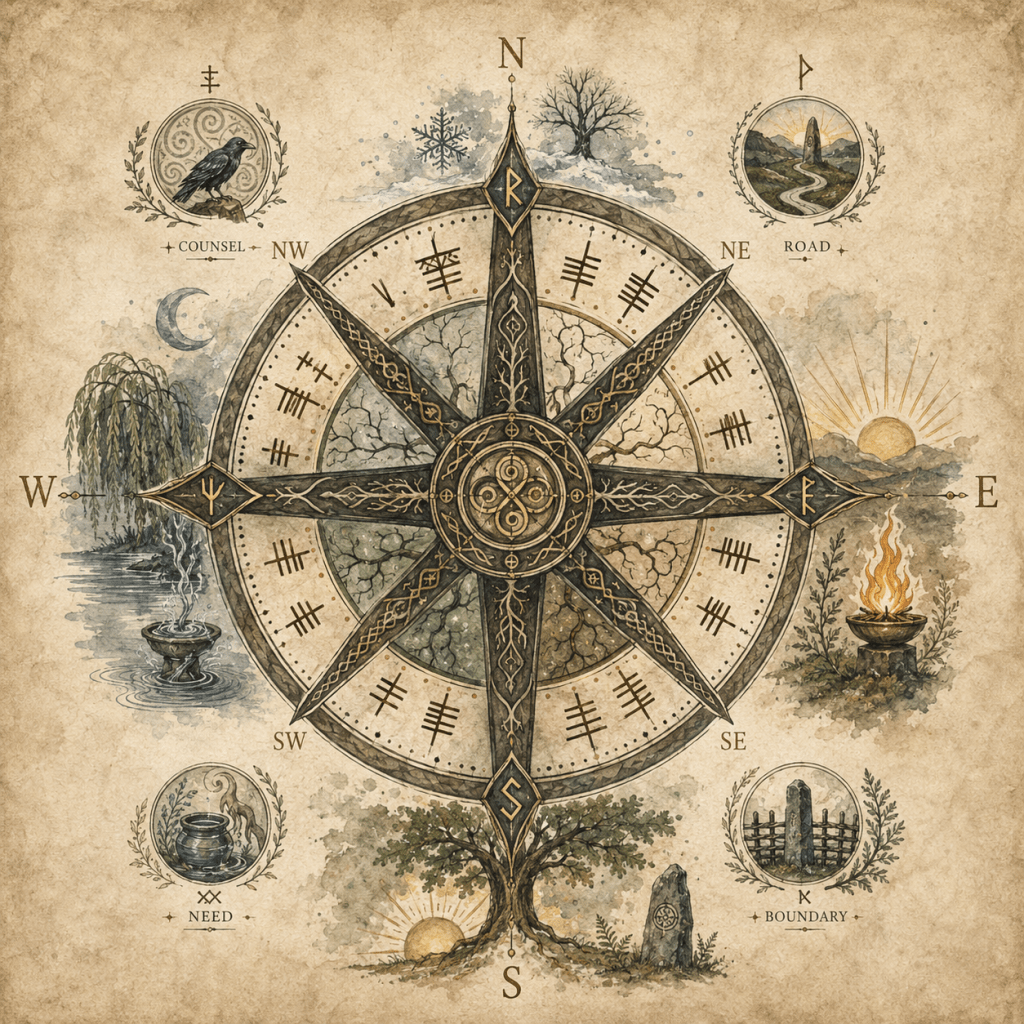
The eight directions
North becomes stillness. Ice. Spine. Endurance. The place where the world is not moving, and neither are you, but you are still alive.
East becomes kindling. The first light. Birch. Fire beginning again. Not a roaring bonfire. Just the first honest spark.
South becomes standing. Oak. Sun. The place where private belief becomes public action.
West becomes water. Willow. Memory. Grief. The place where the day lowers and the old voices start speaking again.
The cross-directions matter too.
Northeast is counsel. Breath. Speech. The wisdom that arrives before action.
Southeast is the road. Movement. Duty. The decision to walk instead of only think.
Southwest is need. Friction. Survival. The hard place where spirituality stops being decorative and has to become useful.
Northwest is boundary. Yew. Ancestor. Death and transformation. The place where you admit that returning does not always mean becoming who you were before.
Not a map home
This is the part I keep coming back to.
A compass is often treated as a tool for getting home. But spiritually, that is too simple.
Sometimes home is gone.
Sometimes home changed while you were away.
Sometimes home was never as safe as memory made it.
And sometimes the point is not to get back at all.
Sometimes the point is to leave without becoming rootless.
That is where this Root-and-Road Compass starts to matter.
Ogham says: remember where the roots were.
The runes say: now move.
The storm-stave says: and do not lose yourself in the weather.
The Unplugged Pagan reading
For Unplugged Pagan, this symbol works because it refuses two easy lies.
The first lie is that everything old is automatically pure.
It is not.
The second lie is that anything modern is automatically empty.
It is not.
A symbol can be modern and still be meaningful. A ritual can be reconstructed and still be honest. A path can be personal without being fake.
The problem is not modern creation. The problem is dishonest creation.
So I would not call this an ancient Celtic-Norse compass.
I would call it what it is:
A modern pagan wayfinder built from root, road, and storm.
It does not tell me where north is.
It asks me what I am using as north.
Blood?
Land?
Memory?
Grief?
Duty?
Fire?
Need?
The answer may change depending on the weather.
And maybe that is the point.
The working declaration
If I were to put the whole symbol into words, it would be this:
I am guided by root and road.
I remember where I come from, but I am not chained to it.
I walk through storm, need, grief, fire, winter, and return.
I do not navigate by blood alone, or place alone, or institution alone.
I navigate by memory, action, boundary, and becoming.
That feels right to me.
Not because it is ancient.
Because it is honest.
And honestly, that may be the better foundation anyway.
 Unplugged Pagan