Myth of Ratatoskr

This is a myth of Ratatoskr. For the uninitiated he is the squirrel who runs up and down the world tree Yggdrasil to carry messages between the eagle perched atop Yggdrasil, and the serpent Níðhöggr who dwells beneath one of the three roots of the tree.

This myth does not appear in the Poetic Edda, it like many myths are told mostly by bards. Past down verbally and embellished by each teller as the story gets told again and again. The first time I heard it was at a gathering known as Hail And Horn at Ravens Knoll some time between 2013 and 2015. I credit it to a young man by the name of Scott if my memory serves me correctly. And now on to the story.

Ratatoskr as we do know from the Eddas is a squirrel. He runs up and down Yggdrasil carrying messages between the Eagle perched upon its top, and the serpent Níðhöggr who resides beneath. Ratatoskr would get very hungry and constantly would be gathering food as he ran up and down Yggdrasil. When he reached the top of the tree to deliver messages or latest barb to the eagle from Níðhöggr he would have to open his mouth to speak and in doing so would drop all the acorns and such he had gathered on his way up. These would fall and invariably drop on some unsuspecting travelers head. Ratatoskr would try to apologize but in his excited state all that would come out of his mouth would be chittering. This as you could imagine would be returned by yelling and things being thrown back at poor Ratatoskr by the passersby. Ratatoskr would receive messages from the eagle and begin is trip back down the tree again gathering food as he went. Sometimes his mouth would be full so he would just knock acorns and the like on to the ground and again these would sometimes hit people. He would try to apologize but again with his mouth full all that came out of it would be the contents of his cheeks, and more chittering.

When Ratatoskr reached the ground he would try to gather up what he had dropped, and stash the food in the nearest hole. Usually these holes were Dwarf Mines. He would have so many pine cones, acorns and other seeds he would some times fill these holes to capacity. This would infuriate the Dwarves. As sometimes they would get trapped in the mines under tonnes of seeds, or their mines would be so full they would have to dig them out again so they could resume work. This might seem trivial but all this having to redo work that was all ready done meant the dwarves were delayed in other tasks, such as making weapons, jewelry and the like for the Gods and the realm of man. So now the Gods were furious because they were not getting their trinkets.

In the mean time Ratatoskr would deliver the messages from the eagle to Níðhöggr and the whole process would repeat. If your wondering why the squirrel did this to begin with it may have something to do with an agreement between the eagle and Níðhöggr that allowed Ratatoskr to travel up and down Yggdrasil and not be eaten as he reached the top or the bottom.

So at this point we have the realm of man, and the Aesir, and the Vanir and many others furious with this poor squirrel. They would chase him with brooms, throw rocks at him, empty out his caches of food. So now is he not only running up and down all day to gather food, exchanging messages so he does not get eaten he is having to run for his life to. Well one day he decided to stop and stop he did. The 9 realms rejoiced no longer did they have this insidious fury little creature acosting them on their walks. No longer did the dwarves have to dig themselves out of their holes and dig new ones to get back to their mining. Every one started to get their bobbles and weapons when they were supposed to. Things we great.

The seasons passed, Winter, spring etc. For two passings of the seasons no one saw Ratatoskr and no one cared. Then things started to happen. You see few new trees, few new strawberries and the like were appearing. The forest creatures were now starving because no new plants were growing. The spring rains came and there were mud slides and flooding the likes of which the 9 realms had ever seen. Yggdrasil was heavily laden with seeds, the ground at its roots softened and eroded by flooding. The dwarven mines were pools.

The eagle would perch upon the top of Yggdrasil and Yggdrasil would shake. Níðhöggr would coil around the base of Yggdrasil to try hold it steady but in doing so would clamp around it so tightly that Yggdrasil began to starve for water. Yggdrasil was dying. The eagle would begin to flap his great wings as he held tightly to Yggdrasils top in his attempt to hold Yggdrasil upright. The winds from his flapping were causing remaining trees to topple. No one in the 9 realms understood what was happening and blamed each of the other realms for the current state of affairs. Ragnarok was coming.

The Aesir gathered in preparation they believed as others that Ragnarok had arrived. They went to Odin, all father, the All Knowing and pleaded with him to do something. Yggdrasil is dying they said, the animals are starving, we have nothing to hunt, we cannot gather food. We have no weapons because the dwarves cannot get into their mines. All the realms are hurting.

Odin looked around and he saw the devastation, he travelled the 9 realms and it was the same every where. On his travels he realized something was missing but could not quite figure out what. He went to Yggdrasil and indeed it was dying. He could feel Níðhöggr straining to hold up the great tree, he could see the eagle perched upon its top flapping his wings his attempt to hold the tree upright. Where was Ratatoskr?

Odin sat at the base of Yggdrasil for a day, no Ratatoskr, he sat there for a week, no Ratatoskr. After two weeks he stood up and went to the Aesir and asked if anyone has seen the squirrel and they all replied they had not. But they all had replied they were happy that he was gone. Again he went to the dwarves and asked the same and the response was the same.

Odin asked the eagle and Níðhöggr when they last saw Ratatoskr and their response was we have not seen him for two passing’s of the seasons. It was then Odin realized what was going on. He put out a call to the 9 realms to have Ratatoskr found. Nearly a month went by and indeed it looked like Ragnarok had arrived but finally Ratatoskr was found. Odin went to him and asked why he went away.

Ratatoskr recanted his story, he was tired of being chased, being yelled at, having stones thrown at him, having his food caches destroyed. He was tired of running up and down the tree all day and being loathed by the all the realms. But mostly he was tired and hungry and just wanted to sleep and eat. Odin looked at him and apologized to Ratatoskr. Odin explained to Ratatoskr that the 9 realms cannot survive without him. For even though Ratatoskr was small he did many important jobs that seemed insignificant on the surface, but overall they have a major impact on the welfare of the the 9 worlds. Odin then went on to say he will speak to the dwarves, and all the realms and explain that they need to be kind to Ratatoskr for without him the end would come. Ratatoskr agreed to go back to work, as he truly did miss it. The realms grumbled but the eagle and Níðhöggr were happy they could have their fun poking at each other again, and pass other messages about. The realms slowly returned to normal, Food was plentiful for all. The world tree recovered.

SO the Next time you see a squirrel… Be patient be understanding. For without him Ragnarok will come.
Community

As I socialize with friends over the last few weeks I had to look up something I posted to facecrack July 1 2017. I have to wonder where the overall harmony is these days.

Common Definition: something wide spread or shared.

Unity Definition: to come or bring together for a common purpose or action. the quality or state of being made one, a condition of harmony

Community compound word Common with Unity

Community Definition: A group of people who come together for a common purpose and having a shared harmonious vision.

If I die today

I am somewhat saddened by all the things happening. But in some ways saw it coming. The lack of planning. the lack of follow through on conversations that seem to be long ago and forgotten. I recall having this conversation with former bosses, and friends of former bosses as well as recently deceased, and the not so distantly deceased.

No one plans to die, all though there are those that do wake up today and say “Today I die” but that is the exception. In either event the outcome is still the same, you have died. Death is not hard on the deceased it is hard on the living. Those the dead leave behind. It is harder still on the living when no thought has been given upon what happens after your death. The now parentless child, lover, mother or father, wife or husband and or business partner are left to deal with what you did not deal with.

If your living and I hope that you are if your reading this lol. Give some thought on the details of what happens on the big “if I die today”

Hoof and horn

We all come from the Goddess
And to her we shall return
Like a drop of rain
Flowing to the ocean

Hoof and horn hoof and horn
Those who die shall be reborn
Corn and grain corn and grain
Those who fall shall rise again

We all come from the sun god
And to him we shall return
Like a spark of fire
Flying to the open sky

Hoof and horn . . .

We all come from one
And to one we shall return
Like a ray of light
Reaching for eternity

Hoof and horn . . .

The earth the air the fire the water

The earth, the air, the fire, the water
Return, return, return, return
The earth, the air, the fire, the water
Return, return, return, return
Ae, ae, ae, ae aio, aio, aio, aio ae, ae, ae, ae
Aio, aio, aio, aio
The earth, the air, the fire, the water
Return, return, return, return
The earth, the air, the fire, the water
Return, return, return, return
Ae, ae, ae, ae aio, aio, aio, aio ae, ae, ae, ae
Aio, aio, aio, aio
The earth, the air, the fire, the water
Return, return, return, return
The earth, the air, the fire, the water
Return, return, return, return
Ae, ae, ae, ae aio, aio, aio, aio ae, ae, ae, ae
Aio, aio, aio, aio
The earth, the air, the fire, the water
Return, return, return, return
The earth, the air, the fire, the water
Return, return, return, return
Ae, ae, ae, ae aio, aio, aio, aio ae, ae, ae, ae
Aio, aio, aio, aio

We won’t wait any longer

Chorus
We won’t wait any longer, we are stronger than before
We won’t wait any longer, we are stronger

We have trusted no man’s promise
We have kept just to ourselves
We have suffered from the lies
In all the books upon your shelves
And our patience and endurance
Through the Burning Times and now
Have given us the strength to keep our vow (chorus)

You have grazed away the heather
And have razed the sacred grove
You have driven native people
From the places that they love
Though your greed has been unbounded
You have felt the pangs of shame
Every time you trod upon the Mother’s name (chorus)

Though you thought you had destroyed the memory of the Ancient Ways
Still the people light the bale fires every year on Solstice Day
And on Beltaine Eve and Samhain, you can find us on the hill
Invoking once again the Triple Will (chorus)

Through the ages many races have risen and have gone
But dispersed among the nations of the world we linger on
Now the time has come to take the sacred Cauldron of Rebirth
And fulfill our ancient pledges to the Earth (chorus 2x)

We are stronger

https://www.youtube.com/watch?v=EolQROHpg0Y

For the Disenfranchised souls.

I went somewhere today where I once I felt at home, I left after about 10 minutes wondering why I went to begin with. I felt lost and just wanted to scream at folx. Instead I left I just screamed inside, and the memories died just a little more. Then I heard this song. This goes out to the souls who scream inside, scream for love that never quite seems to be returned. Who give up and stop. Stop giving your all even stop giving the some. Who scream inside begging for something that never seems to be there. Who scream inside wanting to fill a hole that never seems to be filled.

I went to far By Aurora

https://www.youtube.com/watch?v=eT6dLJd3rYk

Spirituality of Fire Keeping

This is a subject that I started writing on 3 plus years ago in hopes of doing a workshop/weekend dedicated to Fire Keeping, its spirituality of it, and some histrionics of the subject of fire and its importance to Mankind and the like.

These are my personal notes and research. Some may be inaccurate, but this was a work in progress and never completed. I will do this page-by-page transcribing on a semi-regular basis. Feedback is always welcome, and so we begin with page one.
——————————–

Preface

Any person is indeed capable of tending a fire, whether it be large or small. Humankind has used fire for many purposes, to keep themselves warm, to keep away predators, to cook food, and to bring light to the shadows of the night. The reasons are as myriad as the stars in the skies.

Today I wish to touch on the spirituality of fire, the art, and the stagecraft of the sacred fire. For myself, fire keeping is very much a blending of the two. Fire is Sacred; it is a gift. When Chro-magnon man figured out how to use iron pyrite and flint to create a spark and from that spark make fire, the hearth quickly became the central gathering place of the tribe.

Creating fire was probably one of the first feats of Magik performed by Mankind. The Firekeeper/maker was revered and highly esteemed, for he could keep the tribe warm and safe. He was just as crucial as the Hunter. Some may even say more so.

Fire Keepers are considered to be some of the first Shamans. The fire was sacred; it was entrusted to someone believed to have a direct line to the Gods. Fire as an element was considered to be very picky and powerful. One did not provoke the fire spirit or the Fire Keeper, for without fire, the tribe suffered. In some cases, a fire was used as a show of non-aggression to other tribes, wherein fire could be gifted to another tribe. It was also used in some sense as currency, and through its gif,t it could be used to obtain things from other groups, and ye,s it was also fought for and stolen.

Now let’s get back to the “first Shamans” part. As with all things creating fire requires skill and knowledge. Knowledge of what materials could be used to create sparks, where to find these materials, plus the ability to keep these safe. Again the same thing would apply to Tinder and fuel to keep the fire going.

Why did the ability to create fire elevate an otherwise average person to the status of “Shaman?”

Well, let us look at how the fire occurred in nature. Lightning striking the ground can cause a fire. The bright flash of light, accompanied by a thunderous boom, could set a tree or the ground ablaze. Volcanoes erupting, sending volleys of molten lava flying through the air, and rivers of liquid fire rolling downhill, would set things ablaze. In addition, volcanoes erupt toxic gases and ash that could kill and disfigure. Early man, to understand these things, oft attributed them to unseen gods. So it was not a far stretch in early man to believe that any person who could create and contain fire had some link to those unknown gods. Hence he must have been given these powers of nature by these gods.

Since the fire was believed to have originated with the gods and the fire keeper a divine person, it was not long after that fire was used ritualistically to communicate to these gods. Hence the hearth became an altar to the gods simply because it was observed that the smoke, sparks, and ashes would rise up to the skies and, indeed, to the gods themselves. Since objects such as meats or other foods would be consumed by fire, it was believed they went straight to the gods too.

Before man could create fire, he had to learn to capture it by taking advantage of these natural acts. In catching fire, man began to learn how to control his environment. As stated previously, fire became essential to the tribe’s survival. The darkness of the night became less scary and less dangerous. Fire provided not only heat and a way to cook food but also light and kept predators at bay. Some believed that fire also inspired and facilitated early cave paintings. The charcoal from the fire became a writing implement.


I have had many conversations with elders in the Pagan community on fire; those conversations left me dumbstruck. Some elders do not grasp the importance of fire in gatherings; they seem not to understand how fire lends to the overall wholeness of a group or ritual. I personally have filled the role of Fire Keeper since around 2011. At first, doing simple things like tending campfires in the evenings. The warmth of those fires allowed the community to congregate, relax, and unwind. It is at these fires the drums and guitars come out. Storytellers regaled us with stories of past and present times and retold the stories of Gods and men. It is here as well the dancers would get up and dance around the fire accompanied by the drums, as mentioned above, and other instruments. Here, laughter and tears were shared, ideas were born, futures were decided, and the past was learned from.

As time went on and the years passed, I sought my place within the Pagan community. On several occasions, I thought I had it figured out; Druidry and Heathenism seemed to fit, but only loosely. These sorts of work my ancestry but left me wanting. They also did not fit my preconceptions. Meanwhile, I still tended fires, added little knowledge along the way, and began developing my style and fire-keeping craft. Little did I realize the community showed me my path as I plodded along obliviously. I watched, learned, and paid attention to other firekeepers. Soon fire keeping became more than just throwing another log on the fire, but still, I was oblivious. Fire keeping was becoming an art, and I began developing a bit of showmanship. Absorbing bits and pieces bits of lore along the way. As I sat and wrote and researched the subject of fire keeping and spirituality, I was amazed to find not much out there. I could find plenty on drumming and dancing the sacred fire but not much on the aspect of the fire or the fire keeper and their lore. The lore of the Firekeeper seems to be as elusive as that of the Druids of old, or perhaps it is passed on verbally and never recorded in the written word save maybe in personal notes. I found scattered bits mentioned only in passing but nothing in abundance in one place. So I shall begin with what I know, what I believe.

The Art of Fire

So I shall begin with what I know and believe. The art of fire keeping starts long before the fire is lit, with the intent of the fire being a determining factor in preparation. First, One must know the fire’s purpose; is it just being used for warmth? Are you using it to cook food? Is it being used for light for storytelling or the focal point of a drum circle or ritual?

Why is it important to know these things? The reasons are many. The wood you might use for a cooking fire might be maple or oak; you may add hickory to provide flavor. You would not want to use poplar, elm, or cedar as these might give unsavory results. You also may need to dig a pit if you wish to pit cook your food and need to find a suitable pit location. I have seen that Sandy dampish-to-dry soil works best for pit cooking. I will touch on pit cooking and cooking fires later.

For general warming fires, you can almost use any dry wood as it burns well. But I would advise against elm; I have never found the smoke it produces to have an alluring scent. I have also found balancing hardwoods and softwoods works best. Too much pine and you have embers flying out of the fire, potentially landing on people, and it burns very fast; adding cedar can sometimes keep bugs at bay, but again, it too likes to spit out embers. Birch is lovely to add a little brightness but can produce a lot of smoke as the bark burns off. Hardwoods such as oak, maple, ash, and basswood are good for adding longevity to your fire as they tend to burn slower and provide a good bed of coals if someone makes a snack of marshmallows, smores, or hot dogs. Cedar and Pine are often used in ritual fires. Cedar is believed to be a purifying wood. It is believed that its rising smoke can convey messages to the gods, and its aromatic smoke also is good for keeping bugs at bay.

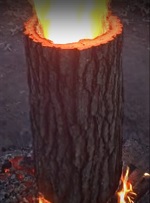
Warming fires generally are less artsy and require less thought. But you can still make the attendees ooohhh and ahh with the simple little things by placing a hollow log in the middle of your fire, and it will act like a chimney drawing flames inward and smoke up through its center, like the image below.

I have done the above on a few occasions. The effect is rather neat and can last for a few hours depending on how dry the wood is; its size will also have a factor. You can vary this and build a fire in the center, but add a few vent/breather holes in the side of the log so your fire gets air. It takes practice, and you probably will never get the same result twice. The above has been referred to as a Swedish fire log. You can use the top as a cooking surface if done correctly.

But the fire is more than just a means for cooking or providing warmth. The spiritual aspect of fire cannot be ignored. Fire is a symbol of transformation and purification. It is believed that burning wood can release trapped energy and emotions, helping to purify oneself and the surrounding environment. Fire is also believed to be a messenger to the gods, allowing one to communicate and ask for guidance or blessings.

The role of the fire keeper is, therefore, not just to tend to the physical fire but also to tend to the spiritual energy that the fire creates. The Firekeeper must be aware of the energy of the space and ensure that it remains clean and pure. They must also be mindful of the attendees’ energy and help facilitate transformation and purification by guiding them through the fire’s energy.

The art of fire keeping involves the physical aspects of tending the fire and the spiritual aspects of working with the fire’s energy. The fire keeper must understand the fire’s intentions and the power it creates and use that to facilitate transformation and healing for themselves and those around them. It truly is an art form that requires attention, focus, and knowledge.

From its origins as a tool for survival to its central role in our spiritual beliefs. Fire keeping requires physical and spiritual preparation, with the knowledge of wood selection, fire implementation, and the awareness of energy and intentions. By embracing the art of fire keeping, we can connect more deeply with our spirituality and harness the transformational power of fire.

As we tend to the flame, we must remember the sacredness of fire and the responsibility that comes with it. We must honor the traditions of our ancestors, who saw fire as a gift from the gods. By understanding the art of fire keeping, we can cultivate a deeper connection with ourselves, others, and the divine. Let us tend to the fire with respect and gratitude; in doing so, may we transform ourselves and our communities for the better.

In conclusion, fire keeping is much more than just tending a flame. It is an art form, a spiritual practice, and a way of connecting with ourselves and the divine. The role of the fire keeper is that of a facilitator, one who guides the attendees through the energy of the fire and helps them to transform and purify. By understanding fire’s physical and spiritual aspects, we can cultivate a deeper connection with our spirituality and create a space of transformation and healing. Let us honor the sacredness of fire and the traditions of our ancestors as we tend to the flame.