

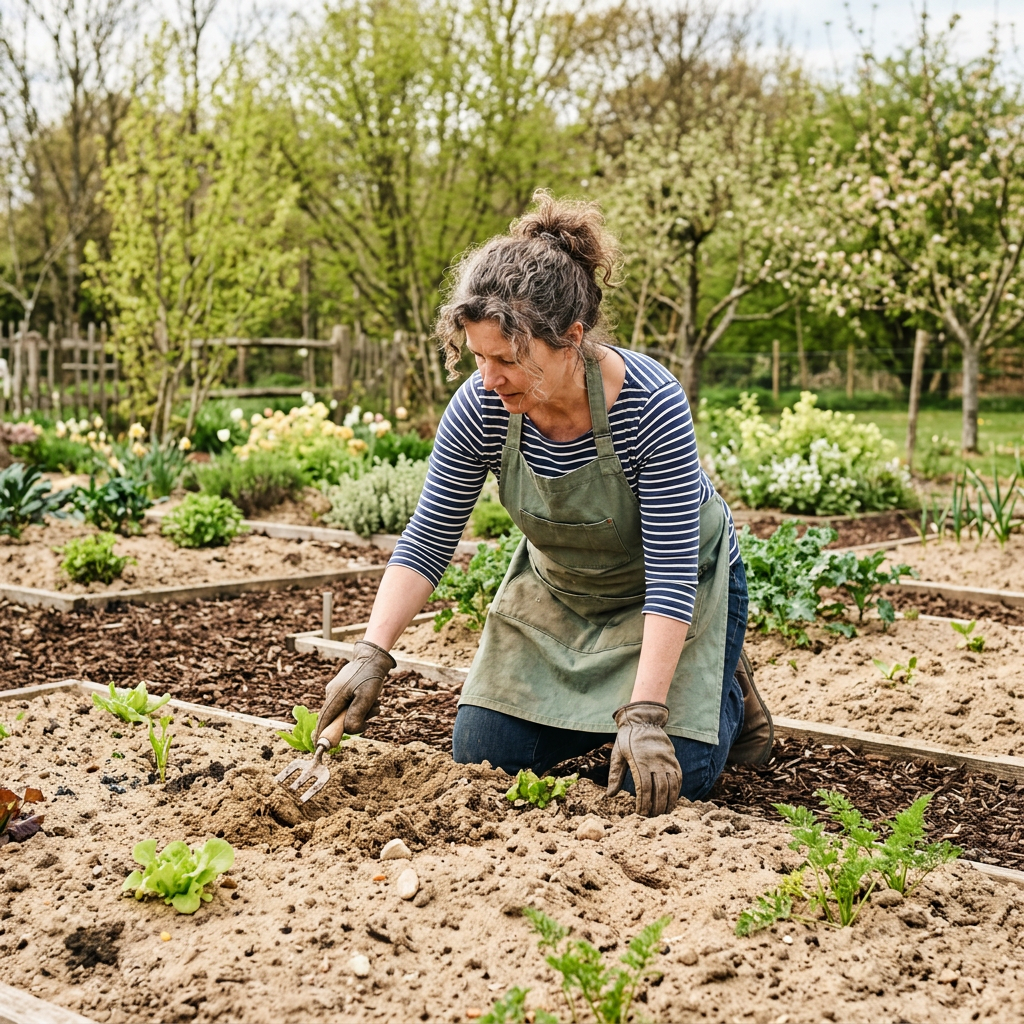
Hey there, my dear Unplugged Pagans.
How are you today?
It is a very nice, warm day. One of those spring days that starts whispering dangerous little things into a gardener’s ear.
Go ahead.
Put the plants out.
The sun is warm. The soil is waking. Surely winter is done with us now.
And that, dear Unplugged Pagans, is how spring lies to you.
I got out yesterday and did a little more work on the driveway. I also contemplated rototilling the garden again, but for now I think I am going to leave it sit another week. There is a time to disturb the soil, and there is a time to let the soil settle back into itself.
That is part of gardening too.
Not every act of care requires a shovel.
Sandy Soil and the Temptation to Overwork
My soil here is very sandy. Sandy, sandy soil. Not much organic material in it at all.
So I am debating whether or not to work some organic matter into the garden before planting. Compost. Well-rotted manure. Leaf mold. Something that gives the soil a little more body, a little more life, a little more ability to hold water and nutrients instead of letting everything run straight through.
Sandy soil has its blessings. It drains well. It warms up faster. It is easy to work compared to heavy clay.
But it is also hungry soil.
It does not hold much.
The tomatoes know this. The peppers will know this. The roots will know this. And if I am honest, I already know this too from the amount of watering those seedlings are demanding.
So yes, organic material is probably the right move. Not to replace the natural soil, but to feed it. To help what is already there become better.
Raised Beds and the Natural Soil
Now, this whole concept people have of raised garden beds — I have never fully understood the obsession.
I am not saying they have no place. They do. If your soil is contaminated, too wet, too compacted, too rocky, or if you need easier access because bending and kneeling are hard on the body, raised beds can make sense.
But sometimes I look at the trend and think we are creating more work than we need to create.
You build the box.
You buy the soil.
You fill the box.
You maintain the box.
You water the box more often.
Meanwhile, the earth is already there beneath your feet.
My own instinct is to use what is there. Improve it. Learn it. Work with it. Let the land teach you its habits instead of immediately building an artificial little kingdom on top of it.
That may be the Pagan in me talking.
The land is not just a surface.
It is a relationship.
The Victoria Day Rule
And then there is the old rule.
My grandmother had a cardinal rule for this area: do not start planting the garden until after Victoria Day weekend.
She broke that rule once or twice.
The results proved her right.
Here in Eganville, here in Renfrew County, warm afternoons do not mean the frost is done. The sun can bless you at three in the afternoon and the cold can betray you at three in the morning.
That is just spring in this part of Ontario.
Right now, the temptation is real. The weather is nice. The garden is calling. The seedlings are getting impatient. The gardener is getting impatient. The whole thing feels like it should be time.
But the forecast still has below-freezing temperatures showing. There is still cold in the bones of the week. There is still the possibility of ugly little surprises.
So wait.
Have patience.
Do not put your tender garden in yet.
You may regret it if you do.
The Seedlings Are Ahead of the Season
I also realize I started some of my seedlings probably four weeks too early.
Some of the poor pepper plants are already starting to blossom, and they are not even in the ground yet. That may bode well. It may not. We will see.
The tomato plants are definitely telling me they are ready for more room. I am watering them every day, sometimes twice a day, because they are thirsty little critters.
That is the funny thing about gardening.
You can do almost everything right and still be slightly out of rhythm.
Start too late, and you lose season.
Start too early, and the plants are staring at you from their little pots, asking why you brought them to the dance before the hall was open.
There is a lesson in that.
Growth is not only about eagerness.
Growth is timing.
The Pagan Lesson in Waiting
There is a reason the old people watched the weather, the moon, the birds, the soil, the trees, and the frost line.
They knew the calendar was only part of the story.
Spring does not arrive because we want it to.
The garden does not care about our impatience.
The seedlings do not care that we are tired of winter.
The frost does not care that the long weekend is coming.
Nature moves by signs, not by moods.
That is one of the hard lessons of the land.
And maybe that is why gardening belongs so naturally inside a Pagan life. It teaches humility without needing a sermon. It teaches patience without asking permission. It teaches that the sacred is not always dramatic.
Sometimes the sacred is compost.
Sometimes the sacred is sandy soil being slowly improved.
Sometimes the sacred is not planting when every impatient part of you wants to plant.
For the Gardeners This Week
So if you are in this part of Ontario, or anywhere still flirting with frost, be careful.
Harden off your plants.
Watch the night temperatures, not just the daytime highs.
Feed the soil before you demand too much from it.
Work with what you have before assuming you need to build something artificial on top of it.
And remember: a warm afternoon is not a contract.
For now, I am going to wait.
The driveway got some attention. The garden can sit another week. The tomatoes and peppers can grumble from their pots a little longer.
My grandmother’s rule still stands.
After Victoria Day.
Not because we are afraid of spring.
Because we respect it.
Godspeed.
 Unplugged Pagan