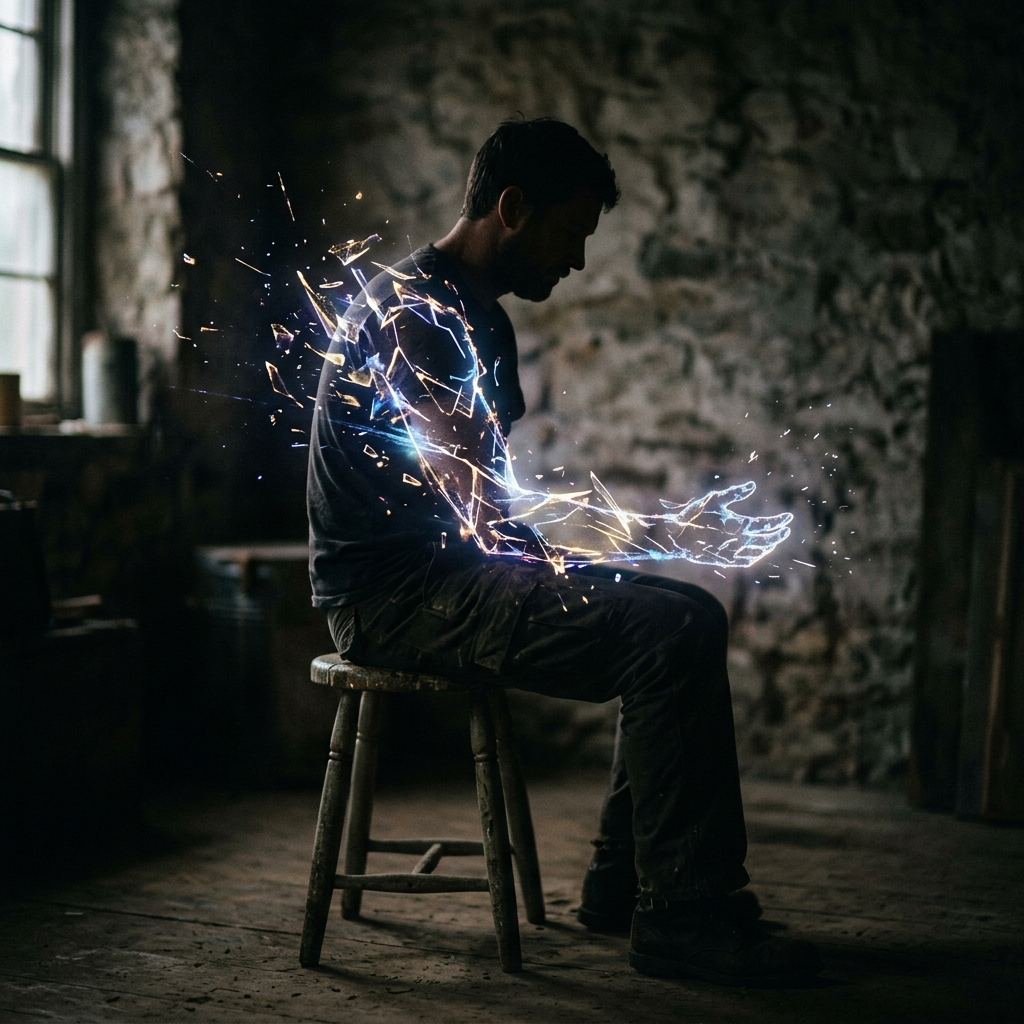

A while back, when I was working through my Intro to Psychology course, I spent some time looking at post-traumatic stress disorder and the treatments being studied for it. One of those treatments was MDMA-assisted therapy.
Some people know MDMA by its street name: ecstasy. But there is an important distinction to make right away. Street ecstasy is uncontrolled, illegal, and unpredictable. Clinical MDMA is administered in a controlled therapeutic setting, with screening, monitoring, preparation, therapeutic support, and follow-up. Those are not the same thing.
That distinction matters.
The point was not, “Take a drug and trauma disappears.” That is not how trauma works. The point was that, under very controlled conditions, MDMA appeared to help some people approach traumatic memories without being overwhelmed by the same level of fear, shutdown, or emotional flooding.
In a 2023 phase 3 trial published in Nature Medicine, MDMA-assisted therapy showed significant improvement in PTSD symptoms and functional impairment over an eighteen-week period. The study reported that 86.5% of participants in the MDMA-assisted therapy group achieved a clinically meaningful benefit, and 71.2% no longer met PTSD criteria by the end of the study.
That is not nothing.
But science is not faith healing. It does not get to stop at hope. In 2024, the U.S. Food and Drug Administration did not approve the MDMA-assisted therapy application as submitted and requested further evidence, including another clinical trial. In Canada, access to substances such as MDMA and psilocybin may be requested through Health Canada’s Special Access Program in limited circumstances, but those requests are assessed case by case and are not the same as general approval or personal possession.
So the honest answer is this: MDMA-assisted therapy is promising, but it is not a free-for-all, not a miracle cure, and not something anyone should confuse with street use. The setting, the therapist, the screening, the dose, the support, and the follow-up are not side details. They are the treatment.
And that brings me to another strange and fascinating area of pain: phantom limb pain.
I came across a story about a veteran who had lost part of an arm and continued to feel severe pain in the missing limb. Pain medication did not solve it. Nerve blocks did not solve it. The pain was so bad he would drink himself into oblivion just to escape it for a while.
Now, some people hear “phantom pain” and think that means imaginary pain.
It does not.
My father is an amputee. He lost part of his leg when he was much younger, in his late teens. Even now, roughly sixty-five years later, he can still feel pain in the part of the leg that is no longer there. That sounds impossible until you remember that pain is not only located in flesh. Pain is also processed in the nervous system. The body may lose the limb, but the brain does not always lose the map.
Cleveland Clinic describes phantom limb pain as real pain felt in a missing body part after amputation. It can feel like aching, burning, itching, stabbing, tingling, throbbing, twisting, or temperature change. More than half of people who lose a limb experience some form of phantom pain.
That matters because pain being “in the brain” does not mean pain is fake. All pain is processed by the brain. The question is not whether the person is imagining it. The question is what the nervous system is doing, what signals are being misread, and whether the brain can be helped to redraw the map.
That is where mirror box therapy comes in.
The basic idea is almost absurdly simple. A mirror is placed so that the person sees the reflection of their intact limb where the missing limb would be. The person moves the intact limb while looking at the reflection, creating the illusion that the missing limb is also moving. In plain language, it is a conversation with the brain.
The brain says, “The hand is clenched. The foot is cramped. The missing limb is hurting.”
The mirror replies, “Look. It is moving. It is opening. It is not trapped.”
And sometimes, the brain listens.
Mirror therapy is often connected to the work of neuroscientist V. S. Ramachandran in the 1990s, who used mirror visual feedback to help some amputees experience movement and relief in phantom limbs. The therapy works by creating visual feedback that can conflict with, and sometimes soften, the brain’s painful map of the missing limb.
But the science is not as clean as the popular story sometimes makes it sound. Some studies and reviews suggest mirror therapy can help, especially as part of a broader rehabilitation approach such as graded motor imagery. Other reviews argue that the evidence for mirror therapy by itself remains mixed, and more robust long-term research is still needed.
Again, that is where honesty matters.
Not every treatment works for every person. Not every hopeful result becomes standard care. But these treatments tell us something powerful about human suffering: the mind and body are not separate kingdoms. They are one system speaking in different languages.
Trauma can live in memory, but also in the nervous system. Phantom pain can come from a missing limb, but be felt as sharply as any wound. A person can know intellectually that the danger has passed, while the body still reacts as if the danger is happening now. A person can know the limb is gone, while the brain still cries out from the place where it used to be.
That does not make the person weak.
That makes the person human.
This is where I think the lesson belongs on Unplugged Pagan. Not because MDMA therapy or mirror boxes are Pagan practices. They are not. But because Paganism, at its best, does not teach us to despise the body. It teaches us to listen to land, season, fire, memory, grief, and presence.
The body is land.
The nervous system is weather.
Pain is not always an enemy; sometimes it is a messenger whose language has become distorted.
The old wound keeps speaking.
The missing limb keeps speaking.
The trauma keeps speaking.
The question becomes: how do we answer without destroying ourselves?
Some people answer with drink. Some answer with silence. Some answer with rage. Some answer by pretending nothing happened. But healing, real healing, seems to require something harder. It requires the courage to turn toward the signal and ask:
What is this?
Where is this coming from?
Is this pain warning me about the present, or is it echoing from the past?
That is true of phantom pain. It is true of PTSD. It is true of grief. It is true of betrayal. It is true of the invisible wounds people carry while still showing up to work, still paying bills, still smiling at the grocery store, still pretending they are fine because explaining the wound would take too long.
The pain is real.
Even when others cannot see the limb.
Even when others cannot see the trauma.
Even when the wound has no blood on it.
And maybe that is the deeper point here. Science is beginning to show us that healing is not always about cutting something out, numbing something down, or telling someone to “get over it.” Sometimes healing is about giving the brain new information. Sometimes it is about creating a safe enough space for the memory to be touched without being relived. Sometimes it is about showing the nervous system that the trapped limb can move, the frozen moment can pass, and the body is not condemned to remain inside the first injury forever.
That is not magic.
But it is close enough to wonder.
Godspeed.
 Unplugged Pagan