The Story of Brighid

This is the story of Brighid as told to me years ago in a ritual to her. It is here in the telling of this story and in the ritual that followed thereafter that I found my path.

*———————————————————————————————————–*

Centuries ago, the people of Ireland discovered a special place in what is now known as Kildare, which in Irish is Cill Dara: the Church of the Oak. In this sacred landscape there was a natural spring and many great oak trees grew around it. The folk began to gather there and found that the spring had healing properties. Here they made offerings, meditated, prayed and found comfort. Eventually it became a site sacred to the Celtic goddess Brighid.


Legend says that one day a priestess, or Druid, was given a vision by the goddess Brighid while meditating beside the spring. Inspired by her vision, she gathered around her a group of women and together they built a small, stone temple. Within this temple they lit the sacred flame of Brighid. This flame was never permitted to go out. Each priestess took her turn to keep vigil over the flame and tend it carefully. Together the women also planted beautiful gardens of healing herbs and sacred flowers. They kept clean the waters of the spring and built around it a scared well. They ministered to the pilgrims who traveled to Kildare for generations.


In the 6th century Christianity came to Kildare. Missionaries on a quest to convert the people of Ireland arrived at the temple and demanded that the priestesses atone for their sins. The women stood steadfast against those who would harm the sacred flame of their goddess. Bravely blocking the doorway to the temple and guarding the flame with their own bodies. Though fierce in their defense of the flame, they were overwhelmed and dragged from the temple. It is said that they died fighting to protect that which had not been extinguished for hundreds of years.
The fire was put out. The walls and roof of the temple pulled down. The gardens were destroyed and the waters of the sacred well fouled.


In place of the old temple was built a monastery. A nun who took up the name Brighid helped to establish the monastery, bringing other nuns with her to the new building. Together they replanted the gardens. Together they cleaned the scared well. Under Brighid’s guidance, a new flame was lit in the chapel of the monastery. She and her nuns tended the flame and kept vigil over it, dedicating it to their Lord God. Brighid performed many miracles through her long life and after her death, her story became mixed up with the myths of the goddess whose name she shared. Brighid was declared a saint by the Catholic church and for generations, the nuns of St. Brighid tended her flame. Over the centuries, attempts were made by church officials to douse the flame, but none prevailed. In the 13th century a new Cathedral was built and the flame was moved there.


In the 16th century the Reformation came to Kildare. The newly reformed Church did not approve of Catholic practices that were clearly inspired by pagan folk traditions. Men were sent to the monastery and they demanded that the nuns forsake their ways. The Brigidine Sisters stood steadfast against those who would harm the sacred flame. Bravely blocking the doorway to the cathedral and guarding the flame with their own bodies. Though fierce in their defense of the flame, they were overwhelmed and dragged from the cathedral. It is said that they died fighting to protect that which had not been extinguished for hundreds of years.
The fire was put out. The cathedral and monastery stripped of all its wealth. The gardens were destroyed and the waters of the sacred well fouled.


Some 200 years later, in the 18th century, the monastery and the cathedral were rebuilt. The Brigidine Sisters returned to Kildare. They replanted the gardens, cleaned the well, put up new statues of St. Brigid and made the place holy once again. During the reclaiming and rebuilding of the site, the old, original pagan temple was discovered. It is now referred to as the Fire Temple. Its foundation has been restored and it can be visited, being slightly behind the new cathedral. In 1993 the Eternal Flame of Brighid was relit, both in the cathedral and in the town square of Kildare.


The Brigidine Sisters are unique in the fact that they acknowledge both goddess and saint in Brighid and in her flame. They also allow people of any faith to visit and to take a “piece” of Brghid’s flame with them. Many people come to Kildare and light a candle from the flame. They then trap the flame within the candle when it is snuffed so that they can carry it with them. So that Brighid’s flame can never truly be put out again. Many groups also hold vigil over the Flame according to their own tradition, be they Christian or Pagan.


Today all over the world, Pagans and Christians alike tend the flame of Brighid. Candles of every description sit upon mantle pieces, above modern stoves, on altars, in dorm rooms and apartments. The flame has spread to the four corners of the Earth. With so many keepers of the flame pledged to protect her fire, Brighid’s flame can never again be extinguished. Each Imbolg thousands of flames are lit all over the world.


We learn many important lessons from the story of Brighid’s flame:

From this we learn that we are not alone. We can light the flame and connect with the many other keepers of the flame. Even in our darkest hours, we can light the flame and be part of a history that spans millennia. We all are part of a great myth, the act of a goddess that is still in motion. A story that has not finished, a story that may never end.


From this we learn courage and to stand up for what we believe in. To defend that which we hold most dear. But we also must choose our battles wisely, while the sacred flame of Brighid was worth dying for, not all things are.

From this we learn to never give up hope … but also to be flexible and accepting of change. Metamorphosis is a part of life and all things grow, adapt and change with time. What remains is the inspiration we receive from the divine in all it’s forms.


From this we learn that history will inevitably repeat itself, especially when those with power do not accept the lessons that the past can teach us. Always we must move forward, but also look back upon that which has come before.

From this we learn perseverance. We learn the power of goddess, woman and saint. The strength of the divine cannot be extinguished by mere mortal men. That which is most sacred will rise again.


From this we learn tolerance and hope for the future. Progress towards a greater understanding of different paths can be achieved. We learn to offer the olive branch and keep an open mind.

From this we learn to always seek the sacred. To look for places that gives us comfort. When life gets crazy, we all need somewhere that offers us solace, a chance to reflect upon the divine and to silence a racing mind. We must make the time to nourish our souls and grow as spiritual beings.


From this we learn that there will not always be an established temple and sisterhood waiting to embrace us with open arms. But within each of us is the strength and skill to seek out and surround ourselves with like minded people. And together, build something that will create warmth, light, joy and healing for all.


From this we learn the fortitude of womanhood. The power and strength that can be found in every woman’s determined heart. With this strength, passed on from generation to generation, nothing can stop us. Not men on horses. Not a new religion. Not the threat of rape and murder. Not the darkness of a flame snuffed out or a temple destroyed. Always, we will rise from the ashes.
Spirituality of Fire Keeping

This is a subject that I started writing on 3 plus years ago in hopes of doing a workshop/weekend dedicated to Fire Keeping, its spirituality of it, and some histrionics of the subject of fire and its importance to Mankind and the like.

These are my personal notes and research. Some may be inaccurate, but this was a work in progress and never completed. I will do this page-by-page transcribing on a semi-regular basis. Feedback is always welcome, and so we begin with page one.
——————————–

Preface

Any person is indeed capable of tending a fire, whether it be large or small. Humankind has used fire for many purposes, to keep themselves warm, to keep away predators, to cook food, and to bring light to the shadows of the night. The reasons are as myriad as the stars in the skies.

Today I wish to touch on the spirituality of fire, the art, and the stagecraft of the sacred fire. For myself, fire keeping is very much a blending of the two. Fire is Sacred; it is a gift. When Chro-magnon man figured out how to use iron pyrite and flint to create a spark and from that spark make fire, the hearth quickly became the central gathering place of the tribe.

Creating fire was probably one of the first feats of Magik performed by Mankind. The Firekeeper/maker was revered and highly esteemed, for he could keep the tribe warm and safe. He was just as crucial as the Hunter. Some may even say more so.

Fire Keepers are considered to be some of the first Shamans. The fire was sacred; it was entrusted to someone believed to have a direct line to the Gods. Fire as an element was considered to be very picky and powerful. One did not provoke the fire spirit or the Fire Keeper, for without fire, the tribe suffered. In some cases, a fire was used as a show of non-aggression to other tribes, wherein fire could be gifted to another tribe. It was also used in some sense as currency, and through its gif,t it could be used to obtain things from other groups, and ye,s it was also fought for and stolen.

Now let’s get back to the “first Shamans” part. As with all things creating fire requires skill and knowledge. Knowledge of what materials could be used to create sparks, where to find these materials, plus the ability to keep these safe. Again the same thing would apply to Tinder and fuel to keep the fire going.

Why did the ability to create fire elevate an otherwise average person to the status of “Shaman?”

Well, let us look at how the fire occurred in nature. Lightning striking the ground can cause a fire. The bright flash of light, accompanied by a thunderous boom, could set a tree or the ground ablaze. Volcanoes erupting, sending volleys of molten lava flying through the air, and rivers of liquid fire rolling downhill, would set things ablaze. In addition, volcanoes erupt toxic gases and ash that could kill and disfigure. Early man, to understand these things, oft attributed them to unseen gods. So it was not a far stretch in early man to believe that any person who could create and contain fire had some link to those unknown gods. Hence he must have been given these powers of nature by these gods.

Since the fire was believed to have originated with the gods and the fire keeper a divine person, it was not long after that fire was used ritualistically to communicate to these gods. Hence the hearth became an altar to the gods simply because it was observed that the smoke, sparks, and ashes would rise up to the skies and, indeed, to the gods themselves. Since objects such as meats or other foods would be consumed by fire, it was believed they went straight to the gods too.

Before man could create fire, he had to learn to capture it by taking advantage of these natural acts. In catching fire, man began to learn how to control his environment. As stated previously, fire became essential to the tribe’s survival. The darkness of the night became less scary and less dangerous. Fire provided not only heat and a way to cook food but also light and kept predators at bay. Some believed that fire also inspired and facilitated early cave paintings. The charcoal from the fire became a writing implement.


I have had many conversations with elders in the Pagan community on fire; those conversations left me dumbstruck. Some elders do not grasp the importance of fire in gatherings; they seem not to understand how fire lends to the overall wholeness of a group or ritual. I personally have filled the role of Fire Keeper since around 2011. At first, doing simple things like tending campfires in the evenings. The warmth of those fires allowed the community to congregate, relax, and unwind. It is at these fires the drums and guitars come out. Storytellers regaled us with stories of past and present times and retold the stories of Gods and men. It is here as well the dancers would get up and dance around the fire accompanied by the drums, as mentioned above, and other instruments. Here, laughter and tears were shared, ideas were born, futures were decided, and the past was learned from.

As time went on and the years passed, I sought my place within the Pagan community. On several occasions, I thought I had it figured out; Druidry and Heathenism seemed to fit, but only loosely. These sorts of work my ancestry but left me wanting. They also did not fit my preconceptions. Meanwhile, I still tended fires, added little knowledge along the way, and began developing my style and fire-keeping craft. Little did I realize the community showed me my path as I plodded along obliviously. I watched, learned, and paid attention to other firekeepers. Soon fire keeping became more than just throwing another log on the fire, but still, I was oblivious. Fire keeping was becoming an art, and I began developing a bit of showmanship. Absorbing bits and pieces bits of lore along the way. As I sat and wrote and researched the subject of fire keeping and spirituality, I was amazed to find not much out there. I could find plenty on drumming and dancing the sacred fire but not much on the aspect of the fire or the fire keeper and their lore. The lore of the Firekeeper seems to be as elusive as that of the Druids of old, or perhaps it is passed on verbally and never recorded in the written word save maybe in personal notes. I found scattered bits mentioned only in passing but nothing in abundance in one place. So I shall begin with what I know, what I believe.

The Art of Fire

So I shall begin with what I know and believe. The art of fire keeping starts long before the fire is lit, with the intent of the fire being a determining factor in preparation. First, One must know the fire’s purpose; is it just being used for warmth? Are you using it to cook food? Is it being used for light for storytelling or the focal point of a drum circle or ritual?

Why is it important to know these things? The reasons are many. The wood you might use for a cooking fire might be maple or oak; you may add hickory to provide flavor. You would not want to use poplar, elm, or cedar as these might give unsavory results. You also may need to dig a pit if you wish to pit cook your food and need to find a suitable pit location. I have seen that Sandy dampish-to-dry soil works best for pit cooking. I will touch on pit cooking and cooking fires later.

For general warming fires, you can almost use any dry wood as it burns well. But I would advise against elm; I have never found the smoke it produces to have an alluring scent. I have also found balancing hardwoods and softwoods works best. Too much pine and you have embers flying out of the fire, potentially landing on people, and it burns very fast; adding cedar can sometimes keep bugs at bay, but again, it too likes to spit out embers. Birch is lovely to add a little brightness but can produce a lot of smoke as the bark burns off. Hardwoods such as oak, maple, ash, and basswood are good for adding longevity to your fire as they tend to burn slower and provide a good bed of coals if someone makes a snack of marshmallows, smores, or hot dogs. Cedar and Pine are often used in ritual fires. Cedar is believed to be a purifying wood. It is believed that its rising smoke can convey messages to the gods, and its aromatic smoke also is good for keeping bugs at bay.

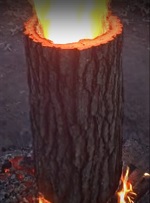
Warming fires generally are less artsy and require less thought. But you can still make the attendees ooohhh and ahh with the simple little things by placing a hollow log in the middle of your fire, and it will act like a chimney drawing flames inward and smoke up through its center, like the image below.

I have done the above on a few occasions. The effect is rather neat and can last for a few hours depending on how dry the wood is; its size will also have a factor. You can vary this and build a fire in the center, but add a few vent/breather holes in the side of the log so your fire gets air. It takes practice, and you probably will never get the same result twice. The above has been referred to as a Swedish fire log. You can use the top as a cooking surface if done correctly.

But the fire is more than just a means for cooking or providing warmth. The spiritual aspect of fire cannot be ignored. Fire is a symbol of transformation and purification. It is believed that burning wood can release trapped energy and emotions, helping to purify oneself and the surrounding environment. Fire is also believed to be a messenger to the gods, allowing one to communicate and ask for guidance or blessings.

The role of the fire keeper is, therefore, not just to tend to the physical fire but also to tend to the spiritual energy that the fire creates. The Firekeeper must be aware of the energy of the space and ensure that it remains clean and pure. They must also be mindful of the attendees’ energy and help facilitate transformation and purification by guiding them through the fire’s energy.

The art of fire keeping involves the physical aspects of tending the fire and the spiritual aspects of working with the fire’s energy. The fire keeper must understand the fire’s intentions and the power it creates and use that to facilitate transformation and healing for themselves and those around them. It truly is an art form that requires attention, focus, and knowledge.

From its origins as a tool for survival to its central role in our spiritual beliefs. Fire keeping requires physical and spiritual preparation, with the knowledge of wood selection, fire implementation, and the awareness of energy and intentions. By embracing the art of fire keeping, we can connect more deeply with our spirituality and harness the transformational power of fire.

As we tend to the flame, we must remember the sacredness of fire and the responsibility that comes with it. We must honor the traditions of our ancestors, who saw fire as a gift from the gods. By understanding the art of fire keeping, we can cultivate a deeper connection with ourselves, others, and the divine. Let us tend to the fire with respect and gratitude; in doing so, may we transform ourselves and our communities for the better.

In conclusion, fire keeping is much more than just tending a flame. It is an art form, a spiritual practice, and a way of connecting with ourselves and the divine. The role of the fire keeper is that of a facilitator, one who guides the attendees through the energy of the fire and helps them to transform and purify. By understanding fire’s physical and spiritual aspects, we can cultivate a deeper connection with our spirituality and create a space of transformation and healing. Let us honor the sacredness of fire and the traditions of our ancestors as we tend to the flame.

StoneHeart

2 years and a bit ago I attended a harvest festival at Stoneheart, located in Coe hill. The hosts were Claudia Valdes and James Ljósviðr Hobson.

Situated on 42 acres of land Stoneheart is beautiful, Pristine forested land. Camping spots are were you can find a cleared area big enough to fit your tent. That is not to say the land has not been tamed to some degree, but it is not a manicured camp ground. And I like that about it.

The road leading in past the house is somewhat rough, from what I can tell it is an access road to get to the lower part of the property that was used to bring firewood out by the previous owner. You can drive down it but you will want a vehicle with decent ground clearance, tires and it is advised to drive slowly. Along the road there a several clearings that are reasonably level for setting up tents. The road slopes downward as you get further into the property and ends near two large clearings on the right hand side is the firepit area, on the left a clearing large enough to put in several tents.

I had the opportunity to fire keep at the event I attended and do some drumming as well with the talented Raven Black and her S/O Shawn Lint. I met Raven at Magik Morn while attending Ancestorfest. I love Ravens music she has that Janis Joplin/Grace Slick kind of sound.

Sadly I have not been able to return for another Harvest festival here due to other commitments, but that has changed so I definitely plan on going back. And I plan to keep better notes as this was pre blogging and I am running off memory to write this.

The Origins of Fire – An Apache Legend

Long, long ago, animals and trees talked with each other, but there was no fire at that time. Fox was the most clever and he thought of a way to create fire for the world.

One day, he decided to vistit the Geese, te-tl, whose cry he wished to learn how to imitate. The promised to teach him if he would fly with them. So they contrived a way to attach wings to fox, but waned him to never open his eys while flying.

When the Geese arose in flight, fox to flew with them so he may practice their cry. On one such adventure, darkness fell suddenly as they flew over the village of the fireflies, ko-na-tcic-a. The glare of the flickering light from the village caused Fox to forget his warning and he opened his eyes – instantly his wings gave out and he fell unable to regain control. He landed within the walls of the village, it so happened a fire constantly burned in its center.

Two fireflies approached fallen Fox, who gave each one a necklace of juniper berries, katl-te-i-tse.

Fox pursuaded the two fireflies to tell him how he could get over the wall to the outside. They led him to a cedar tree, which they explained to him would bend down upon command and catapult him over the wall if he so desired.

That evening, Fox found the spring from which the fireflies drew their water. There also, he discovered coloured Earth, which when mixed with the spring water made paint. He decided to give himself a coat of white. Upon returning to the village, Fox suggested to the fireflies to have a festival where they could dance to music made by himself.

They agreed this would be fine and fun. They gathered wood to build up a great fire. In secret Fox tied a piece of cedar bark to his tail. Afterwards he made a drum, probably the first one ever made. He beat it vigourously with a stick for the dancing fireflies. Gradually as the night progressed he moved closer and closer to the fire.

Fox pretended to tire from playing the drum. He gave it to some fireflies who wanted to help make music. At that moment he quickly thrust his tail into the fire, Lighting the bark, and exclaimed, “it is too warm here for me, I must find a cooler place.”

Fox ran straight to the cedar tree, calling, “Bend down to me, my cedar tree, bend down!”

Down bent the cedar, then up it carried him launching him far over the wall. On and on he ran, the fireflies in pursuit.

As he ran brush and wood on either side of him were ignited by the embers dropping from the bark tied to his tail.

After a great distance Fox tired and gave the burning bark to Hawk, i-tsari-tsu-i, who carried it to brown crane, tsi-nes-tso-l. He flew far southward, sparks flying everywhere. This is how fire spread across the Earth.

Fireflies still pursued Fox. They followed him all the way back to his burrow and declared, “For ever after, Wily-Fox, your punishment for stealing our fire will be that you can never make uses of it yourself.”

For the Apache nation, this too was the beginning of fire for them. Soon they learned to use it for cooking and for keeping themselves warm in cold weather.