The Root-and-Road Compass: Ogham, Runes, and the Storm Wayfinder

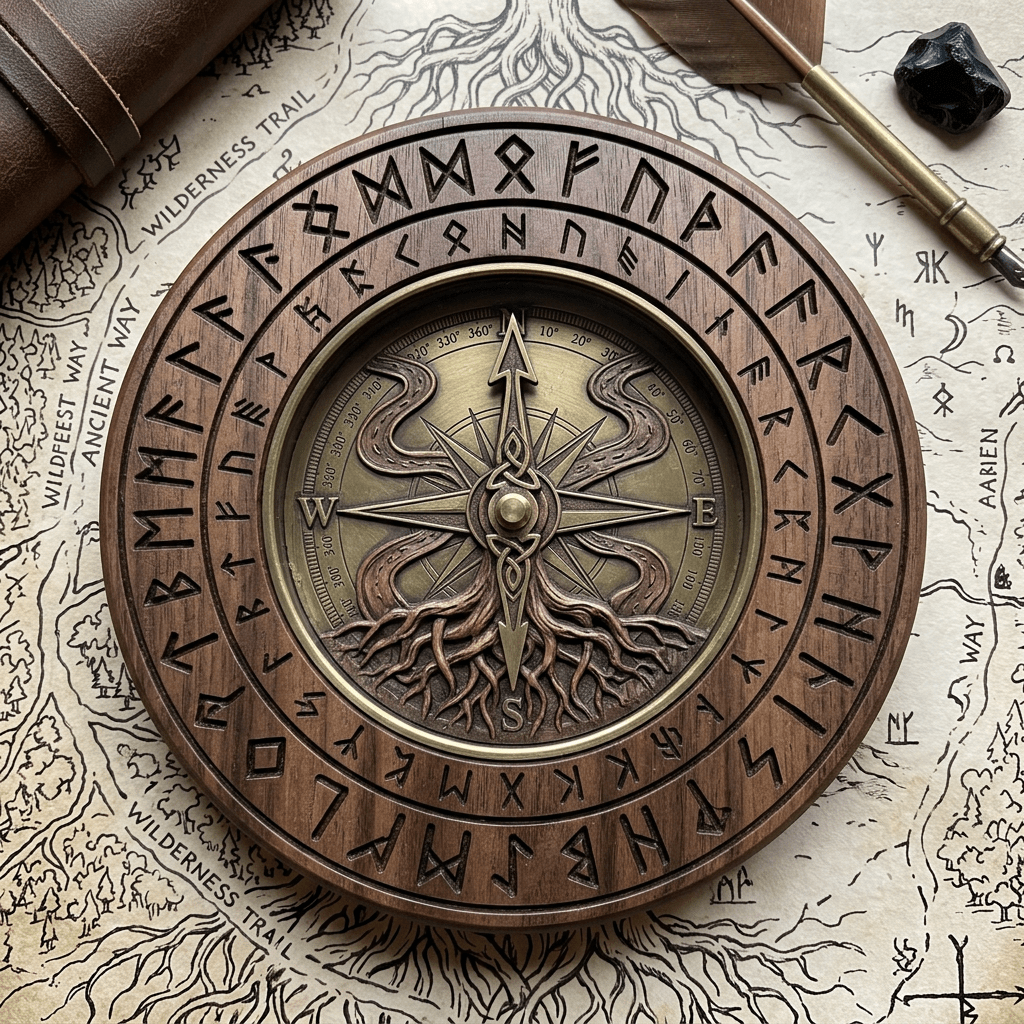
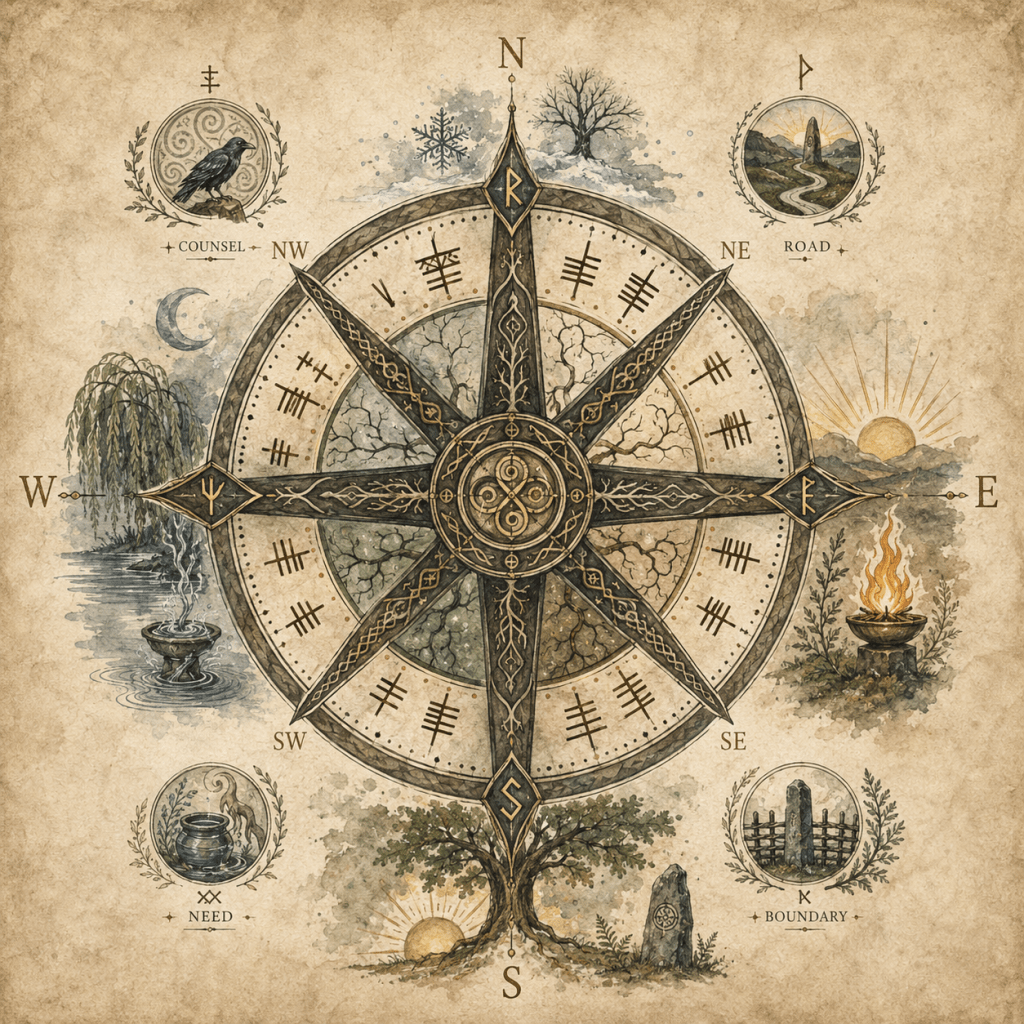
Viking-style compass with runes and tree design on ancient map

I have been sitting with the idea of the so-called Norse compass again. Not as a museum piece. Not as something I can honestly claim came straight out of the Viking Age. That part matters.

The symbol most people call the Norse compass is usually the Vegvísir, an Icelandic magical stave associated with finding one’s way through rough weather. It is powerful imagery, but it is not ancient Viking proof. It is a later symbol. That does not make it useless. It just means we should stop pretending it is something it is not.

And that is where this thought gets interesting.

What happens if we stop trying to prove ownership over the symbol and instead ask what it can become when placed beside older systems of marking, naming, and remembering?

What happens when Ogham meets Elder Futhark?

North ᛁ Isa / Ailm Stillness ᚨ Ansuz / Coll Counsel East ᚲ Kenaz / Beith Kindling ᚱ Raidho / Ash Road South ᛋ Sowilo / Oak Standing ᚾ Nauthiz / Alder Need West ᛚ Laguz / Willow Memory ᛇ Eihwaz / Yew Boundary Root and Road
A modern symbolic compass: Ogham as root, rune as road, storm-stave as wayfinding.

First, the honest line

This is not me claiming that the Celts and Norse sat down together and designed a secret compass. That would be a nice story, but nice stories are not the same thing as true stories.

What we are doing here is different.

We are building a modern pagan symbol honestly, using old materials without lying about them.

Ogham gives us the stemline. A central line. Marks crossing it. Names cut into edges. Boundary stones. Memory made physical. A way of saying: this person stood here, this name mattered, this place had meaning.

Elder Futhark gives us the roadline. Sound carved into wood, bone, stone, and metal. A row of forces. Wealth, need, ice, sun, journey, gift, day, inheritance. Not just letters, but a way of seeing pressure and movement.

The compass shape gives us the stormline. Not north on a map, necessarily, but the harder question: how do I keep from becoming lost when the weather turns?

Put those three together and we do not get an ancient artifact.

We get a modern wayfinder.

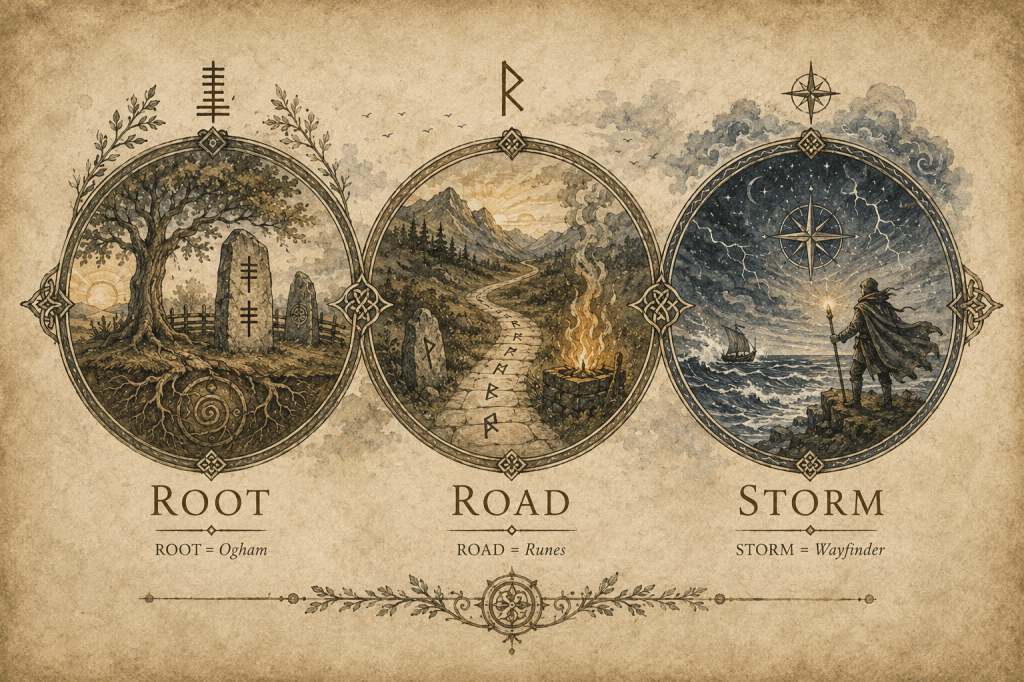
The three layers

Root Ogham memory / land / edge Road Runes force / speech / motion Storm Wayfinder weather / trial / return
The working idea: Ogham roots the symbol, Elder Futhark moves it, and the compass form tests it against weather.

That is the core of it for me.

Ogham is not just pretty scratch marks. It feels like root. It feels like the edge of a stone, the edge of a path, the edge between one holding and another. It is a language of boundary and memory.

Elder Futhark feels different. It moves. It bites. It carries conflict, need, gift, fire, ice, harvest, sun, and inheritance. The runes feel less like a fencepost and more like a road marker.

And then the compass shape asks the question that every spiritual system eventually has to answer:

Can this still guide me when things go bad?

The eight directions

North becomes stillness. Ice. Spine. Endurance. The place where the world is not moving, and neither are you, but you are still alive.

East becomes kindling. The first light. Birch. Fire beginning again. Not a roaring bonfire. Just the first honest spark.

South becomes standing. Oak. Sun. The place where private belief becomes public action.

West becomes water. Willow. Memory. Grief. The place where the day lowers and the old voices start speaking again.

The cross-directions matter too.

Northeast is counsel. Breath. Speech. The wisdom that arrives before action.

Southeast is the road. Movement. Duty. The decision to walk instead of only think.

Southwest is need. Friction. Survival. The hard place where spirituality stops being decorative and has to become useful.

Northwest is boundary. Yew. Ancestor. Death and transformation. The place where you admit that returning does not always mean becoming who you were before.

Not a map home

This is the part I keep coming back to.

A compass is often treated as a tool for getting home. But spiritually, that is too simple.

Sometimes home is gone.

Sometimes home changed while you were away.

Sometimes home was never as safe as memory made it.

And sometimes the point is not to get back at all.

Sometimes the point is to leave without becoming rootless.

That is where this Root-and-Road Compass starts to matter.

Ogham says: remember where the roots were.

The runes say: now move.

The storm-stave says: and do not lose yourself in the weather.

The Unplugged Pagan reading

For Unplugged Pagan, this symbol works because it refuses two easy lies.

The first lie is that everything old is automatically pure.

It is not.

The second lie is that anything modern is automatically empty.

It is not.

A symbol can be modern and still be meaningful. A ritual can be reconstructed and still be honest. A path can be personal without being fake.

The problem is not modern creation. The problem is dishonest creation.

So I would not call this an ancient Celtic-Norse compass.

I would call it what it is:

A modern pagan wayfinder built from root, road, and storm.

It does not tell me where north is.

It asks me what I am using as north.

Blood?

Land?

Memory?

Grief?

Duty?

Fire?

Need?

The answer may change depending on the weather.

And maybe that is the point.

The working declaration

If I were to put the whole symbol into words, it would be this:

I am guided by root and road.
I remember where I come from, but I am not chained to it.
I walk through storm, need, grief, fire, winter, and return.
I do not navigate by blood alone, or place alone, or institution alone.
I navigate by memory, action, boundary, and becoming.

That feels right to me.

Not because it is ancient.

Because it is honest.

And honestly, that may be the better foundation anyway.
The Hermit’s Cabin

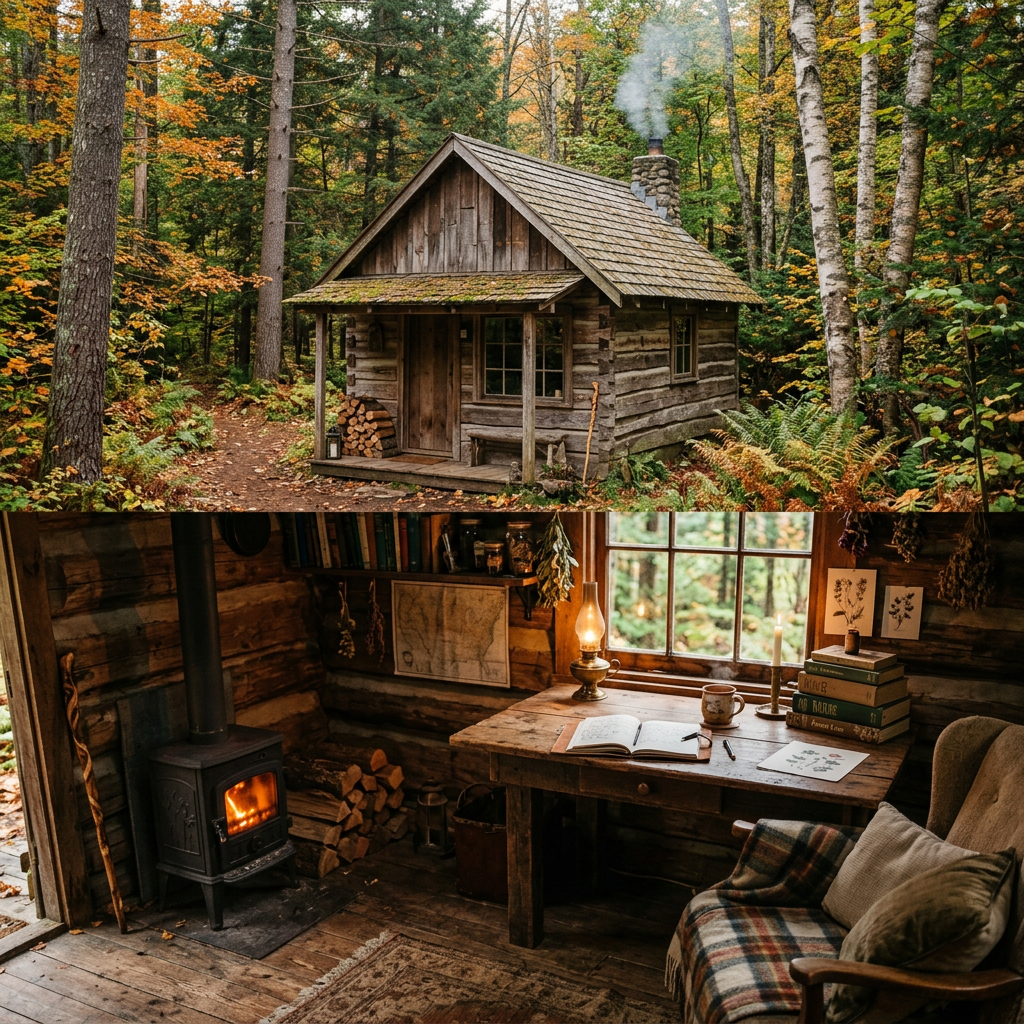
Small wooden cabin in forest with wood stove and cozy interior

Years ago, I wrote a short reflection about the perfect space for reading and writing.

At the time, it was mostly an image.

A cabin.

A quiet room.

Books close at hand.

A place to sit, read, think, write, and be left alone long enough for the mind to settle.

I said then that I might come back to it someday and add more.

Well, here we are.

And I think I understand the need better now.

Because the older I get, the less that cabin feels like fantasy.

It feels like a spiritual requirement.

Not Escape. Refuge.

There is a difference between running away and seeking refuge.

Running away is avoidance.

Refuge is recovery.

Running away says, “I do not want to face the world.”

Refuge says, “I need a place where the world cannot keep eating me alive.”

That is what the hermit’s cabin represents to me now.

Not some romantic disappearance from responsibility.

Not a dramatic exit from society.

Not a fantasy where bills, work, grief, family, health, memory, and obligation magically vanish at the tree line.

No.

The cabin is the place where a person can hear themselves again.

And in a noisy world, that is no small thing.

The Shape of the Room

I can see it clearly.

Not large.

It does not need to be large.

A small cabin tucked somewhere quiet. Trees close enough to feel like company, but not so close that the sky disappears. A little porch. A place for boots by the door. Maybe a woodpile stacked neatly along one side, because even dreams should come with chores.

Inside, there is a stove.

Not just for heat, though heat matters.

A stove changes the entire spirit of a room.

It gives the room a center.

It gives the cold somewhere to go.

It reminds you that comfort is not automatic. It is tended. It is fed. It is earned one split log at a time.

There would be a chair near the stove.

A real chair.

Not some decorative thing that looks good in a picture but punishes your back after twenty minutes.

A chair meant for long reading, long thinking, and the strange half-silence that comes when you stare into flame and realize your mind has finally stopped sprinting.

There would be a desk by a window.

That matters.

A desk should face something alive.

Trees. Field. Snow. Rain. Birds. Wind moving through branches. The ordinary world doing ancient things without needing applause.

That kind of view reminds a writer to stop being clever and start being honest.

Books as Companions

There would be books, of course.

Not endless shelves for performance.

Not a wall of books meant to impress visitors who were never invited in the first place.

Useful books.

Old favourites.

Myth and folklore.

Poetry.

History.

Psychology.

Sociology.

Pagan practice.

Field guides.

A few heavy books that demand a pencil in hand.

A few worn books that ask nothing from me except return.

Books are not just information.

They are company.

They are elders, tricksters, witnesses, argument partners, mirrors, maps, and occasionally good solid bricks for the rebuilding of a life.

In the hermit’s cabin, books would not be decoration.

They would be part of the hearth.

The Altar and the Workbench

There would be an altar, but not an overly polished one.

I have never been drawn to spiritual spaces that look too staged.

Give me something lived in.

A candle.

A bowl.

A stone picked up on a hard day.

A feather found by chance.

A small image or symbol for Brigid.

Something cold and clean for Skadi.

A branch, nut, or small token for Ratatoskr.

A piece of fir, or a cone, or even just the scent of evergreen in the room.

There would be incense sometimes.

There would be cards on the table.

There would be silence.

But the altar would not sit apart from the practical work of the room.

That matters to me.

The sacred does not need to be quarantined.

The altar and the workbench belong in conversation.

The candle and the notebook.

The prayer and the plan.

The old story and the next paragraph.

The ritual and the grocery list.

That is real life.

That is where practice lives.

A Room of One’s Own

Virginia Woolf wrote about the need for a room of one’s own, and I understand that more with every passing year.

A person needs space.

Not just square footage.

Not just storage.

Not just somewhere to sleep before work starts again.

Space.

Actual interior permission.

A door that closes.

A table that does not have to be cleared for someone else’s emergency.

A silence that is not immediately filled by demand.

A place where the mind can unfold without being interrupted halfway through the sentence.

For some people, that room is a studio.

For some, it is a garage.

For some, a garden shed, a basement corner, a spare bedroom, a library table, a parked car, a trail, a church pew, or a kitchen before sunrise.

For me, the image has always been the cabin.

The hermit’s cabin.

The place at the edge of things.

Close enough to the world to return.

Far enough away to remember who is returning.

The Hermit Is Not Empty

People sometimes misunderstand the Hermit.

They see isolation and think loneliness.

They see withdrawal and think failure.

They see solitude and think something has gone wrong.

But the Hermit is not empty.

The Hermit carries a lantern.

That part matters.

Solitude, at its best, is not the absence of life.

It is the tending of light.

The cabin is not where I would go to become less human.

It is where I would go to become more honest.

To read without rushing.

To write without performing.

To pray without explaining.

To sit with the gods, the ancestors, the old stories, the hard lessons, and the quiet stubborn flame that has somehow stayed alive through all of it.

Off-Grid, But Not Unrooted

There is also something appealing about the off-grid part of the dream.

Not because technology is evil.

I am not that naïve.

I use technology constantly. I write with it. I learn with it. I communicate through it. I build with it.

But there is a difference between using a tool and being swallowed by a system.

The cabin dream has less to do with rejecting the modern world and more to do with remembering that life does not have to be plugged into noise at every moment.

Wood heat.

Water carried or carefully stored.

Lantern light.

Simple food.

Books.

Paper.

Weather.

A rhythm that does not depend on a screen telling me what to care about next.

That is not poverty of life.

That is richness of attention.

The Sacred Need for Quiet

I think quiet has become one of the most underrated spiritual needs.

Not silence as punishment.

Not silence as abandonment.

Not the cold silence of being ignored.

I mean chosen quiet.

Restorative quiet.

The kind of quiet where thoughts stop shouting and start lining up.

The kind of quiet where grief can speak without being rushed.

The kind of quiet where a card reading has room to breathe.

The kind of quiet where a sentence arrives whole.

The kind of quiet where the gods do not need to compete with notifications.

That is the quiet I imagine in the hermit’s cabin.

Not dead silence.

Living quiet.

Stove ticking.

Wind outside.

Birds in the morning.

Rain on the roof.

Pen on paper.

Breath returning to its proper depth.

The Cabin I Can Build Now

Of course, I do not currently live in that perfect cabin.

Most of us do not live inside the image our soul keeps handing us.

But that does not make the image useless.

A vision can still teach.

The question is not only, “Can I build the cabin tomorrow?”

The question is, “What part of the cabin can I build now?”

A better reading chair.

A cleaner desk.

A candle before writing.

A shelf that holds the books I actually return to.

A morning ritual that does not begin with the phone.

A small altar that feels lived in, not staged.

A few minutes of fire, even if the fire is only a candle.

A little less noise.

A little more room.

A little more honesty.

Maybe that is how the hermit’s cabin begins.

Not with land, lumber, and a perfect life.

But with one protected corner.

One honest chair.

One flame.

One book.

One page.

The Place I Keep Returning To

So yes, I still think about that perfect space for reading and writing.

But I understand it differently now.

It is not just about comfort.

It is about attention.

It is about spiritual maintenance.

It is about the kind of solitude that does not make a person disappear, but helps them return with something worth carrying.

The hermit’s cabin is the place in my mind where the page, the hearth, the altar, and the self all meet without apology.

It is where Brigid gets her flame.

Where Skadi can stand outside in the cold without being feared.

Where Ratatoskr can chatter in the branches without taking over the whole room.

Where the Fir remains green at the edge of the clearing.

And where I sit, finally quiet enough to read, write, listen, and remember that a life does not have to be loud to be sacred.

Godspeed.