A Peaceful Four-Card Cancer Reading for an Overslept Morning

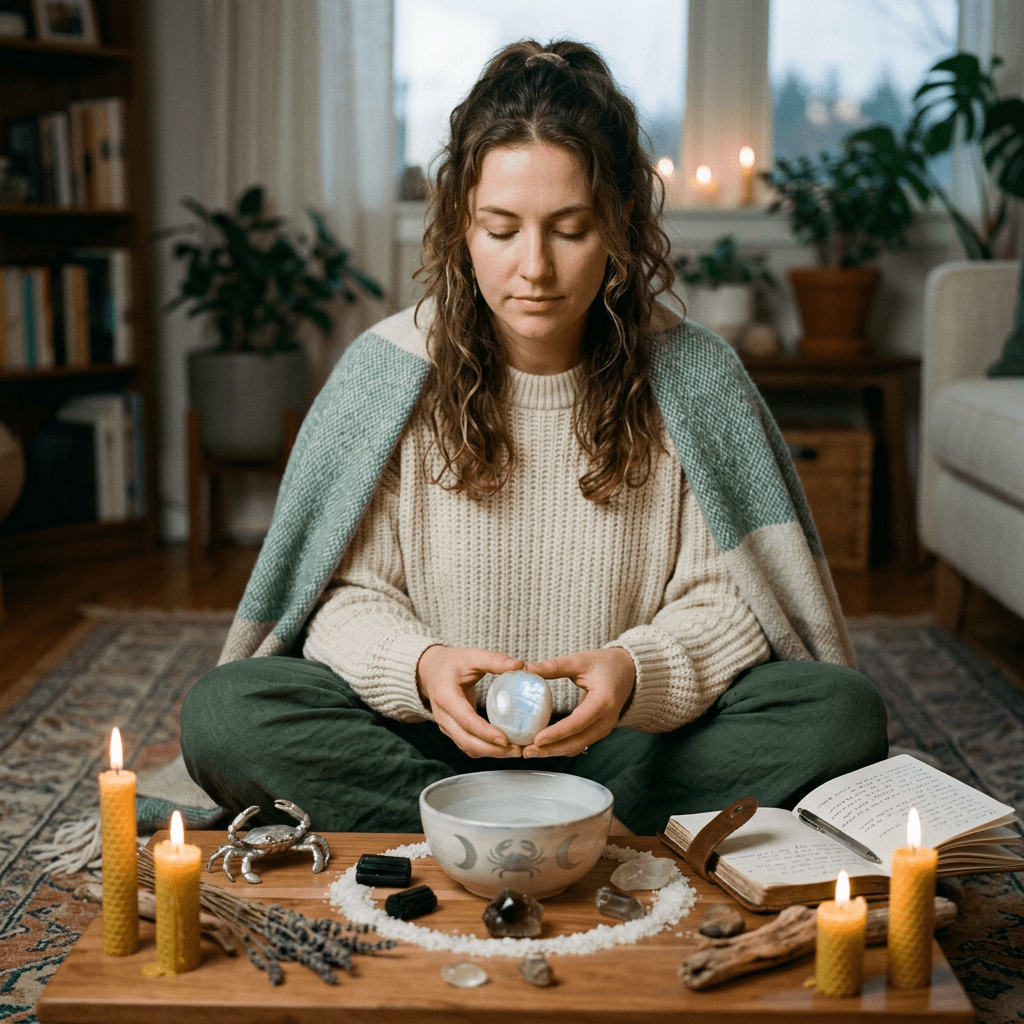
Woman sitting cross-legged meditating with crystals, candles, and a journal on a wooden table

Some mornings do not begin with candles, cards, incense, and a quiet table. Some mornings begin with waking too late, feeling slightly thrown off, and realizing the ritual will have to come another way.

That does not make the reading less meaningful.

Today, for Cancer, the message feels gentle but clear: communication matters, but not every conversation deserves your energy. Support may be available, but your peace still needs boundaries. This is a day for returning to the body, softening the mind, and choosing the next right step without turning the whole morning into a failure.

So we let the cards speak quietly.

The Spread

Deck: Rider-Waite Tarot
Spread: Past, Present, Future, Query Card
Tone: Peaceful, grounded, restorative

Past — The Lovers, Upright

The Lovers is not only a romance card. At its deeper level, it speaks of alignment, choice, values, and the moment when the heart has to admit what it truly recognizes.

In the past position, this card suggests a season of crossroads. Not one single dramatic choice, perhaps, but a long series of smaller ones: what to keep, what to release, what deserves your energy, and what only drains the well.

Brigid stands beside this card as the keeper of the hearth flame. She reminds us that some choices must be made in service of the inner fire. Not every path feeds the soul. Not every obligation is sacred. Not every old pattern deserves another season.

Choose what keeps the flame alive.

Present — Page of Cups, Reversed

This card fits an overslept morning beautifully.

The Page of Cups reversed can point to emotional tiredness, sensitivity, dreaminess, or a message from the body that says: not so fast today.

This is not failure. This is a softer signal.

You may not have been able to physically sit with the cards today, but the desire for the reading still matters. The ritual was not abandoned. It simply changed shape.

Skaði stands here in the cold clear air. She does not panic because the trail starts later than planned. She checks the footing. She adjusts the cloak. She waits for the body to be ready.

Delay is not defeat. Rest is not weakness. The mountain is still there when you rise.

Future — Nine of Pentacles, Upright

The Nine of Pentacles is a beautiful future card. It speaks of quiet independence, dignity, self-respect, and the reward of steady work.

This is not a card of rescue. It is not fireworks. It is not chaos dressed up as progress.

It is the garden after tending. The breath after pressure. The small proof that you are capable of building something stable, even if the morning began unevenly.

The fir tree belongs here. Evergreen. Patient. Rooted. It does not perform its resilience for applause. It simply remains alive through season after season.

Root first. Reach later.

Query Card — Seven of Swords, Reversed

The query card asks the question beneath the reading:

Where can I stop carrying something alone, hiding something from myself, or overthinking my way around a simple truth?

The Seven of Swords reversed does not feel harsh today. It feels like release. It says: put down the clever escape route. Stop turning every feeling into a courtroom. Tell yourself the truth gently.

Some conversations may need to wait. Some do not need to happen at all. But inner honesty still matters.

Ratatoskr appears here as the messenger moving between worlds: from dream to waking, from thought to action, from the upper branches to the roots below. The message does not need to be loud to be real.

Carry the message, but do not carry the whole tree.

The Vættir and the Ground Beneath You

The vættir, the spirits of place and land, bring this reading back into the physical world.

Open the window. Drink the water. Step outside for one minute if you can. Touch the real day. Let the body know it has arrived.

Spiritual work does not always require ceremony. Sometimes it requires returning to the floor beneath your feet and remembering that you are still here.

Today’s Peaceful Message

Today is not a day to force the river.

You overslept because the body asked for more time in the dark. Let that be part of the reading, not an interruption of it.

Brigid keeps the small flame lit.

Skaði reminds you that late starts are still starts.

Ratatoskr carries the quiet message between worlds.

The fir tree teaches patience and endurance.

The vættir bring you back to the land, the room, the body, the breath.

The Card Message

Choose what is aligned.
Be gentle with the tired heart.
Build the quiet life.
Tell yourself the truth without turning it into a battle.

That is enough for today.

Godspeed.

Rain in the Valley, Death on the Table

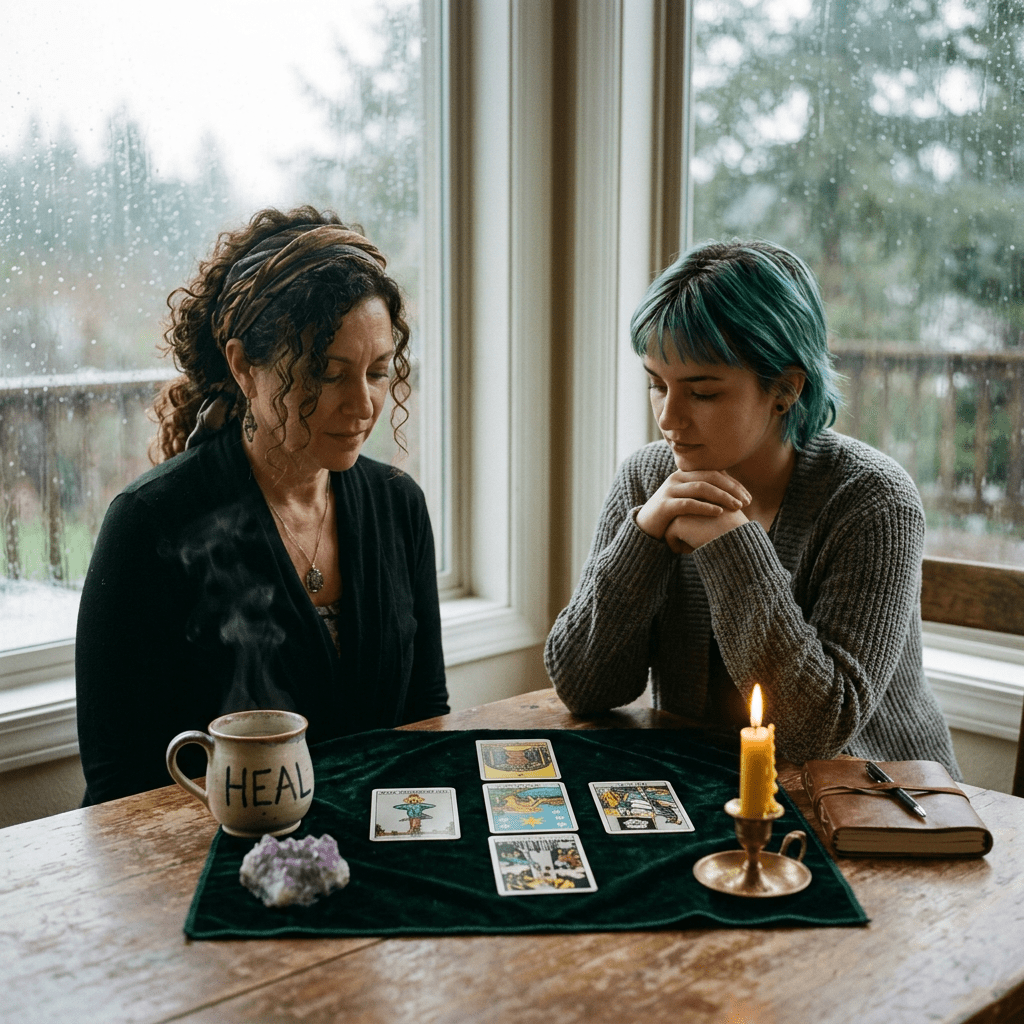
Two women sitting at a wooden table with tarot cards, candle, and healing mug

Good morning, Unplugged Pagans.

It is a rainy day here in the valley. Not a hard winter rain, not exactly cold enough to be cruel, but cold enough to remind you that spring does not arrive all at once. The air is still warmish for this time of year, but the rain has that edge to it. That little bite. That little reminder that the turning of the wheel is never as clean as we would like it to be.

So today, we light the candles. We light the incense. We ask Brigid, Skadi, Ratatoskr, and the fir tree to join us at the table.

Brigid for the flame and the craft. Skadi for the cold places we survive. Ratatoskr for the messages running up and down the tree. And the fir tree for endurance, memory, and the quiet strength of staying green when the rest of the world goes bare.

There is not much new or exciting happening today, and maybe that is part of the message too. Not every reading arrives with thunder. Some arrive with rain tapping on the window and a cup of something warm nearby.

We are still waiting for the next course to begin on May 12th. A couple more weeks to go. Hopefully the books arrive before the course starts. That would be nice. We shall see. We shall see.

For today’s Rider-Waite reading, the cards are these:

Past: Six of Pentacles reversed
Present: Death
Future: Knight of Swords reversed
Self: Three of Swords reversed

Now, a lot of people see the Death card and immediately think bad omen. They see the skeleton, the flag, the horse, the fallen king, and they think something terrible is coming.

But Death is rarely that simple.

To me, Death is not usually about doom. It is about the end of one form and the beginning of another. The death of an old way of thinking. The death of an old pattern. The death of a version of yourself that could only survive under certain conditions, but cannot carry you forward anymore.

And when Death shows up in the present position, it asks a very direct question:

What is ending right now, whether you are ready to admit it or not?

The Six of Pentacles reversed in the past suggests an imbalance. Giving too much. Receiving too little. Being caught in systems where generosity, obligation, guilt, help, and dependence all became tangled together. Maybe someone gave with strings attached. Maybe you gave until there was not much left of you. Maybe the scales were never as fair as they looked from the outside.

That is the ground this reading grows out of: uneven exchange.

Then comes Death.

Not punishment. Not disaster. Transformation.

Something about the old arrangement cannot continue. Something about the old way of showing up, giving, explaining, defending, or carrying other people’s emotional weather has reached its limit.

And then, in the future, we have the Knight of Swords reversed.

That is a warning against rushing in. Against charging forward with words sharpened like blades. Against trying to explain everything too quickly, fix everything too fast, or respond before the spirit has had time to breathe.

The Knight of Swords reversed says: slow your tongue, slow your thoughts, slow the reaction.

Not every awkward moment needs a speech. Not every uncomfortable encounter needs a grand response. Not every emotional confession, strange conversation, or sudden pressure requires you to leap out of your own skin to manage it.

And that ties directly into today’s Cancer horoscope.

Today’s message for Cancer speaks of an awkward encounter. Someone may overshare, confess something unexpected, or put you in a position where you feel suddenly exposed. The horoscope reminds the Moonchild that being uncomfortable does not mean being trapped. You are not truly “on the spot.” You do not have to retreat into your shell just because someone else has placed something awkward in front of you.

That lands hard with this reading.

The Three of Swords reversed represents the self today. This is not the heart freshly stabbed. This is the heart after the worst of the bleeding. The wound is still there, yes, but it is not the whole story anymore.

Three of Swords reversed is the card of healing after heartbreak. Not perfect healing. Not cinematic healing. Real healing. The kind where you still flinch sometimes, but you no longer build your whole house around the wound.

So the reading today feels like this:

You have come from imbalance. You are standing in transformation. You are being warned not to rush your response. And underneath it all, your heart is healing.

That is not a bad omen.

That is a threshold.

Maybe today’s rain is part of that. The valley gets washed down. The old dust settles. The ground softens. Seeds buried weeks ago begin to remember what they came here to do.

Death on the table does not mean the end of the road.

It means the old road may no longer be yours.

And if something awkward comes today, if someone says too much, asks too much, reveals too much, or makes you feel like you need to crawl back into your shell, pause first.

You do not have to hide.

You do not have to attack.

You do not have to solve the whole thing in one breath.

You can simply stand there, candle lit, rain falling, heart mending, and say:

I hear you. I need a moment. I will respond when I am ready.

That may be the real magic today.

Not prophecy. Not drama. Not fear.

Just the quiet discipline of not becoming the old version of yourself when the old pattern knocks at the door.

Godspeed, my fellow pagans.

The Earth Will Survive Us

Silhouette of a person dissolving into glowing particles with a sunset mountain landscape
CAUTION THIS POST MAY OFFEND SOME

There is something deeply uncomfortable about admitting that humanity is temporary.

Not metaphorically temporary.

Not politically temporary.

Not “we need to change our ways or things will get difficult” temporary.

I mean temporary in the older, colder, truer sense.

One day, human beings will be gone.

Maybe by our own hand. Maybe by disease. Maybe by climate, war, asteroid, famine, mutation, time, or some force we do not yet have a name for. Maybe not for thousands of years. Maybe not for millions.

But eventually?

Yes.

Eventually, we pass too.

Reader’s Moment

If that thought unsettles you, good.

It should.

Not because it is hopeless, but because it cuts through one of the deepest illusions modern humanity carries: the belief that we are permanent.

We build as if we are permanent.

We consume as if we are permanent.

We make plans as if history bends toward us forever.

Even our environmental language often carries the same arrogance.

We say we are going to save the Earth.

But are we?

Or are we trying to save the conditions that make human life comfortable, possible, and familiar?

That is not the same thing.

The Earth Is Not the Fragile One

The Earth has endured fire, ice, extinction, impact, flood, volcanic winters, shifting continents, poisoned atmospheres, and oceans that rose and fell long before anything resembling a human being stood upright and gave itself a name.

She has buried worlds before us.

She will bury ours too.

That is not cruelty.

That is time.

The Earth is not a glass ornament sitting on the edge of a shelf, waiting for humanity to catch it before it falls.

She is older than our prayers.

Older than our gods.

Older than our languages.

Older than our grief.

And if humanity vanished tomorrow, the wind would still move.

The rain would still fall.

The roots would still search downward.

The fungi would continue their quiet work.

Something would crawl, bloom, rot, adapt, and begin again.

Life may change shape, but the Earth does not require our permission to continue.

That Is the Revelation People Fear

I do not think people are only afraid of environmental collapse.

I think they are afraid of insignificance.

They are afraid of realizing that humanity may not be the main character of creation.

They are afraid of looking at the long story of this planet and seeing that we are recent.

A brief flame.

A loud animal.

A clever ape with tools, myths, machines, and a dangerous belief in its own importance.

That does not mean we are meaningless.

It means we are not eternal.

There is a difference.

The Problem With “Saving the Earth”

This is where I become cautious with some modern environmental thinking.

Not because I believe pollution is fine.

Not because I think forests should be stripped, rivers poisoned, animals erased, or every living thing turned into profit.

I do not believe that.

But I also do not believe every action taken under the banner of “saving the Earth” is automatically wise, balanced, or sacred.

Human beings have a bad habit of panicking in one direction after causing damage in another.

We create a problem through arrogance, then try to fix it with more arrogance.

We strip-mine in the name of green progress.

We industrialize our solutions.

We replace one form of extraction with another.

We call it sustainability because the slogan sounds cleaner than the machinery behind it.

That is not reverence.

That is rebranding.

A Pagan View of Extinction

From a pagan perspective, extinction is not unnatural.

That may be hard to hear.

But nature is not a museum.

Nature does not freeze every species in place because we find them beautiful, useful, symbolic, or emotionally comforting.

Things arise.

Things flourish.

Things decline.

Things vanish.

The leaf falls.

The body returns.

The bone becomes soil.

The old forest burns and something else grows where it stood.

This is not a failure of the sacred order.

This is the sacred order.

The mistake is believing humanity somehow stands outside that cycle.

We do not.

Humility, Not Hopelessness

Now, this does not mean we shrug and say, “Nothing matters.”

That is not wisdom.

That is laziness wearing a dark cloak.

The fact that humanity is temporary does not excuse carelessness.

A flower is temporary too.

So is a deer.

So is a fire.

So is a human life.

And yet we still tend the garden, feed the animals, honour the hearth, bury our dead, protect our children, and try not to poison the well we drink from.

Temporary things still matter.

Maybe they matter because they are temporary.

But we need to be honest about what we are protecting.

We are not saving the Earth.

We are trying to preserve a livable place for ourselves, our children, and the other beings currently sharing this age with us.

That is a worthy goal.

But it is not the same as pretending the planet cannot go on without us.

The Earth Does Not Need Our Ego

The Earth does not need our saviour complex.

She does not need our panic dressed up as virtue.

She does not need us to pretend every new technology is automatically salvation because someone placed a green label on it.

She does not need another priesthood of experts, corporations, politicians, and marketers telling ordinary people that salvation can be purchased in a newer, cleaner package.

What she may require from us, while we are here, is much simpler and much harder.

Restraint.

Humility.

Reverence.

Honesty.

The ability to say, “This helps us, but it still costs something.”

The ability to say, “This solution may not be as clean as we were told.”

The ability to say, “We are not gods. We are participants.”

The Old Lesson

The old ways never promised that human beings would last forever.

The old stories are full of endings.

Worlds burn.

Gods fall.

Winters come.

Kingdoms rot.

Heroes die.

Even the mighty are eventually taken back into the great turning.

That is not nihilism.

That is perspective.

To walk a pagan path is not to pretend nature is soft.

It is to know that nature is beautiful, brutal, generous, indifferent, intimate, and vast.

It feeds the lamb and the wolf.

It grows the healing herb and the poison berry.

It gives the harvest and the killing frost.

It gives birth, and it takes back.

Always.

So What Do We Do?

We live well while we are here.

We stop pretending our comfort is the centre of the universe.

We stop calling every human fear a planetary emergency.

We stop using “saving the Earth” as a way to avoid saying, “We are afraid of our own ending.”

We plant trees anyway.

We protect water anyway.

We waste less anyway.

We question easy answers anyway.

We resist greed anyway.

We honour the land anyway.

Not because we are immortal.

Not because we are saviours.

Not because the Earth will collapse into nothing without us.

But because relationship matters while it exists.

Because the hearth matters even though the fire eventually burns down.

Because the song matters even though the singer dies.

Because the path matters even though no one walks it forever.

The Hard Comfort

Humanity will pass.

That is not a curse.

That is the same law that governs leaf, bone, star, empire, forest, and flesh.

The Earth will survive us.

Perhaps changed by us.

Perhaps scarred by us.

Perhaps relieved of us.

But she will continue in some form, because continuation is what she has always done.

The question is not whether we can make ourselves eternal.

We cannot.

The question is whether, while we are here, we can become humble enough to live as kin instead of conquerors.

That may be the real spiritual work.

Not saving the Earth.

Saving ourselves from the illusion that we were ever outside her reach.

Godspeed, fellow walkers of the old paths.

The Hermit’s Cabin

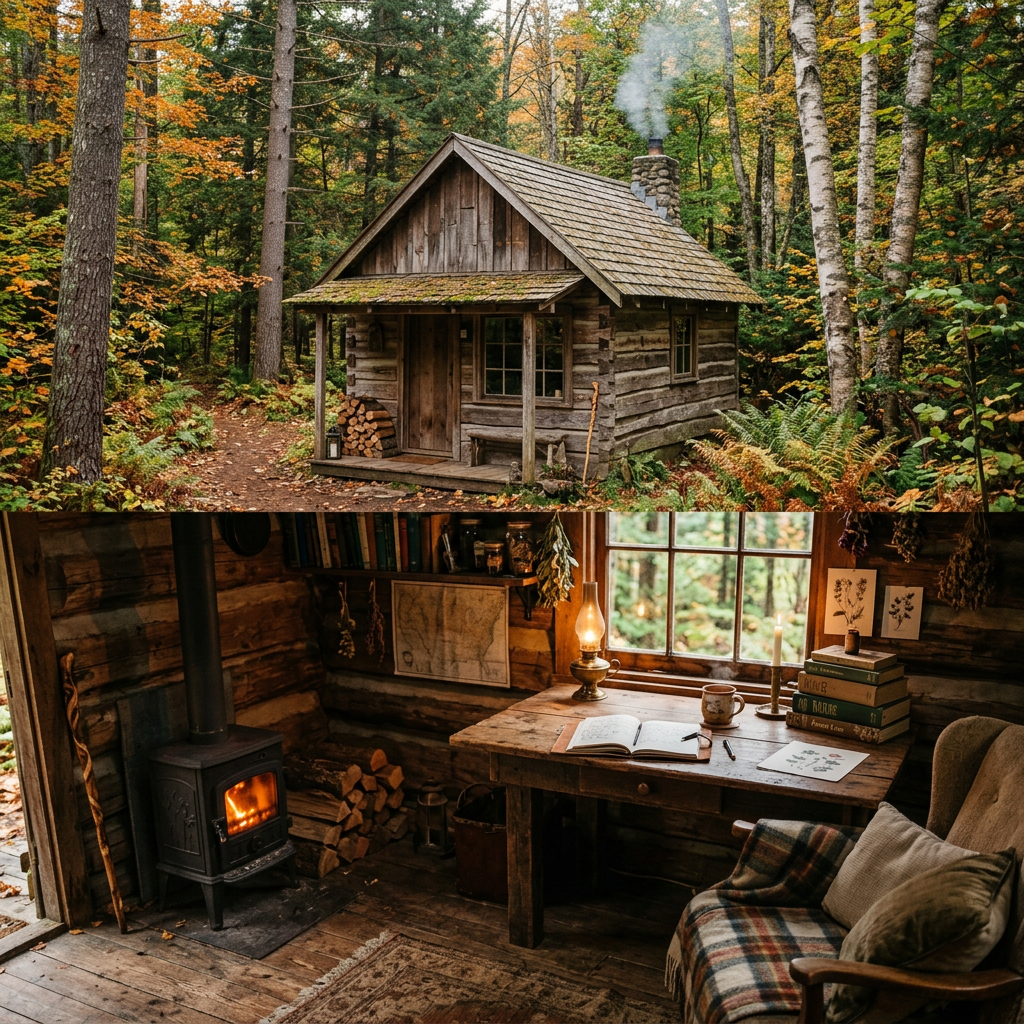
Small wooden cabin in forest with wood stove and cozy interior

Years ago, I wrote a short reflection about the perfect space for reading and writing.

At the time, it was mostly an image.

A cabin.

A quiet room.

Books close at hand.

A place to sit, read, think, write, and be left alone long enough for the mind to settle.

I said then that I might come back to it someday and add more.

Well, here we are.

And I think I understand the need better now.

Because the older I get, the less that cabin feels like fantasy.

It feels like a spiritual requirement.

Not Escape. Refuge.

There is a difference between running away and seeking refuge.

Running away is avoidance.

Refuge is recovery.

Running away says, “I do not want to face the world.”

Refuge says, “I need a place where the world cannot keep eating me alive.”

That is what the hermit’s cabin represents to me now.

Not some romantic disappearance from responsibility.

Not a dramatic exit from society.

Not a fantasy where bills, work, grief, family, health, memory, and obligation magically vanish at the tree line.

No.

The cabin is the place where a person can hear themselves again.

And in a noisy world, that is no small thing.

The Shape of the Room

I can see it clearly.

Not large.

It does not need to be large.

A small cabin tucked somewhere quiet. Trees close enough to feel like company, but not so close that the sky disappears. A little porch. A place for boots by the door. Maybe a woodpile stacked neatly along one side, because even dreams should come with chores.

Inside, there is a stove.

Not just for heat, though heat matters.

A stove changes the entire spirit of a room.

It gives the room a center.

It gives the cold somewhere to go.

It reminds you that comfort is not automatic. It is tended. It is fed. It is earned one split log at a time.

There would be a chair near the stove.

A real chair.

Not some decorative thing that looks good in a picture but punishes your back after twenty minutes.

A chair meant for long reading, long thinking, and the strange half-silence that comes when you stare into flame and realize your mind has finally stopped sprinting.

There would be a desk by a window.

That matters.

A desk should face something alive.

Trees. Field. Snow. Rain. Birds. Wind moving through branches. The ordinary world doing ancient things without needing applause.

That kind of view reminds a writer to stop being clever and start being honest.

Books as Companions

There would be books, of course.

Not endless shelves for performance.

Not a wall of books meant to impress visitors who were never invited in the first place.

Useful books.

Old favourites.

Myth and folklore.

Poetry.

History.

Psychology.

Sociology.

Pagan practice.

Field guides.

A few heavy books that demand a pencil in hand.

A few worn books that ask nothing from me except return.

Books are not just information.

They are company.

They are elders, tricksters, witnesses, argument partners, mirrors, maps, and occasionally good solid bricks for the rebuilding of a life.

In the hermit’s cabin, books would not be decoration.

They would be part of the hearth.

The Altar and the Workbench

There would be an altar, but not an overly polished one.

I have never been drawn to spiritual spaces that look too staged.

Give me something lived in.

A candle.

A bowl.

A stone picked up on a hard day.

A feather found by chance.

A small image or symbol for Brigid.

Something cold and clean for Skadi.

A branch, nut, or small token for Ratatoskr.

A piece of fir, or a cone, or even just the scent of evergreen in the room.

There would be incense sometimes.

There would be cards on the table.

There would be silence.

But the altar would not sit apart from the practical work of the room.

That matters to me.

The sacred does not need to be quarantined.

The altar and the workbench belong in conversation.

The candle and the notebook.

The prayer and the plan.

The old story and the next paragraph.

The ritual and the grocery list.

That is real life.

That is where practice lives.

A Room of One’s Own

Virginia Woolf wrote about the need for a room of one’s own, and I understand that more with every passing year.

A person needs space.

Not just square footage.

Not just storage.

Not just somewhere to sleep before work starts again.

Space.

Actual interior permission.

A door that closes.

A table that does not have to be cleared for someone else’s emergency.

A silence that is not immediately filled by demand.

A place where the mind can unfold without being interrupted halfway through the sentence.

For some people, that room is a studio.

For some, it is a garage.

For some, a garden shed, a basement corner, a spare bedroom, a library table, a parked car, a trail, a church pew, or a kitchen before sunrise.

For me, the image has always been the cabin.

The hermit’s cabin.

The place at the edge of things.

Close enough to the world to return.

Far enough away to remember who is returning.

The Hermit Is Not Empty

People sometimes misunderstand the Hermit.

They see isolation and think loneliness.

They see withdrawal and think failure.

They see solitude and think something has gone wrong.

But the Hermit is not empty.

The Hermit carries a lantern.

That part matters.

Solitude, at its best, is not the absence of life.

It is the tending of light.

The cabin is not where I would go to become less human.

It is where I would go to become more honest.

To read without rushing.

To write without performing.

To pray without explaining.

To sit with the gods, the ancestors, the old stories, the hard lessons, and the quiet stubborn flame that has somehow stayed alive through all of it.

Off-Grid, But Not Unrooted

There is also something appealing about the off-grid part of the dream.

Not because technology is evil.

I am not that naïve.

I use technology constantly. I write with it. I learn with it. I communicate through it. I build with it.

But there is a difference between using a tool and being swallowed by a system.

The cabin dream has less to do with rejecting the modern world and more to do with remembering that life does not have to be plugged into noise at every moment.

Wood heat.

Water carried or carefully stored.

Lantern light.

Simple food.

Books.

Paper.

Weather.

A rhythm that does not depend on a screen telling me what to care about next.

That is not poverty of life.

That is richness of attention.

The Sacred Need for Quiet

I think quiet has become one of the most underrated spiritual needs.

Not silence as punishment.

Not silence as abandonment.

Not the cold silence of being ignored.

I mean chosen quiet.

Restorative quiet.

The kind of quiet where thoughts stop shouting and start lining up.

The kind of quiet where grief can speak without being rushed.

The kind of quiet where a card reading has room to breathe.

The kind of quiet where a sentence arrives whole.

The kind of quiet where the gods do not need to compete with notifications.

That is the quiet I imagine in the hermit’s cabin.

Not dead silence.

Living quiet.

Stove ticking.

Wind outside.

Birds in the morning.

Rain on the roof.

Pen on paper.

Breath returning to its proper depth.

The Cabin I Can Build Now

Of course, I do not currently live in that perfect cabin.

Most of us do not live inside the image our soul keeps handing us.

But that does not make the image useless.

A vision can still teach.

The question is not only, “Can I build the cabin tomorrow?”

The question is, “What part of the cabin can I build now?”

A better reading chair.

A cleaner desk.

A candle before writing.

A shelf that holds the books I actually return to.

A morning ritual that does not begin with the phone.

A small altar that feels lived in, not staged.

A few minutes of fire, even if the fire is only a candle.

A little less noise.

A little more room.

A little more honesty.

Maybe that is how the hermit’s cabin begins.

Not with land, lumber, and a perfect life.

But with one protected corner.

One honest chair.

One flame.

One book.

One page.

The Place I Keep Returning To

So yes, I still think about that perfect space for reading and writing.

But I understand it differently now.

It is not just about comfort.

It is about attention.

It is about spiritual maintenance.

It is about the kind of solitude that does not make a person disappear, but helps them return with something worth carrying.

The hermit’s cabin is the place in my mind where the page, the hearth, the altar, and the self all meet without apology.

It is where Brigid gets her flame.

Where Skadi can stand outside in the cold without being feared.

Where Ratatoskr can chatter in the branches without taking over the whole room.

Where the Fir remains green at the edge of the clearing.

And where I sit, finally quiet enough to read, write, listen, and remember that a life does not have to be loud to be sacred.

Godspeed.

Pagan Symbols Are Not Dictionaries

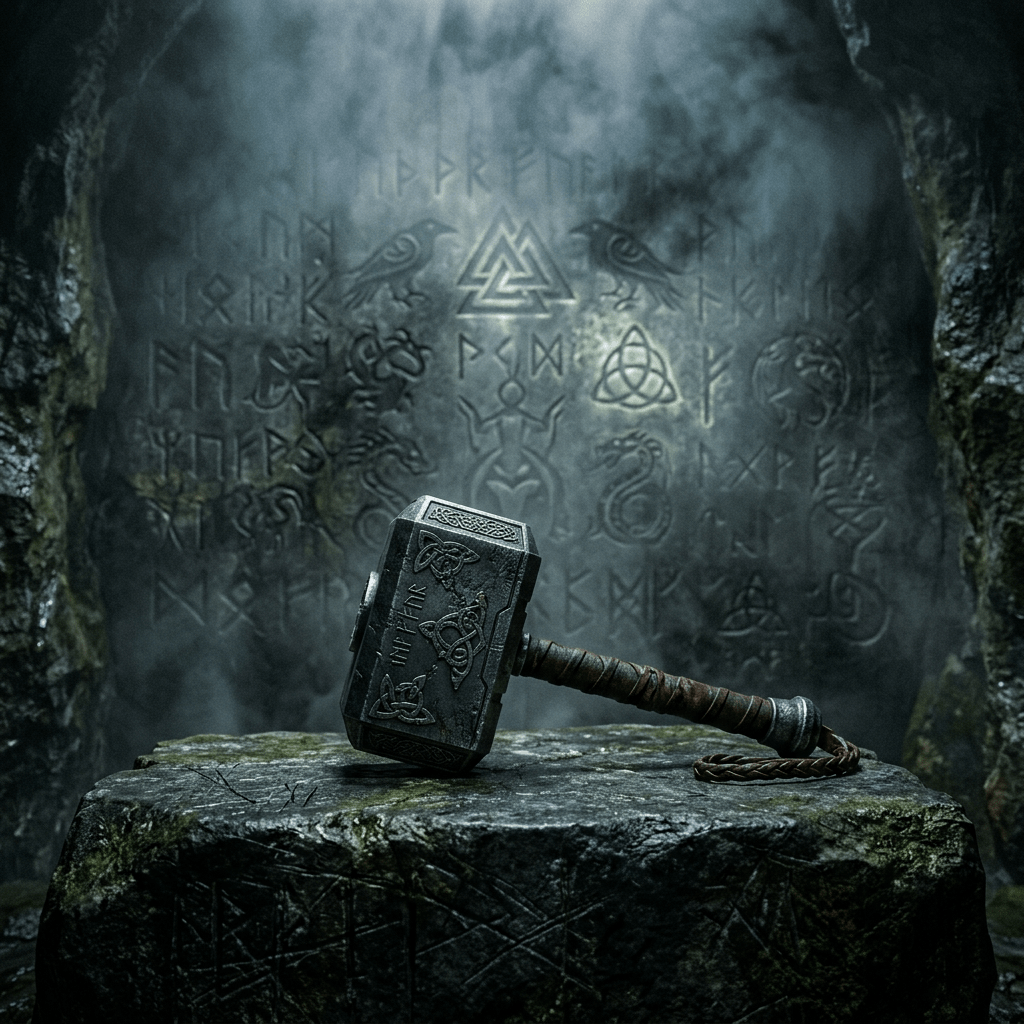
Norse hammer with runic engravings lying on stone altar in misty cave

In an earlier post, I wrote about the art on Mjölnir and what it really means.

Or maybe more honestly, what it can mean.

That distinction matters.

Because one of the traps modern pagans can fall into — and I include myself in this — is treating every symbol like a dictionary entry.

This mark means this.

That knot means that.

This rune always means protection.

That symbol always means Odin.

This design is ancient.

That design is Viking.

This one is definitely historical because somebody on the internet said it with confidence.

And there is the problem.

Confidence is not evidence.

Aesthetic is not history.

Personal meaning is not the same thing as documented tradition.

And yet, personal meaning is not worthless either.

That is the line I keep coming back to.

The Trouble With Certainty

Pagan symbolism sits in a strange place.

Some of it is old.

Some of it is reconstructed.

Some of it is modern.

Some of it is inspired by older material but not identical to anything our ancestors would have worn, carved, painted, or prayed over.

And some of it has been repeated so often online that people mistake repetition for proof.

That does not mean we throw everything away.

It means we slow down.

It means we ask better questions.

Where does this symbol actually appear?

How old is the evidence?

Is the name ancient, or is the name modern?

Was this used in a religious context, a decorative context, a magical context, a political context, or do we simply not know?

And maybe the most important question:

Am I saying “this is what it meant,” or am I saying “this is what it means to me”?

Those are not the same sentence.

Mjölnir Has Weight

Mjölnir is one of the easier symbols to talk about because it has real historical weight behind it.

Thor’s hammer appears across Norse material culture and myth. It has protective force. It has sacred force. It belongs to thunder, strength, blessing, defense, and the hallowing of important moments.

That does not mean every modern hammer pendant is a perfect copy of an ancient artifact.

It does not mean every decorative knot or animal shape carved into one has one single fixed meaning.

But Mjölnir itself has roots.

It is not just an internet invention.

It is not just a fantasy logo.

It carries something older than the modern marketplace around pagan identity.

For me, that matters.

When I look at Mjölnir, I do not see only Thor as a comic-book thunder god or a simplified symbol of masculine force. I see protection. I see boundary. I see the power to hallow. I see the hammer that can bless, defend, and strike when needed.

But even there, I have to be careful.

That is my reading.

It is informed by tradition, but it is still my lived relationship with the symbol.

The Valknut, Vegvísir, and the Fog Around Symbols

Other symbols get foggier.

The Valknut is one of those symbols people often speak about with more certainty than the evidence allows.

It is powerful visually. Three interlocked triangles. Death, Odin, warriors, binding, sacrifice, the slain — those associations circle around it constantly in modern pagan spaces.

But when we speak about it, we should be honest about what we know and what we are interpreting.

“This symbol appears in contexts that may connect it to death, Odin, or the slain” is one kind of statement.

“This definitely meant exactly this to every Norse person who saw it” is another.

The first is careful.

The second is costume certainty.

Vegvísir is another good example.

It is beautiful. It is meaningful to many people. It is often treated online as an ancient Viking compass, but that simple version of the story is not the whole story.

Its documented history is later and more complicated than the popular internet version usually admits.

Does that make Vegvísir meaningless?

No.

But it does mean we should stop calling everything “ancient Viking” just because it looks good beside a longship.

There is nothing wrong with saying:

This symbol speaks to me.

This symbol helps me feel guided.

This symbol has become part of my practice.

This symbol carries personal meaning.

There is something wrong with pretending personal meaning automatically becomes historical fact.

Personal Meaning Is Not the Enemy

This is where people sometimes get defensive.

They hear caution and think it means dismissal.

They hear “that may not be historically accurate” and think it means “you are not allowed to use it.”

That is not what I am saying.

Modern paganism is not museum cosplay.

We are not living in the Viking Age, the Iron Age, or the old tribal worlds of Europe. We live now. We live with modern jobs, modern wounds, modern homes, modern technology, modern grief, modern confusion, modern loneliness, and modern spiritual hunger.

So yes, symbols evolve.

Yes, people form relationships with symbols in new ways.

Yes, a symbol can become spiritually meaningful even when its history is complicated.

But honesty matters.

I do not need to lie about a symbol’s age to let it matter to me.

I do not need to pretend a modern interpretation is ancient in order to make it sacred.

I do not need false certainty to have a real practice.

In fact, I think the practice gets stronger when I stop needing everything to be older, purer, or more official than it actually is.

Three Different Buckets

This is the way I try to sort it now.

First, there is evidence.

That is the historical bucket. Artifacts. manuscripts. carvings. archaeology. language. context. What can we reasonably say was there?

Second, there is tradition.

That is the inherited and reconstructed bucket. Stories, lore, repeated meanings, devotional patterns, and the ways communities have carried symbols forward.

Third, there is personal meaning.

That is the lived bucket. The symbol on your altar. The pendant around your neck. The mark you return to when you need courage, protection, guidance, remembrance, or grounding.

All three matter.

But they are not the same thing.

Confusing them creates shallow certainty.

Separating them creates deeper practice.

What the Art Means

So what does the art on Mjölnir mean?

Sometimes it means what we can historically support.

Sometimes it means what a maker intended.

Sometimes it means what a community has come to see in it.

Sometimes it means what you carry into it after years of wearing it close to the skin.

And sometimes, if we are honest, we do not fully know.

That should not scare us.

Mystery is not failure.

Not knowing everything about a symbol does not make it empty.

It may actually leave room for relationship.

The mistake is not loving a symbol whose history is complicated.

The mistake is refusing to admit the history is complicated.

A Better Way to Wear the Hammer

If I wear Mjölnir, I want to wear it honestly.

Not as a costume.

Not as a claim that I have solved Norse paganism.

Not as a badge of internet certainty.

But as a symbol of protection, blessing, strength, and sacred boundary.

As something rooted in old soil, yes, but still alive in the present.

As something that carries history, tradition, and personal meaning without forcing all three to become the same thing.

That, to me, is the more honest path.

Let the evidence be evidence.

Let tradition be tradition.

Let personal meaning be personal meaning.

And let the symbol breathe.

Pagan symbols are not dictionaries.

They are doors.

They are thresholds.

They are old marks carried into new hands.

Some come with clear stories.

Some come with fog.

Some come with warnings.

Some come with beauty.

And some simply sit against the chest, close to the heartbeat, reminding us that meaning does not always arrive as certainty.

Sometimes it arrives as relationship.

Godspeed.
In an earlier post, I wrote about the art on Mjölnir and what it really means.

Or maybe more honestly, what it can mean.

That distinction matters.

Because one of the traps modern pagans can fall into — and I include myself in this — is treating every symbol like a dictionary entry.

This mark means this.

That knot means that.

This rune always means protection.

That symbol always means Odin.

This design is ancient.

That design is Viking.

This one is definitely historical because somebody on the internet said it with confidence.

And there is the problem.

Confidence is not evidence.

Aesthetic is not history.

Personal meaning is not the same thing as documented tradition.

And yet, personal meaning is not worthless either.

That is the line I keep coming back to.

The Trouble With Certainty

Pagan symbolism sits in a strange place.

Some of it is old.

Some of it is reconstructed.

Some of it is modern.

Some of it is inspired by older material but not identical to anything our ancestors would have worn, carved, painted, or prayed over.

And some of it has been repeated so often online that people mistake repetition for proof.

That does not mean we throw everything away.

It means we slow down.

It means we ask better questions.

Where does this symbol actually appear?

How old is the evidence?

Is the name ancient, or is the name modern?

Was this used in a religious context, a decorative context, a magical context, a political context, or do we simply not know?

And maybe the most important question:

Am I saying “this is what it meant,” or am I saying “this is what it means to me”?

Those are not the same sentence.

Mjölnir Has Weight

Mjölnir is one of the easier symbols to talk about because it has real historical weight behind it.

Thor’s hammer appears across Norse material culture and myth. It has protective force. It has sacred force. It belongs to thunder, strength, blessing, defense, and the hallowing of important moments.

That does not mean every modern hammer pendant is a perfect copy of an ancient artifact.

It does not mean every decorative knot or animal shape carved into one has one single fixed meaning.

But Mjölnir itself has roots.

It is not just an internet invention.

It is not just a fantasy logo.

It carries something older than the modern marketplace around pagan identity.

For me, that matters.

When I look at Mjölnir, I do not see only Thor as a comic-book thunder god or a simplified symbol of masculine force. I see protection. I see boundary. I see the power to hallow. I see the hammer that can bless, defend, and strike when needed.

But even there, I have to be careful.

That is my reading.

It is informed by tradition, but it is still my lived relationship with the symbol.

The Valknut, Vegvísir, and the Fog Around Symbols

Other symbols get foggier.

The Valknut is one of those symbols people often speak about with more certainty than the evidence allows.

It is powerful visually. Three interlocked triangles. Death, Odin, warriors, binding, sacrifice, the slain — those associations circle around it constantly in modern pagan spaces.

But when we speak about it, we should be honest about what we know and what we are interpreting.

“This symbol appears in contexts that may connect it to death, Odin, or the slain” is one kind of statement.

“This definitely meant exactly this to every Norse person who saw it” is another.

The first is careful.

The second is costume certainty.

Vegvísir is another good example.

It is beautiful. It is meaningful to many people. It is often treated online as an ancient Viking compass, but that simple version of the story is not the whole story.

Its documented history is later and more complicated than the popular internet version usually admits.

Does that make Vegvísir meaningless?

No.

But it does mean we should stop calling everything “ancient Viking” just because it looks good beside a longship.

There is nothing wrong with saying:

This symbol speaks to me.

This symbol helps me feel guided.

This symbol has become part of my practice.

This symbol carries personal meaning.

There is something wrong with pretending personal meaning automatically becomes historical fact.

Personal Meaning Is Not the Enemy

This is where people sometimes get defensive.

They hear caution and think it means dismissal.

They hear “that may not be historically accurate” and think it means “you are not allowed to use it.”

That is not what I am saying.

Modern paganism is not museum cosplay.

We are not living in the Viking Age, the Iron Age, or the old tribal worlds of Europe. We live now. We live with modern jobs, modern wounds, modern homes, modern technology, modern grief, modern confusion, modern loneliness, and modern spiritual hunger.

So yes, symbols evolve.

Yes, people form relationships with symbols in new ways.

Yes, a symbol can become spiritually meaningful even when its history is complicated.

But honesty matters.

I do not need to lie about a symbol’s age to let it matter to me.

I do not need to pretend a modern interpretation is ancient in order to make it sacred.

I do not need false certainty to have a real practice.

In fact, I think the practice gets stronger when I stop needing everything to be older, purer, or more official than it actually is.

Three Different Buckets

This is the way I try to sort it now.

First, there is evidence.

That is the historical bucket. Artifacts. manuscripts. carvings. archaeology. language. context. What can we reasonably say was there?

Second, there is tradition.

That is the inherited and reconstructed bucket. Stories, lore, repeated meanings, devotional patterns, and the ways communities have carried symbols forward.

Third, there is personal meaning.

That is the lived bucket. The symbol on your altar. The pendant around your neck. The mark you return to when you need courage, protection, guidance, remembrance, or grounding.

All three matter.

But they are not the same thing.

Confusing them creates shallow certainty.

Separating them creates deeper practice.

What the Art Means

So what does the art on Mjölnir mean?

Sometimes it means what we can historically support.

Sometimes it means what a maker intended.

Sometimes it means what a community has come to see in it.

Sometimes it means what you carry into it after years of wearing it close to the skin.

And sometimes, if we are honest, we do not fully know.

That should not scare us.

Mystery is not failure.

Not knowing everything about a symbol does not make it empty.

It may actually leave room for relationship.

The mistake is not loving a symbol whose history is complicated.

The mistake is refusing to admit the history is complicated.

A Better Way to Wear the Hammer

If I wear Mjölnir, I want to wear it honestly.

Not as a costume.

Not as a claim that I have solved Norse paganism.

Not as a badge of internet certainty.

But as a symbol of protection, blessing, strength, and sacred boundary.

As something rooted in old soil, yes, but still alive in the present.

As something that carries history, tradition, and personal meaning without forcing all three to become the same thing.

That, to me, is the more honest path.

Let the evidence be evidence.

Let tradition be tradition.

Let personal meaning be personal meaning.

And let the symbol breathe.

Pagan symbols are not dictionaries.

They are doors.

They are thresholds.

They are old marks carried into new hands.

Some come with clear stories.

Some come with fog.

Some come with warnings.

Some come with beauty.

And some simply sit against the chest, close to the heartbeat, reminding us that meaning does not always arrive as certainty.

Sometimes it arrives as relationship.

Godspeed.

Where They Found Me

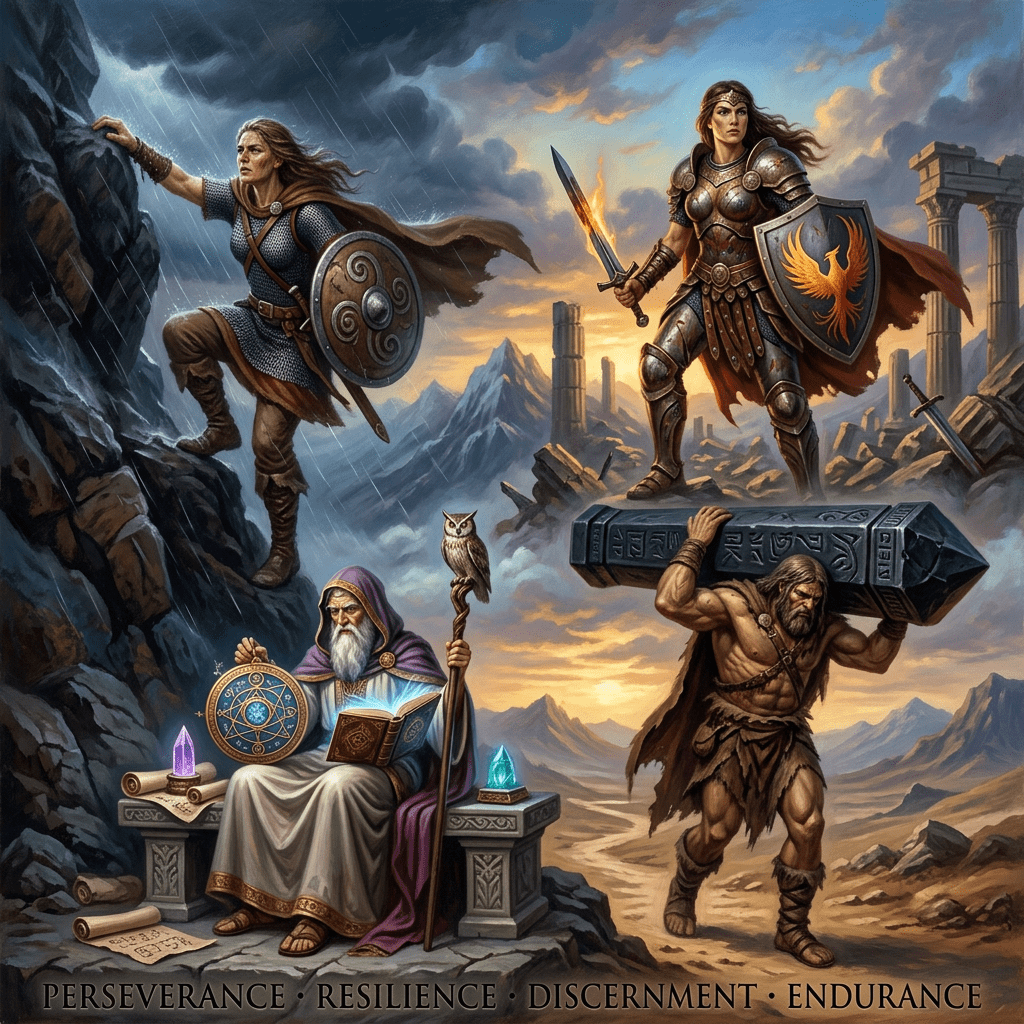
Four heroic figures representing virtues with medieval and mythical elements

Where They Found Me

In an earlier reflection, I wrote that not every god comes into a life the same way.

Some arrive through study.

Some arrive through ritual.

Some arrive through lineage, longing, old stories, old names, old fires.

And some arrive because life has already carved out a place for them before you ever know how to name what is standing there.

That is the part I want to come back to.

Because it is easy to say Brigid, Skadi, Ratatoskr, and the Fir met me where I was. It is easy to shape that into clean symbolic language. Flame. Frost. Messenger. Evergreen.

But where was I?

What weather was I standing in?

What part of my life had made room for them before I ever spoke their names with any real understanding?

That is the deeper question.

Brigid Found Me at the Workbench and the Page

Brigid was the obvious one.

I have said that before, and it remains true.

She was almost staring me in the face from the beginning.

Not as a distant, decorative goddess. Not as a pretty image on a candle label. Not as some soft aesthetic of hearth and poetry stripped of all its weight.

She found me in the work.

In the writing.

In the stubborn act of keeping things alive when letting them go cold would have been easier.

She was there in the part of me that kept returning to the page. She was there in the impulse to make meaning from pressure. She was there in the need to take wreckage, fatigue, anger, memory, and hard experience and hammer it into something useful.

That is the Brigid I recognize.

The useful flame.

The fire under the kettle.

The light on the desk.

The warmth that has to be tended, not merely admired.

The forge where pain does not magically disappear, but changes shape under heat, attention, and repeated effort.

Looking back, I think Brigid had been present long before I named her properly. Every time I tried to build something from the broken pieces. Every time I wrote instead of simply stewing. Every time I tried to keep family, memory, work, hope, or some stubborn little project alive when the easier thing would have been to let it die.

That was her ground.

Not a thunderbolt.

A hearth.

A desk.

A half-lit room.

A tired man still trying to make something useful from what life had handed him.

Skadi Found Me When Life Became Cold Enough

Skadi came differently.

Colder.

Starker.

Less like comfort and more like the first hard breath of winter air that tells you to wake up and pay attention.

I do not think I understood Skadi because I went looking for her.

I think I understood her because life became cold enough.

There are seasons where comfort is not the first teacher. There are seasons where nobody is coming quickly enough, nothing resolves cleanly enough, and the road does not soften just because you are tired.

That kind of cold teaches.

Collapse teaches.

Waiting teaches.

Legal fog teaches.

Exhaustion after work teaches.

The hard silence of carrying responsibilities that do not pause just because your inner weather has turned brutal teaches.

Skadi met me there.

Not in the warm center of the room, but at the edge.

Where the snow still lingers in the shadows.

Where the air bites the lungs clean.

Where the question is no longer, “Do I feel inspired?” but, “Can I still stand?”

That is where Skadi makes sense to me.

She does not coddle. She clarifies.

She does not tell me the cold is not real. She teaches me how not to surrender my footing to it.

Some powers arrive when life is soft enough to receive them.

Skadi arrived when life was hard enough for me to finally understand her.

Ratatoskr Found Me in the Noise

Ratatoskr did not arrive with the same severity.

He just fit.

That may sound casual, but it is not small.

For someone who lives so much in words, thought, interpretation, messaging, meaning-making, and trying to understand the space between what happened and what it means, Ratatoskr makes strange and perfect sense.

Messenger in the branches.

Runner between levels.

Movement between above and below.

Signal. Chatter. Warning. Communication. Mischief. Meaning.

He found me in the noise.

Not just outer noise, though there has been plenty of that. Emails. documents. conversations. obligations. posts. comments. legal language. workplace language. spiritual language. academic language. All of it moving through the branches at once.

But inner noise too.

The nervous system reporting on everything.

The mind trying to turn every irritation into an omen.

The old habit of carrying messages that may not even belong to me.

Ratatoskr found me there, somewhere between message and mischief.

And the lesson was not simply, “Listen.”

The lesson was, “Discern.”

Not every thought is revelation.

Not every fear deserves a throne.

Not every message needs to be carried from root to crown and back again.

Some things are signal.

Some things are noise.

Some things are warnings.

Some things are just the squirrel in the branches making a racket because the whole tree is alive.

Ratatoskr did not find me in silence.

He found me in the chatter, and taught me to ask what was actually worth carrying.

The Fir Found Me Still Standing

And then there is the Fir.

Not a god in the same way.

Not a figure with the same kind of story.

But a mirror.

A presence.

A standing lesson.

The Fir found me in hard weather.

That is the simplest truth of it.

It did not find me blooming. It did not find me polished. It did not find me in some bright, easy season where everything was growing quickly and visibly.

It found me in the part of life where endurance is quieter than victory.

Evergreen does not mean untouched by winter.

It means retaining life through it.

That distinction matters.

I do not connect with the Fir because I imagine myself invincible. I connect with it because I know what it means to be weathered and still not stripped bare.

The Fir does not need perfect weather to remain itself.

It does not wait for spring to remember its nature.

It does not confuse hardship with the end of life.

It remains green.

It remains rooted.

It remains.

That word has mattered to me more than I expected.

Remain.

Not because nothing hurts.

Not because the season is easy.

Not because the cold is imaginary.

Remain because something living is still there.

Not Chosen Like Decorations

So no, I do not think these powers came to me at random.

And I do not think I chose them like decorations for a spiritual shelf.

Brigid met me where I was already tending fires.

Skadi met me where the road had gone cold.

Ratatoskr met me where the messages would not stop moving.

The Fir met me where I was still standing, even if I did not yet feel strong.

That is different from collecting symbols.

That is recognition.

It is looking back over the road and realizing the names were not imposed from outside. They were already written into the weather of the life being lived.

The flame was already there.

The cold was already there.

The messenger was already running through the branches.

The evergreen was already holding its colour.

I simply learned to see them.

The Place They Meet Me Now

These days, I meet them in smaller ways.

In the morning card pull.

In the candle flame.

In the incense smoke.

In the pause before the day takes over.

In the cold edge of the morning when the body is tired but the work still waits.

In the writing that turns pressure into language.

In the discipline of asking whether a thought is truth, fear, noise, or message.

In the evergreen part of the self that keeps saying, quietly but firmly: not finished yet.

That may be the most honest shape of my practice right now.

Not perfect devotion.

Not grand certainty.

Not some polished pagan performance.

Just the old rhythm returning.

Cards on the table.

Flame in the room.

Cold at the edge.

Messenger in the branches.

Fir at the threshold.

And me, still walking between them, trying to listen better than I did yesterday.

Godspeed.

The Grandmother’s Rule of the Frost Line

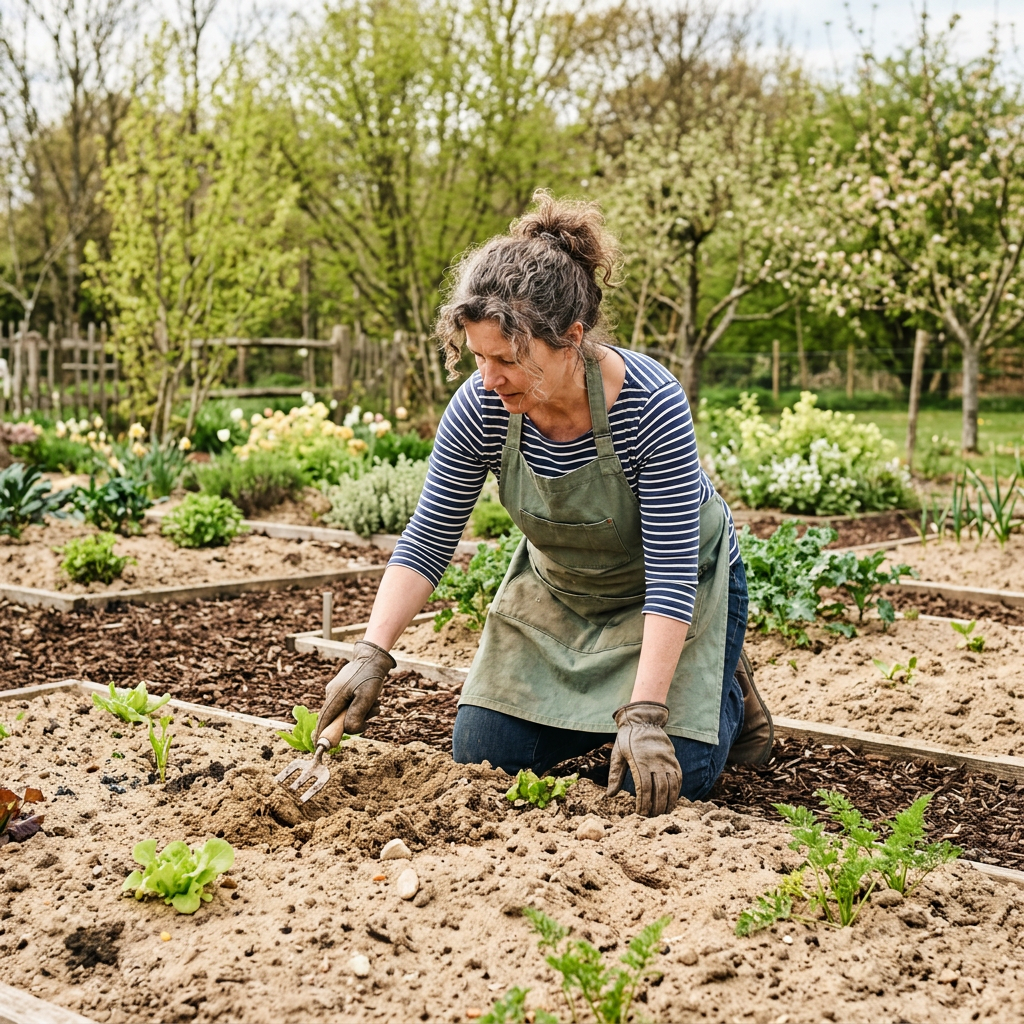
Woman kneeling in garden bed wearing gloves and apron, planting seedlings

Hey there, my dear Unplugged Pagans.

How are you today?

It is a very nice, warm day. One of those spring days that starts whispering dangerous little things into a gardener’s ear.

Go ahead.

Put the plants out.

The sun is warm. The soil is waking. Surely winter is done with us now.

And that, dear Unplugged Pagans, is how spring lies to you.

I got out yesterday and did a little more work on the driveway. I also contemplated rototilling the garden again, but for now I think I am going to leave it sit another week. There is a time to disturb the soil, and there is a time to let the soil settle back into itself.

That is part of gardening too.

Not every act of care requires a shovel.

Sandy Soil and the Temptation to Overwork

My soil here is very sandy. Sandy, sandy soil. Not much organic material in it at all.

So I am debating whether or not to work some organic matter into the garden before planting. Compost. Well-rotted manure. Leaf mold. Something that gives the soil a little more body, a little more life, a little more ability to hold water and nutrients instead of letting everything run straight through.

Sandy soil has its blessings. It drains well. It warms up faster. It is easy to work compared to heavy clay.

But it is also hungry soil.

It does not hold much.

The tomatoes know this. The peppers will know this. The roots will know this. And if I am honest, I already know this too from the amount of watering those seedlings are demanding.

So yes, organic material is probably the right move. Not to replace the natural soil, but to feed it. To help what is already there become better.

Raised Beds and the Natural Soil

Now, this whole concept people have of raised garden beds — I have never fully understood the obsession.

I am not saying they have no place. They do. If your soil is contaminated, too wet, too compacted, too rocky, or if you need easier access because bending and kneeling are hard on the body, raised beds can make sense.

But sometimes I look at the trend and think we are creating more work than we need to create.

You build the box.

You buy the soil.

You fill the box.

You maintain the box.

You water the box more often.

Meanwhile, the earth is already there beneath your feet.

My own instinct is to use what is there. Improve it. Learn it. Work with it. Let the land teach you its habits instead of immediately building an artificial little kingdom on top of it.

That may be the Pagan in me talking.

The land is not just a surface.

It is a relationship.

The Victoria Day Rule

And then there is the old rule.

My grandmother had a cardinal rule for this area: do not start planting the garden until after Victoria Day weekend.

She broke that rule once or twice.

The results proved her right.

Here in Eganville, here in Renfrew County, warm afternoons do not mean the frost is done. The sun can bless you at three in the afternoon and the cold can betray you at three in the morning.

That is just spring in this part of Ontario.

Right now, the temptation is real. The weather is nice. The garden is calling. The seedlings are getting impatient. The gardener is getting impatient. The whole thing feels like it should be time.

But the forecast still has below-freezing temperatures showing. There is still cold in the bones of the week. There is still the possibility of ugly little surprises.

So wait.

Have patience.

Do not put your tender garden in yet.

You may regret it if you do.

The Seedlings Are Ahead of the Season

I also realize I started some of my seedlings probably four weeks too early.

Some of the poor pepper plants are already starting to blossom, and they are not even in the ground yet. That may bode well. It may not. We will see.

The tomato plants are definitely telling me they are ready for more room. I am watering them every day, sometimes twice a day, because they are thirsty little critters.

That is the funny thing about gardening.

You can do almost everything right and still be slightly out of rhythm.

Start too late, and you lose season.

Start too early, and the plants are staring at you from their little pots, asking why you brought them to the dance before the hall was open.

There is a lesson in that.

Growth is not only about eagerness.

Growth is timing.

The Pagan Lesson in Waiting

There is a reason the old people watched the weather, the moon, the birds, the soil, the trees, and the frost line.

They knew the calendar was only part of the story.

Spring does not arrive because we want it to.

The garden does not care about our impatience.

The seedlings do not care that we are tired of winter.

The frost does not care that the long weekend is coming.

Nature moves by signs, not by moods.

That is one of the hard lessons of the land.

And maybe that is why gardening belongs so naturally inside a Pagan life. It teaches humility without needing a sermon. It teaches patience without asking permission. It teaches that the sacred is not always dramatic.

Sometimes the sacred is compost.

Sometimes the sacred is sandy soil being slowly improved.

Sometimes the sacred is not planting when every impatient part of you wants to plant.

For the Gardeners This Week

So if you are in this part of Ontario, or anywhere still flirting with frost, be careful.

Harden off your plants.

Watch the night temperatures, not just the daytime highs.

Feed the soil before you demand too much from it.

Work with what you have before assuming you need to build something artificial on top of it.

And remember: a warm afternoon is not a contract.

For now, I am going to wait.

The driveway got some attention. The garden can sit another week. The tomatoes and peppers can grumble from their pots a little longer.

My grandmother’s rule still stands.

After Victoria Day.

Not because we are afraid of spring.

Because we respect it.

Godspeed.

Do Not Let the Mood Become the Oracle

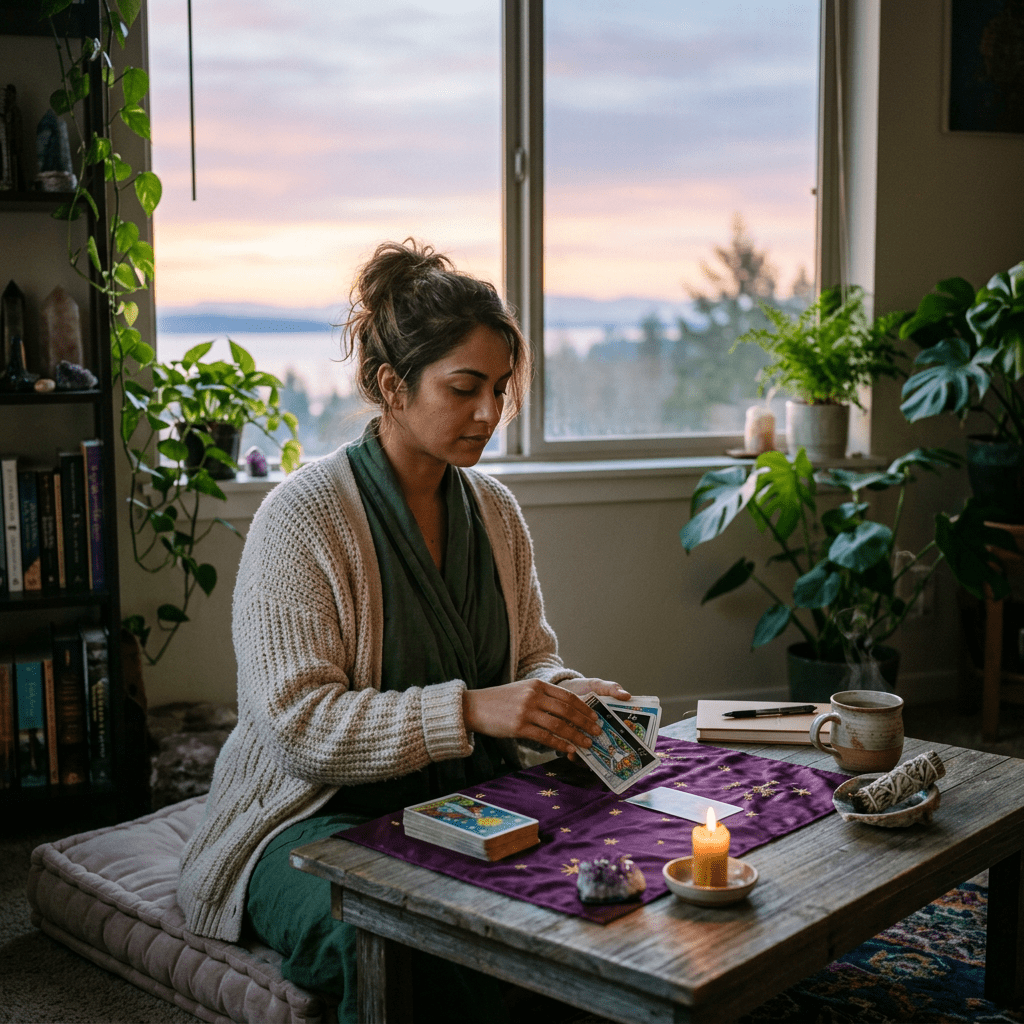
Woman shuffling tarot cards at wooden table with candle and plants

Good morning, my dear Unplugged Pagans.

It is Monday, April 27th. The incense is lit, though the candles are not. Some mornings the altar is bright. Some mornings the altar is simple smoke, tired eyes, and the stubborn decision to keep the ritual alive anyway.

And that matters.

Because what makes ritual ritual?

You return to it.

Not only when you are rested. Not only when the candles are perfect. Not only when the mood is sacred and the mind is clear. Sometimes ritual is yawning through the shuffle, cranky from nicotine withdrawal, tired enough that the cards blur a little at the edges, and still saying:

I am here.

So this morning we call to Brigid, keeper of flame and craft. We call to Skadi, who knows the cold road and the discipline of endurance. We call to Ratatoskr, messenger between root and crown, carrying words up and down the great tree. And we call to the fir tree, evergreen witness, standing through weather without pretending the weather is not real.

Today’s spread:

Past: Six of Wands
Present: Page of Cups reversed
Future: The Emperor reversed
Querent: Nine of Swords reversed

The Past: Six of Wands

The Six of Wands in the past is a card of victory, recognition, and having made it through something with your head still above the crowd.

This is not necessarily grand victory. It does not have to mean trumpets, applause, and banners in the street.

Sometimes the victory is much smaller and much more honest.

You got through the weekend.

You kept showing up.

You ordered the books.

You looked at the size of the next challenge and did not turn away.

That matters.

The Six of Wands says there has already been movement. There has already been proof. The tired mind may not feel victorious this morning, but the card says: do not erase what you have already carried.

The Present: Page of Cups Reversed

Now we come to the present: the Page of Cups reversed.

This is the emotional cup turned sideways.

The message is there, but it may be distorted. The feeling is real, but it may not be accurate. The mood is speaking, but the mood may not be the oracle.

This card fits the morning almost too well.

Tired. Cranky. Nicotine pulling at the nerves. Coordination off. Patience thin. The body grumbling. The mind trying to turn discomfort into meaning.

The Page of Cups reversed says: be careful.

Not every bad mood is a revelation.

Not every irritation is a prophecy.

Not every restless feeling deserves a throne.

Sometimes the cup is simply cloudy because the body needs sleep.

The Future: The Emperor Reversed

The Emperor reversed in the future warns against trying to solve disorder with brute force.

This is the card of structure out of balance. Too much control, or not enough. Too much rigidity, or the collapse of routine. The ruler slumped on the throne, or gripping the sceptre too tightly.

The future does not ask for domination.

It asks for gentle order.

Go to bed.

Eat something decent when you wake.

Do the next small thing.

Do not make a kingdom out of exhaustion. Do not build a law out of a temporary mood.

The Emperor reversed says the day needs structure, yes — but not punishment. Not self-attack. Not the old voice barking orders from a cracked throne.

Structure can be kind.

The Querent: Nine of Swords Reversed

And representing the sleepy querent, we have the Nine of Swords reversed.

There it is: the mind under pressure.

Worry. Doubt. Shame. Suspicion. The old night voices. The thoughts that grow teeth when the body is tired.

But reversed, this card can also show the beginning of release. The nightmare does not own the whole room. The swords may still hang above the bed, but the dawn is beginning to touch the edge of them.

This card says: you are not seeing the day clearly yet.

And that is okay.

You do not need to solve your life before sleep.

You do not need to interpret every irritation before rest.

You do not need to drag the whole future into one tired morning and demand that it explain itself.

The Moonchild Thread

Today’s Cancer horoscope lands right in the middle of this spread.

It speaks of feeling testy, having reasons for irritation, and still being offered a choice: let the mood rule the day, or look for the small reasons to smile.

That does not mean pretending.

It does not mean denying the crankiness, the tiredness, the withdrawal, or the human mess of the morning.

It means refusing to crown the mood as king.

The Page of Cups reversed says the emotional waters are choppy.

The Emperor reversed says the inner ruler is not at his best.

The Nine of Swords reversed says the tired mind may exaggerate the shadows.

And the Six of Wands says: remember, you have already won harder mornings than this one.

The Message of the Cards

The cards are not scolding today.

They are practical.

They are saying:

You are tired. Do not confuse tired with doomed.

You are cranky. Do not confuse cranky with truth.

You are uncomfortable. Do not confuse discomfort with prophecy.

You need rest before interpretation.

That is the whole reading.

Brigid says: bank the fire. It does not need to blaze every hour.

Skadi says: endure, but do not make hardship your identity.

Ratatoskr says: carry cleaner messages. Do not run every anxious thought up and down the tree.

The fir tree says: stay green, even on the low-energy mornings.

So today, dear Unplugged Pagans, the ritual is simple.

Smoke rising.

Cards drawn.

No candles.

No grand question.

No forced wisdom.

Just the honest practice of showing up, listening lightly, and knowing when the most sacred next step is sleep.

Godspeed.

The Lovers at the Threshold

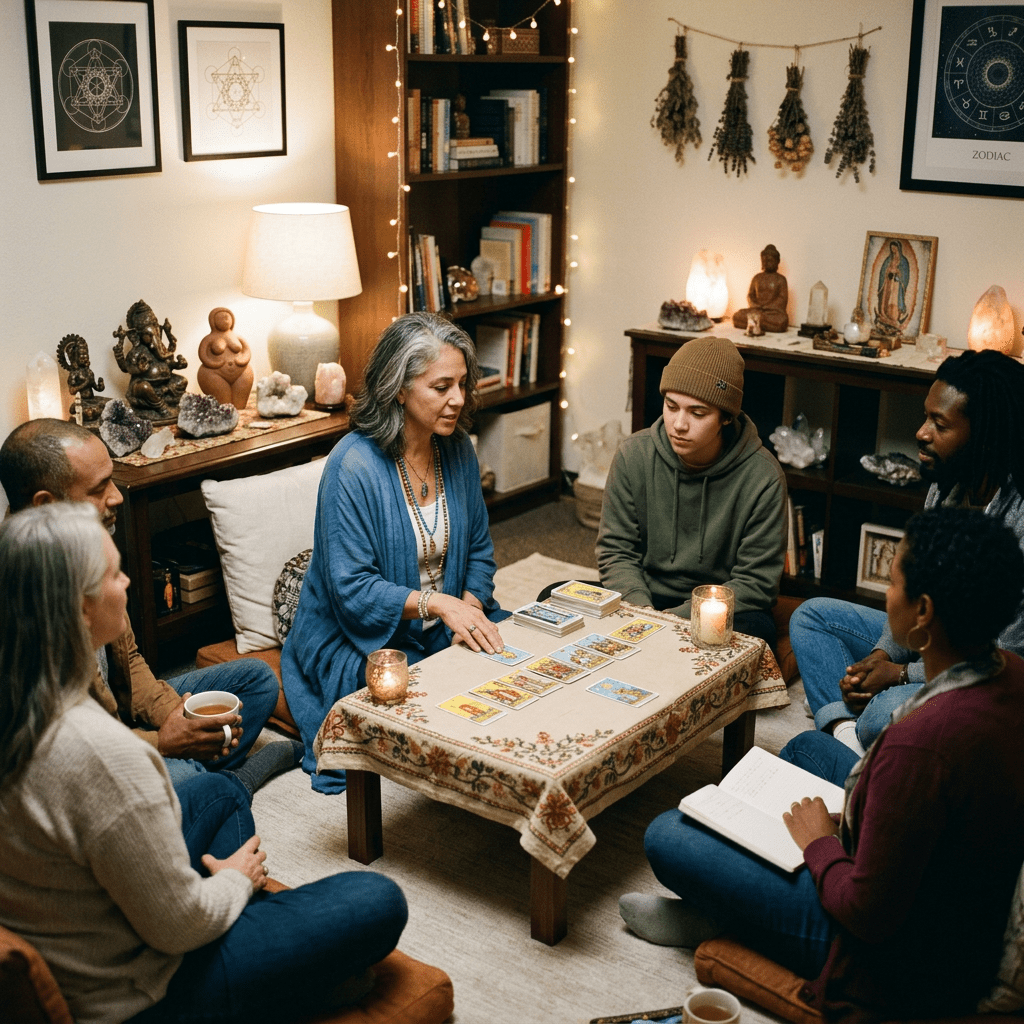
Five people sitting in a circle around a table with tarot cards and candles

Good morning, my dear Unplugged Pagans.

It is Sunday, April 26th. The candles are lit. The incense is burning. We call to Brigid, to Skadi, to Ratatoskr, and to the fir tree: flame, endurance, messenger, and evergreen witness.

This has been a good weekend. There is a new course on the horizon, and judging by the size of the book alone, it is not coming softly. Seven hundred and sixty-eight pages is not a light companion. But not every path worth walking is light. Some books arrive like stones for the foundation.

And so we shuffle.

Today’s spread brings us:

Past: Ten of Swords reversed
Present: The Lovers
Future: King of Pentacles
Querent: Two of Cups reversed

The Wound Is Not the Whole Story

The Ten of Swords reversed in the past says something important:

You were down, but not finished.

This is not the card of pretending the wound did not happen. It is not spiritual bypassing. It is not fake positivity painted over collapse. It is the first breath after the ending. The body on the ground begins to move. The dawn appears behind the blades.

Something ended. Something cut deep. Something may have left you asking whether trust, partnership, work, stability, or direction could ever feel clean again.

But reversed, the Ten of Swords tells us the worst of that chapter no longer gets to write the whole book.

The Lovers in the Present

The Lovers is not only romance. It is choice. Alignment. Covenant. A decision made with the whole self present.

In today’s reading, The Lovers stands in the center like a gate.

It asks: What are you choosing now?

Not what wounded you. Not what disappointed you. Not what fell apart. Not what others failed to honour.

What are you choosing now?

This is where the reading gets interesting, because the querent card is the Two of Cups reversed. That speaks of disharmony, disconnection, imbalance, or a bond that is not flowing cleanly. Sometimes that bond is with another person. Sometimes it is with work. Sometimes it is with the self.

The Lovers says, “Choose alignment.”

The Two of Cups reversed says, “But first, admit where the connection is strained.”

That is the work of the day.

The Cup That Needs Repair

The Two of Cups reversed does not always mean something is broken beyond saving. It can mean the vessel needs attention.

Where have you been giving too much?

Where have you been expecting too much?

Where have you been saying yes while your spirit quietly steps backward?

Where has the outer agreement stopped matching the inner truth?

This card asks for honesty without drama. Not every imbalance needs a bonfire. Some need a boundary. Some need a conversation. Some need a quiet admission: “This no longer works the way it once did.”

And that is not failure. That is clarity.

The King of Pentacles Ahead

The future card is the King of Pentacles, and that is a strong sign.

This is not frantic success. This is not chasing. This is not proving.

This is grounded authority.

The King of Pentacles builds with patience. He respects the material world: money, health, work, home, time, food, tools, books, routines. He does not treat stability as boring. He understands that stability is sacred when you have known instability.

After the Ten of Swords reversed, this card matters.

The path forward is not panic. It is structure.

The path forward is not emotional spending, emotional promises, emotional overreach, or emotional escape. Today’s wider astrology carries the same warning: feel what you feel, but do not let a passing mood make permanent decisions with your wallet, your commitments, or your peace.

Let the King of Pentacles hold the line.

Today’s Moonchild Thread

For the Cancerian, the Moonchild, today feels like a reminder to keep the shell and the heart in right relationship.

The shell is not there to make you cold.

The heart is not there to make you foolish.

One protects. One guides.

Together, they say: move carefully, but keep moving.

There may be emotion around money, work, study, or relationships today. There may be a temptation to soothe discomfort by buying, agreeing, reacting, or reaching too quickly for certainty. But the cards say otherwise.

Pause.

Choose.

Repair what can be repaired.

Release what cannot be made mutual.

Then build.

The Message of the Spread

This reading is not about collapse.

It is about what comes after collapse, when the person who survived finally gets to choose from a place of awareness instead of injury.

The Ten of Swords reversed says: you are rising.

The Lovers says: choose what aligns.

The Two of Cups reversed says: do not ignore imbalance.

The King of Pentacles says: build something real from what remains.

So today, dear Unplugged Pagans, let the candles burn for discernment. Let the incense carry away the stale air of old wounds. Let Brigid bring the flame. Let Skadi bring endurance. Let Ratatoskr carry the message between root and crown. Let the fir tree remind us that not everything living loses its green when the weather turns cruel.

The wound was real.

The choice is now.

The foundation is waiting.

Godspeed.

When the Cards Come Sideways, and The Moonchild is Misread

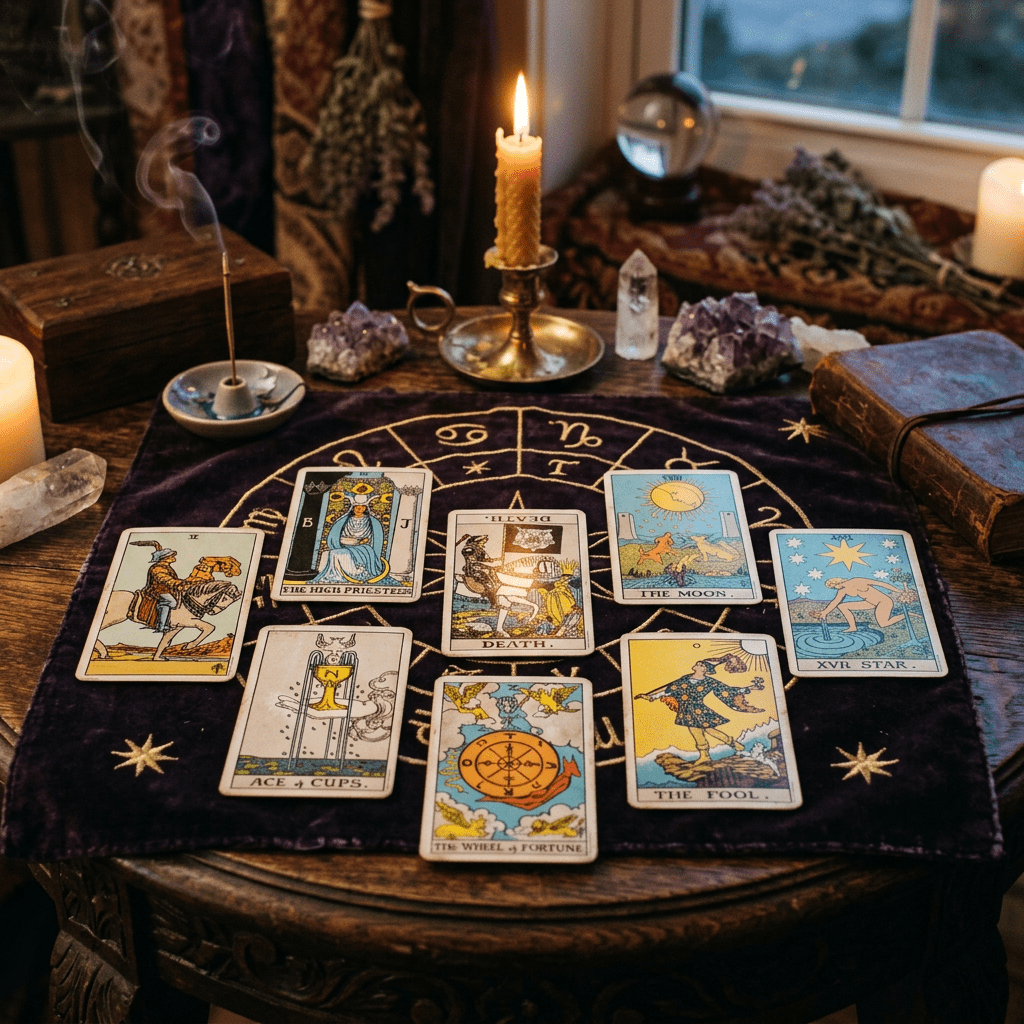
Eight tarot cards arranged on a zodiac-themed cloth with crystals, candles, and incense nearby

Hello, Unplugged Pagans.

How are you all today?

We bring to you another tarot reading, another astrology reading for my fellow Cancerians, my fellow Moonchildren, my children of the moon.

But before we begin today’s session, I want to offer a thought on tarot.

For those of you who read the cards, here is something I have never fully understood:

When a card comes up reversed, do you include the reversal?

Or do you turn it upright and read it as though the reversal never happened?

And if you do that, why?

Because to me, it came up reversed for a reason.

Not all reversals are bad. Not all reversed cards are warnings, disasters, or doom. Sometimes a reversal softens a harsh card. Sometimes it delays something rather than destroys it. Sometimes it points inward instead of outward. Sometimes it says, “This energy is blocked,” or “This lesson has not fully landed yet.”

Sometimes, the reversal is the whole point.

Let’s face it: not everything in the world is right side up.

Sometimes life is topsy-turvy. Sometimes the table has been flipped. Sometimes the meaning is not in the card alone, but in the way it lands.

So I wonder: do some readers avoid reversals because they do not want to learn the reversed meanings? Or because they are harder to weave into the reading? Or because upright readings feel cleaner, neater, easier to explain?

I do not ask that as an accusation. I ask it as part of the craft.

Because for me, the reversal belongs in the room.

If the card arrives upside down, I listen to it upside down.


The candles are lit. The incense is moving through the air.

And speaking of incense, I have to ask: do you have a favourite?

Does it matter to you what you burn when you sit down to read?

Sage? Cedarwood? Pine? Sandalwood? Frankincense? Something floral? Something smoky? Something sharp enough to wake the spirit up?

Does incense change the way you enter the day?

Does it alter your mood, settle your thoughts, open the room, or mark the space as something different from ordinary time?

Inquiring minds want to know.

For me, the incense is part of the threshold. It says: we are leaving the regular noise for a moment. We are entering the reading. We are making the morning into ritual.

So we invite Brigid, keeper of flame and craft.

We invite Skadi, cold-eyed and steady, the one who knows how to survive the bitter places.

We invite Ratatoskr, messenger between the worlds, running the branches with words and warnings.

And we invite the fir tree, evergreen and enduring, rooted through storm and season.

Today’s ritual begins with smoke, flame, shuffled cards, and one stubborn rock at the edge of the driveway.

I was out straightening up the driveway earlier, and there is this one rock sitting at the edge that I would love to move. If I could get that stone shifted, the whole driveway would feel better. Cleaner. Easier. More open.

But it is a huge rock.

And I do not think my tractor is capable of moving it.

One of these days, maybe I will get someone out here to give me an estimate on what it would cost to move it.

And maybe that is part of today’s reading too.

Some things we can shift ourselves.

Some things require the right tool, the right timing, or the right help.


Today’s Astrology Reading for Cancer

Cancer horoscope for Saturday, April 25

You have a kind, gracious way about you, dear Moonchild. You’re empathic and thoughtful, not to mention sentimental. Yet someone you encountered recently may not have that impression of you. They may see you as tough, distant, and maybe even cold. If so, that probably bothers you to no end. Maybe they’ve only seen your tougher, self-protective side when under duress. This isn’t about anyone else – you have to be you! That means you’re a multifaceted individual. If someone misjudges you without giving you a fair chance, don’t let it get to you. You still possess all of those beautiful traits! Remember that, and be less self-conscious.

Copyright © Daily Horoscope.

Now that is an interesting reading to place beside today’s tarot question about reversals.

Because maybe that is one of the lessons of the day:

People are not always read correctly when they appear upside down.

A kind person under pressure may look cold.

An empathic person protecting themselves may look distant.

A sentimental person who has had to survive hard seasons may look tougher than they really are.

But that does not mean the softness is gone.

It means there is more than one side to the card.

It means there is more than one face to the person.

It means the reversed position may not reveal a flaw. It may reveal pressure. Protection. Survival. A side of the self that only appears when the world has pushed too hard.

And maybe that is why reversals matter.

They remind us that what appears on the surface is not always the whole reading.

Sometimes the world only sees the armour.

The heart is still there underneath.


Today’s Tarot Reading

For today’s spread, we have:

  • Past: Ace of Pentacles reversed
  • Present: The World
  • Future: Knight of Wands
  • Representing me, the querent: Eight of Wands reversed

And since reversals are the thought of the day, let’s do this two ways.

First, we will read the cards as they actually appeared, reversals included.

Then, just for comparison, we will pretend there are no reversals and read the same cards upright.

Let’s see how the story changes.


Reading One: Including the Reversals

Past — Ace of Pentacles Reversed

The Ace of Pentacles upright often speaks of opportunity, material beginnings, work, money, health, stability, and the planting of a seed that may grow into something real.

But reversed, this card suggests that the seed did not land properly.

There may have been an opportunity in the past that stalled, slipped away, failed to root, or came with conditions that were not as solid as they first appeared.

This is the false start card.

The “almost, but not quite” card.

The “there was potential here, but something in the foundation was off” card.

In the past position, the Ace of Pentacles reversed says that the ground behind me was not as stable as it looked. There may have been work, money, planning, or practical effort involved, but something did not hold.

The promise was there.

The footing was not.

Present — The World

And then we arrive at The World.

This is a powerful present card.

The World is completion, integration, endings that become beginnings, lessons gathered, cycles closing, and a wider view finally forming.

It does not always mean everything is perfect.

It means something has come full circle.

There is a sense here of standing at the edge of one chapter and looking back across the whole terrain. Not just the easy parts. Not just the victories. The losses, the reversals, the missteps, the blocked roads, the delayed starts, all of it.

The World says: you have lived through enough of the cycle now to understand it differently.

You are not at the same place you were when the Ace of Pentacles reversed first appeared in your life.

You are not just surviving the lesson anymore.

You are beginning to see the shape of it.

Future — Knight of Wands

The Knight of Wands brings movement, fire, confidence, momentum, and a willingness to charge forward.

This is not a sitting-still card.

It is action.

It is heat.

It is the horse kicking up dust and saying, “Enough waiting. Let’s go.”

In the future position, this suggests renewed energy. Something starts moving again. Passion returns. Drive returns. A project, idea, journey, or decision may pick up speed.

But the Knight of Wands also needs discipline.

Fire is useful when it is held in the hearth.

It is dangerous when it burns down the house.

So the message here is not simply “charge ahead.”

It is: when the energy returns, guide it.

Do not waste the fire.

Querent — Eight of Wands Reversed

Now here is where the reading gets interesting.

The Eight of Wands upright is speed, messages, momentum, sudden movement, things flying through the air and landing quickly.

But reversed, it suggests delays, blocked communication, scattered energy, slowdowns, or the feeling that things should be moving faster than they are.

As the card representing me, the querent, this says I may be sitting in a strange tension.

The World says a cycle is completing.

The Knight of Wands says future movement is coming.

But the Eight of Wands reversed says I may not feel that movement yet.

Or I may feel the pressure of wanting to move before everything is lined up.

There may be messages not yet received, plans not yet confirmed, energy not yet focused, or action that needs to wait for the right opening.

This is the rock at the edge of the driveway.

I can see what needs to move.

I know the space would feel better if it were shifted.

But brute force may not be the answer.

The right tool matters.

The right help matters.

The right timing matters.


The Reversal Reading: Overall Message

When we include the reversals, the reading becomes more grounded and more honest.

It says:

A past opportunity did not fully take root. Something that looked practical or promising may have been blocked, unstable, delayed, or incomplete.

But the present is not failure.

The present is integration.

The World says the cycle is closing, the lesson is being gathered, and the larger picture is finally visible.

The future brings fire and movement through the Knight of Wands, but the querent is still sitting with delayed momentum through the Eight of Wands reversed.

So the message is not “nothing is happening.”

The message is: something is preparing to move, but it has not fully released yet.

Do not mistake delay for defeat.

Do not mistake blocked speed for blocked destiny.

And do not force the rock with a machine that cannot move it.

Find the right tool.


Reading Two: If We Ignore the Reversals

Now let’s pretend, just for comparison, that there are no reversals.

The spread would become:

  • Past: Ace of Pentacles upright
  • Present: The World
  • Future: Knight of Wands
  • Querent: Eight of Wands upright

Past — Ace of Pentacles Upright

Read upright, the Ace of Pentacles says the past held a solid opportunity.

A seed was planted. Something practical began. There may have been money, work, health, a plan, or a material chance to build something real.

This version of the reading says the foundation was good.

It says something began with promise.

Present — The World

The World remains the same.

A cycle is complete. A lesson is gathered. A chapter is closing. The querent stands at the edge of one stage and prepares for the next.

Future — Knight of Wands

The Knight of Wands still brings motion, confidence, passion, and drive.

The future still holds fire.

There is still movement coming.

Querent — Eight of Wands Upright

But here, the querent becomes much different.

With the Eight of Wands upright, the querent is not delayed or blocked. The querent is moving quickly. Messages are flying. Momentum is already in motion. Things are lining up fast.

This version of the reading says: the seed was planted, the cycle is complete, the future is fiery, and the querent is already moving with speed.

That is a much cleaner reading.

But is it the truer one?


The Difference Reversals Make

Without reversals, the reading becomes almost too smooth.

It says:

A good opportunity began in the past. A cycle is complete now. Passionate movement is coming. The querent is already moving forward quickly.

That is not a bad reading.

But it loses the friction.

It loses the blocked seed.

It loses the delayed message.

It loses the sense of waiting for the right tool, the right help, the right opening.

It also loses the deeper connection to today’s astrology reading.

Because the horoscope reminds us that people can misread us when they only see one side.

Someone may see toughness and think coldness.

Someone may see distance and miss self-protection.

Someone may see a guarded face and never realize there is kindness underneath it.

That is the human version of ignoring reversals.

It takes the first visible meaning and stops there.

It refuses to turn the card around in the hand and ask, “What else is being shown here?”

Sometimes we are tempted to make the cards sound cleaner than life actually is.

But life is not always upright.

Sometimes the beginning was blocked.

Sometimes the message is delayed.

Sometimes the fire is coming, but the gate has not opened yet.

Sometimes the heart is kind, but the face looks hard because the person has been carrying too much.

Sometimes the rock is still sitting at the edge of the driveway, and no amount of pretending makes it lighter.


Today’s Reflection

For me, today’s reading says this:

There was a beginning that did not fully become what it could have become.

There was a seed that struggled to root.

There was a practical path that may have looked promising but did not quite hold.

But now, The World sits in the present.

That means the story did not end in the failed seed.

The lesson kept unfolding.

The cycle kept turning.

The understanding deepened.

And ahead, the Knight of Wands waits with fire in his hands.

Movement is coming.

Energy is coming.

But the Eight of Wands reversed reminds me not to confuse impatience with readiness.

The delay may be protection.

The slowdown may be instruction.

The blocked movement may be telling me to gather the right support before I try to move something too heavy by myself.

And the horoscope adds another layer:

Do not become too self-conscious because someone misread the armour.

Do not forget your own kindness because someone only met you under stress.

Do not mistake another person’s limited view for the full truth of who you are.

You can be kind and guarded.

You can be empathic and exhausted.

You can be sentimental and self-protective.

You can be soft-hearted and still have edges.

That is not contradiction.

That is being whole.

That is being human.

That is being a Moonchild who has lived through weather.


So, my Unplugged Pagans, my Moonchildren, my candle-lighters and card-shufflers:

Do you read reversals?

Do you turn the card upright?

Do you let the card speak as it lands?

And what incense carries you into the ritual space?

Today, the smoke rises.

The cards turn.

The World stands open.

The fire waits ahead.

The rock remains until the right tool arrives.

And the reversed wands remind us:

Not all delays are defeats.

Sometimes they are the pause before the right movement.

Not all guarded faces are cold.

Sometimes they are protecting a kind heart.

Godspeed.