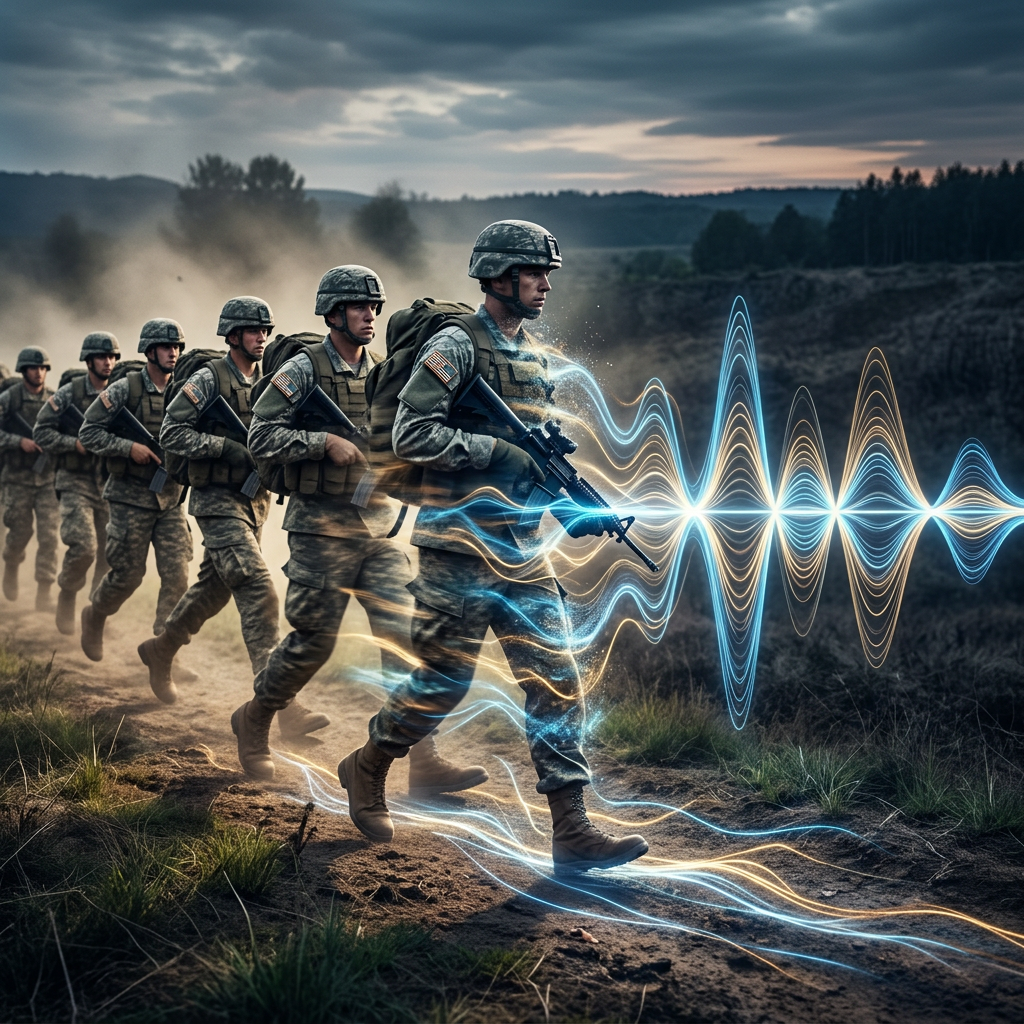

I was reminded of something tonight that my military training taught me years ago.
It is one of those simple things that seems obvious once you have seen it, heard it, and felt it in your bones. One person stepping forward makes almost no sound. One boot striking the ground is just a footstep. A knock. A tap. A single beat in the dark.
But twenty boots striking the ground at the same time?
That is different.
Fifty boots?
A hundred?
A thousand?
Now you are no longer hearing a footstep. You are hearing a wall. You are hearing force, unity, discipline, and intention made audible. That is part of the power of drill. Yes, marching in step teaches discipline. Yes, it teaches obedience, timing, teamwork, and control. But it also teaches something deeper: when many small sounds become one sound, the effect changes completely.
That is the part people forget.
A single sound does not need to be massive to become powerful. It only needs to be repeated in unison. One voice can be ignored. Many voices speaking together cannot be dismissed so easily. One drumbeat is a rhythm. Many drumbeats become thunder.
And that brings me to music.
Our modern music industry seems to believe that louder automatically means better. Louder means stronger. Louder means more exciting. Louder means more alive. So speakers get pushed harder. Cars rattle. Concerts roar. Festivals pump sound at levels that do not just fill the air, but assault it.
At a certain point, that is not music anymore.
That is pressure.
That is force.
That is damage dressed up as entertainment.
The truth is, you do not always need one massive speaker blasting at an absurd level. You could take many smaller speakers, place them properly, and let the sound carry through space instead of trying to bludgeon the space into submission. Thirty, forty, fifty smaller sound sources working together can create presence, coverage, and clarity without needing to make one source scream.
That is the lesson of the marching boots.
You do not create power only by increasing force. Sometimes you create power by increasing unity.
There is a difference between amplifying a sound and multiplying a sound. When you keep turning up one source, you eventually get distortion, harshness, and fatigue. The sound may become louder, but it does not necessarily become clearer. Often, it becomes worse. It loses shape. It loses texture. It loses the thing that made it worth hearing in the first place.
But when sound is spread properly, when it is balanced, when it is allowed to arrive from more than one place without being forced beyond reason, it can become fuller without becoming cruel.
That matters.
Because our ears are not disposable. Our peace is not disposable. The people around us are not disposable. The land is not disposable.
There is an arrogance in unnecessary volume. There is an arrogance in believing that because you want to hear something, everyone else must be made to feel it whether they consent to it or not. Sound does not respect fences. It does not stop at property lines. It does not ask whether the child is sleeping, whether the elder is resting, whether the animals are unsettled, whether the neighbours have had enough.
Sound travels.
Sound enters.
Sound imposes.
And maybe that is the thought for today.
Power does not always need to be loud.
Presence does not always need to be aggressive.
Music does not need to wound in order to move people.
The old lesson still holds: one footstep is nothing. A thousand footsteps together can shake the ground.
So before you blast the car stereo, before you stand in front of that speaker stack, before you call 120 decibels “necessary,” maybe stop and ask yourself whether it really is necessary — or whether we have simply confused volume with value.
Just a thought to ponder.
Have a good day, and Godspeed.
 Unplugged Pagan