

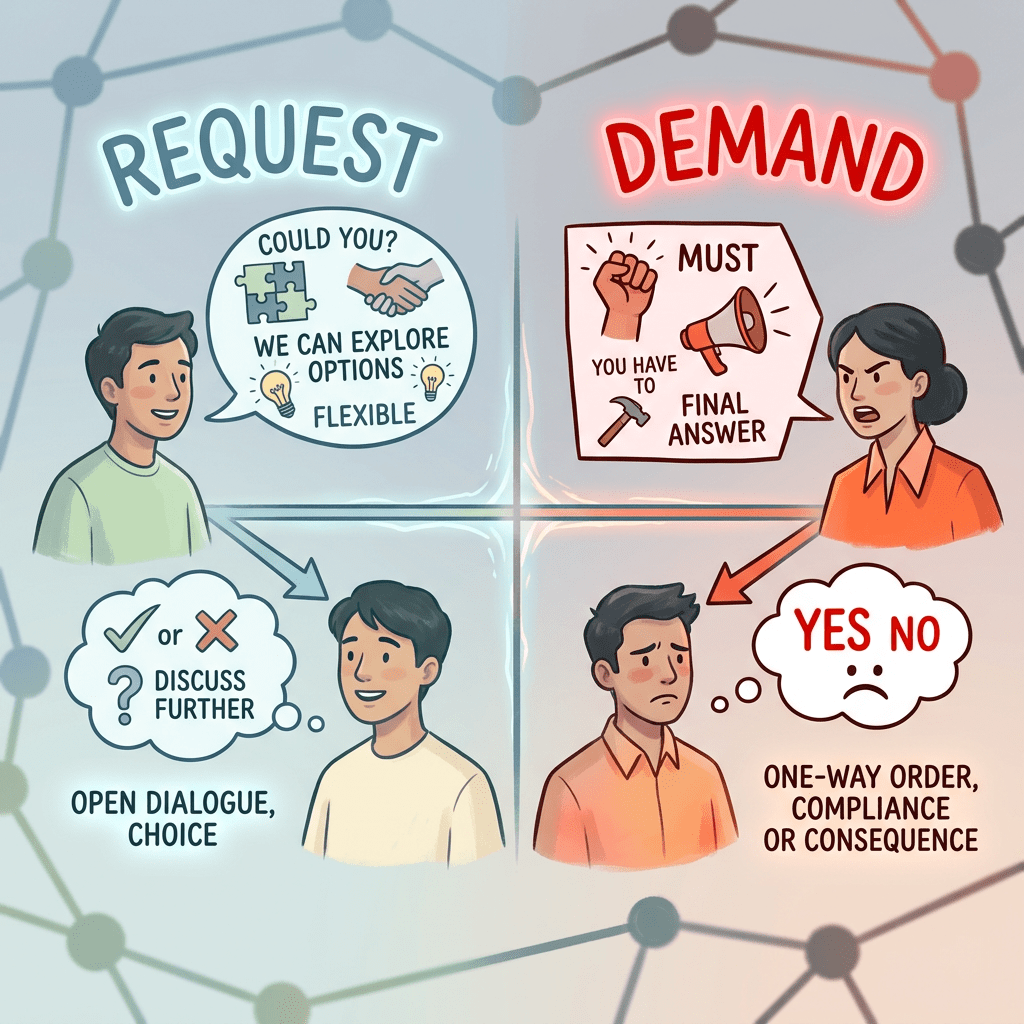
Something caught my attention while I was scrolling through the web.
Sometimes people do not seem to understand the difference between asking someone to consider something and demanding that they do something.
They are not the same thing.
A request for consideration sounds something like this:
“Here is what I am seeing. Here is why I am concerned. Please think about it.”
A demand for action sounds more like this:
“I have already decided what must happen. Your job is to do it.”
The confusing part is that both can be spoken politely. Someone can say “please” while issuing a demand. Someone else can speak firmly, or even emotionally, while only asking to be heard.
The difference is not always found in the wording.
The difference is found in whether the other person is actually allowed to think, question, disagree, offer another solution, or say no.
Asking Someone to Consider Something
When I ask someone to consider a concern, I am not necessarily telling them that I control the final decision.
I may strongly believe that something needs to change. I may explain why I believe people are being harmed, ignored, pushed aside, or treated unfairly. I may ask difficult questions. I may point out consequences that others would rather not discuss.
That still does not automatically make it a demand.
Sometimes the request is simply:
“Please stop for a moment and look at this from somewhere other than your own position.”
Consideration means listening before reacting. It means examining the concern rather than immediately defending yourself against it.
It means asking:
- What is actually happening here?
- Who is being affected?
- Is there something we have overlooked?
- Could this be handled differently?
- Is there room for compromise?
A person may hear the concern, consider it honestly, and still disagree. That is part of the process.
Consideration does not guarantee agreement.
When a Request Becomes a Demand
A demand is different because the answer has already been decided.
The conversation may still be presented as though everyone has a choice, but only one answer will actually be accepted.
That becomes clear when someone says no.
If the response to no is anger, punishment, exclusion, retaliation, guilt, or accusations of betrayal, then it probably was not a request in the first place.
It was a command wearing softer clothing.
A genuine request allows the other person to answer honestly. A disguised demand keeps asking the question until the desired answer is finally given.
We have probably all experienced this at some point:
“I am not telling you what to do. I am only asking.”
Yet somehow, saying no brings consequences.
That is not really asking.
Power Changes the Conversation
Power also matters.
A request from a friend is not always the same as a request from an employer, a landlord, an organizer, a leader, an elder, or someone who controls access to a place or community.
Someone with power can make a sentence sound optional when it is not optional at all.
“Would you consider doing this?”
That may sound harmless, but it feels very different when the person asking can take away your income, your place in a community, your access to land, your reputation, or something else you depend upon.
On the other hand, someone with very little power may speak forcefully because speaking forcefully is the only tool they have left.
A strong voice does not automatically make something a demand.
Sometimes it is simply the voice of someone who has asked quietly before and was ignored.
The Simplest Test
There is a fairly simple way to tell the difference between a request and a demand:
What happens when the answer is no?
With a genuine request, there may be disappointment. There may be further discussion. There may even be disagreement.
But the person is still allowed to answer honestly.
With a demand, no is treated as defiance.
The person may suddenly be called difficult, selfish, disloyal, unreasonable, or hostile. They may be pushed out, spoken about, or quietly punished.
That tells us something important.
A request that only accepts yes was probably never a request.
Asking to Be Heard Is Not Trying to Control Everyone
I think this is where many conversations go wrong.
Someone asks that a concern be considered, and the other person reacts as though their authority is being challenged.
Someone says:
“Please look at what this decision is doing to other people.”
What is heard is:
“You must do exactly what I say.”
Those are not the same thing.
Asking for a discussion is not demanding surrender.
Asking for accommodation is not always demanding cancellation.
Questioning a decision is not the same as claiming authority over everyone involved.
Sometimes it is simply asking those with power to remember that their decisions do not happen in a vacuum.
Other people are affected.
Relationships are affected.
Trust is affected.
Frith is affected.
A Boundary Is Not Automatically a Demand
There is another distinction worth making.
A boundary says:
“These are the conditions under which I am willing to participate.”
A demand says:
“You are not allowed to continue unless you do what I want.”
A boundary describes what I will do.
A demand attempts to control what you will do.
For example:
“I will not take part in this under the present conditions.”
That is different from:
“You must stop because I have decided you should.”
Of course, people can misuse the language of boundaries. A threat does not become healthy just because someone calls it a boundary.
Again, we have to look beyond the words and examine what is actually happening.
What Was Really Being Asked?
Sometimes a conflict grows because people are defending themselves against a demand that was never made.
Someone asks to be heard, and others hear an attack.
Someone asks that consequences be considered, and others hear an attempt to seize control.
Someone asks for change, and others assume they are being ordered to abandon everything.
The reverse also happens.
Someone issues an expectation backed by consequences and then insists they were “only making a suggestion.”
Neither helps build trust.
In any healthy community, people must be able to raise concerns without immediately being accused of issuing commands.
At the same time, those with authority should be honest when something is not actually open for discussion.
Do not call it consultation when the decision has already been made.
Do not call it a request when refusal will be punished.
And do not call someone controlling simply because they asked you to stop and consider how your actions affect others.
The Question That Matters
In the end, the difference between a request and a demand may come down to a few simple questions.
Was the person genuinely allowed to think?
Were they allowed to ask questions?
Were other solutions taken seriously?
Could they disagree without being punished?
Were they actually allowed to say no?
That is where a request ends and a demand begins.
 Unplugged Pagan