The Header Comes Down

Winding dirt path through grassy fields and bushes under a colorful sunset sky

There is an old line from the Hávamál that says, in spirit, that cattle die, kinsmen die, and eventually we ourselves die. What remains is the name we leave behind, the weight of our deeds, and the truth of how we carried ourselves while we were here.

I have been thinking about that while changing the header image on Unplugged Pagan.

It seems like a small thing at first. A picture at the top of a website. Snow, trees, winter light. A quiet image. A beautiful image. One I still like.

But not every beautiful thing needs to remain.

The old header was taken at Raven’s Knoll. For a long time, that mattered in a good way. It carried memory. It carried a sense of place. It carried a piece of what Unplugged Pagan was when it was still rooted in certain hopes, certain people, certain gatherings, and certain ideas about community.

But places change.

Or maybe more honestly, our connection to them changes.

A place can be sacred to us for a season and still not be ours forever. A grove can shelter us for a while and later become somewhere we no longer belong. A fire can warm us once and later become only ash. That does not mean the warmth was false. It means time moved, people changed, and the bond reached its ending.

Cattle die. Kinsmen die. Friendships die. Communities die. The stories we told ourselves about belonging can die too.

And yes, connections to places die.

That is not bitterness. That is nature.

The pagan path, at least as I understand it, should not require us to pretend that dead things are still alive. Ancestor work is not the same as dragging a corpse around. Memory is not the same as obligation. Gratitude is not the same as captivity.

There comes a point where keeping an old image becomes more than keeping an image. It becomes keeping a tether. A small thread, maybe, but still a thread. A visual reminder that the top of this site was still carrying a place I am choosing to fully disconnect from.

So the header had to change.

Not because the old image was ugly.

Not because the winter trees were wrong.

Not because the memory never mattered.

But because Unplugged Pagan needs its own ground.

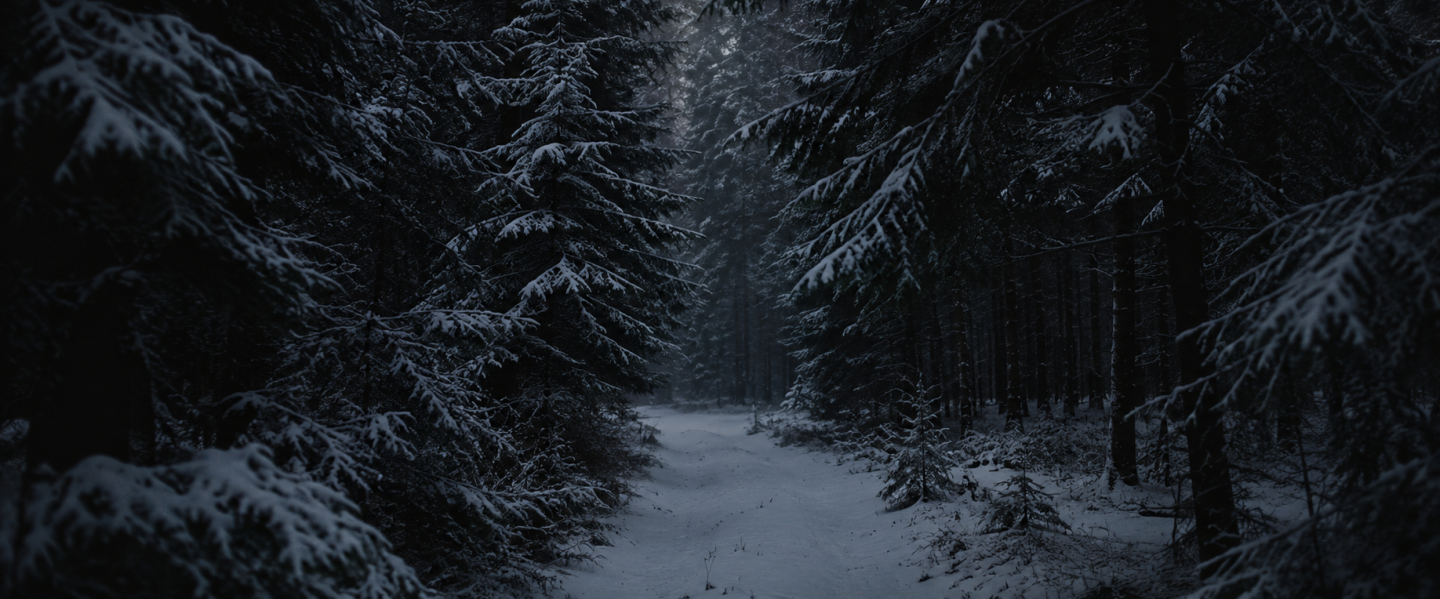
The new image still holds the winter woods. It still holds snow, shadow, silence, and the path ahead. But it is no longer tied to that place. It is not a borrowed grove. It is not a memory of someone else’s land. It is not a shrine to an old connection.

It is a threshold.

That feels right.

A darker winter path. Evergreen branches. Snow underfoot. No people. No buildings. No claim except the walk itself.

That is closer to where this path has gone: quieter, rougher, less concerned with belonging to a named community, and more concerned with walking honestly through the woods that remain.

There is grief in changing these things, even when the change is right. We do not always give enough respect to the small rituals of disconnection. Removing a photo. Changing a name. Taking down a link. No longer mentioning a place with warmth. These are not dramatic acts, but they are acts of boundary. They are small funerals.

And like funerals, they matter.

Because to let something die properly is different from pretending it never lived.

The old header lived. It belonged to an earlier version of this path. I can honour that without keeping it above the door.

Now a new image stands there.

Still winter.

Still trees.

Still silence.

But free of the old tie.

Maybe that is the lesson in all of this. The path does not end because one grove is left behind. The sacred does not vanish because one place no longer holds us. The land is larger than any single campfire, any single gathering, any single name on a map.

Cattle die.

Kinsmen die.

Places die to us.

But the path remains.

And sometimes the most honest pagan act is not staying where the old roots were.

Sometimes it is stepping into the dark woods, alone if necessary, and letting the snow cover the tracks behind you.

Gold, Silver, and the Roots we refuse to cut

Family of two adults and two children hugging happily outdoors with banknotes flying in the background

To quote an old friend: “You have chosen gold and silver over kith and kin.”

Those words tie directly into my earlier reflection, Don’t Cut Off the Roots. A tree may have strong branches. It may have a solid trunk. It may appear healthy from the outside. But if the roots are cut away, starved, ignored, or treated as disposable, the tree will eventually suffer. It may stand for a while. It may even look fine for a season. But the damage has already begun beneath the surface.

Today was a difficult choice day.

The quote I opened with rings more true than I ever thought it would. I never thought I would see the day where it would feel so personally accurate. Yet quite a few folk have reached out to me, and while they may not use those exact words, the sentiment is the same. Something has shifted. Something has been chosen. And what has been chosen does not appear to be kith and kin.

I choose kith and kin over gold and silver any day.

That does not mean gold and silver do not matter. Money keeps a roof over your head. It pays the hydro bill. It keeps the lights on. It pays for food, fuel, repairs, land, tools, buildings, amenities, and all the practical things that life requires. Pretending otherwise would be foolish.

But gold and silver do not sit beside you when the world is falling apart.

Gold and silver do not give you comfort when your spirit is tired.

Gold and silver do not restore your self-worth when you have been made to feel disposable.

Gold and silver do not remember your name around the fire.

Gold and silver do not become community. They do not become kinship. They do not become roots.

In Christian tradition, greed, or avarice, is counted among the seven deadly sins. In pagan language, I would say it another way: greed is what happens when the hoard becomes more sacred than the hearth. It is what happens when the keeping of things matters more than the keeping of bonds.

Words from the Wise One

The Hávamál, the sayings of the High One, has something sharp to say about wealth:

“Wealth is just like the winking of an eye, it’s the most fickle of friends.”

Hávamál, stanza 78

That line cuts cleanly. Wealth is not condemned outright. The old wisdom does not pretend that a person can live on air and good intentions. But wealth is called fickle. It comes and goes. It promises security, but it does not always keep that promise. It can vanish quickly. It can turn people against one another. It can make a person believe they are secure while everything human around them is being weakened.

And elsewhere, the Hávamál reminds us:

“Cattle die and kinsmen die, thyself too soon must die.”

Hávamál, stanza 75

That is not a cheerful line, but it is an honest one. Everything passes. Wealth passes. Status passes. Ownership passes. Even the people we love pass. The question is not whether we can hold everything forever. We cannot. The question is what we chose while we were here.

Did we choose the hoard, or did we choose the hearth?

Did we choose gold and silver, or did we choose kith and kin?

Did we remember the roots, or did we cut them off and then wonder why the forest grew sick?

A community is not made healthy by money alone. A sacred place is not made sacred by buildings alone. A gathering is not made whole by schedules, ticket sales, rules, or polished language. These things may support the structure, but they are not the roots.

The roots are the people.

The roots are the old bonds.

The roots are the ones who showed up before it was profitable, before it was polished, before it was convenient, before it became something that could be packaged and sold.

When those roots are forgotten, something living begins to dry out.

So today, I come back to the same place in my heart. I choose kith and kin. I choose the hearth over the hoard. I choose the roots over the shine of silver. I choose the people who remember what this was supposed to be, even when remembering hurts.

Gold and silver may keep the lights on.

But kith and kin are why we light the fire in the first place.

Godspeed to kith and kin.