
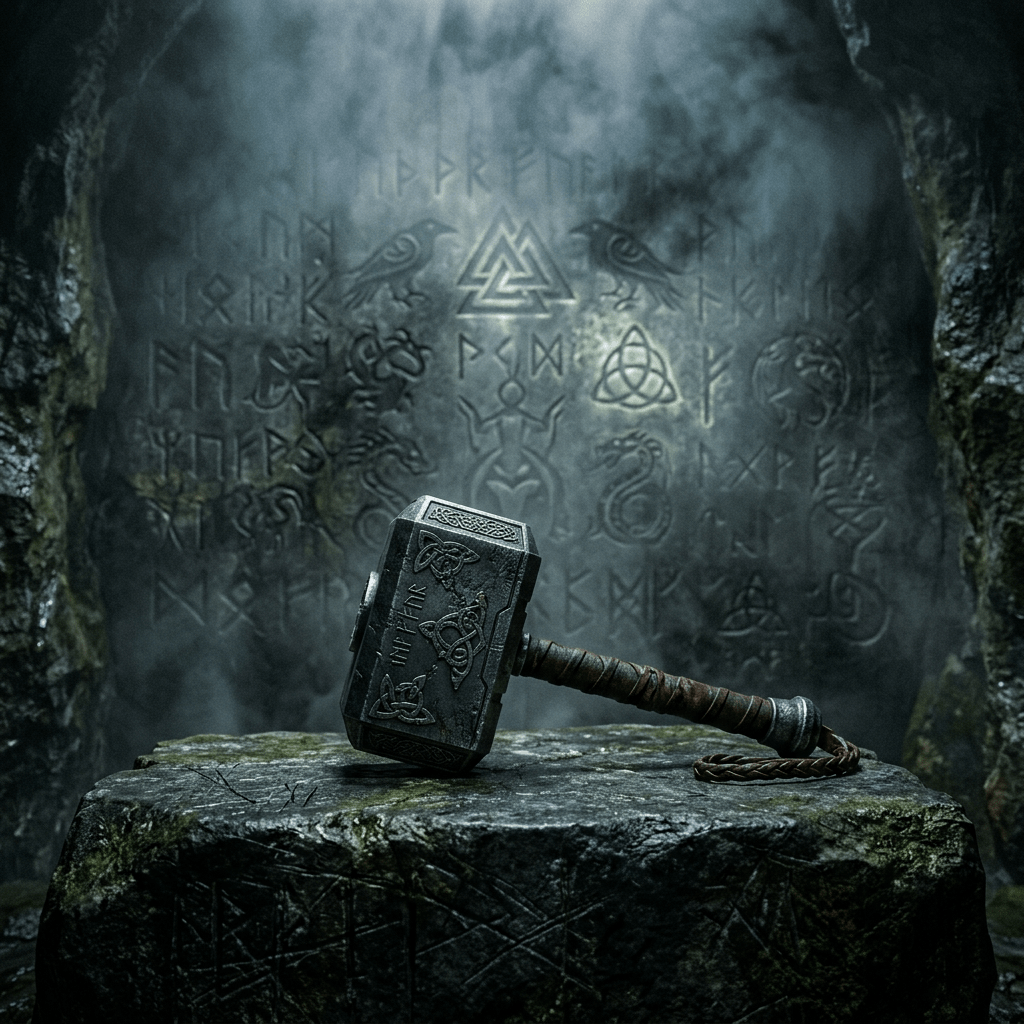
In an earlier post, I wrote about the art on Mjölnir and what it really means.
Or maybe more honestly, what it can mean.
That distinction matters.
Because one of the traps modern pagans can fall into — and I include myself in this — is treating every symbol like a dictionary entry.
This mark means this.
That knot means that.
This rune always means protection.
That symbol always means Odin.
This design is ancient.
That design is Viking.
This one is definitely historical because somebody on the internet said it with confidence.
And there is the problem.
Confidence is not evidence.
Aesthetic is not history.
Personal meaning is not the same thing as documented tradition.
And yet, personal meaning is not worthless either.
That is the line I keep coming back to.
The Trouble With Certainty
Pagan symbolism sits in a strange place.
Some of it is old.
Some of it is reconstructed.
Some of it is modern.
Some of it is inspired by older material but not identical to anything our ancestors would have worn, carved, painted, or prayed over.
And some of it has been repeated so often online that people mistake repetition for proof.
That does not mean we throw everything away.
It means we slow down.
It means we ask better questions.
Where does this symbol actually appear?
How old is the evidence?
Is the name ancient, or is the name modern?
Was this used in a religious context, a decorative context, a magical context, a political context, or do we simply not know?
And maybe the most important question:
Am I saying “this is what it meant,” or am I saying “this is what it means to me”?
Those are not the same sentence.
Mjölnir Has Weight
Mjölnir is one of the easier symbols to talk about because it has real historical weight behind it.
Thor’s hammer appears across Norse material culture and myth. It has protective force. It has sacred force. It belongs to thunder, strength, blessing, defense, and the hallowing of important moments.
That does not mean every modern hammer pendant is a perfect copy of an ancient artifact.
It does not mean every decorative knot or animal shape carved into one has one single fixed meaning.
But Mjölnir itself has roots.
It is not just an internet invention.
It is not just a fantasy logo.
It carries something older than the modern marketplace around pagan identity.
For me, that matters.
When I look at Mjölnir, I do not see only Thor as a comic-book thunder god or a simplified symbol of masculine force. I see protection. I see boundary. I see the power to hallow. I see the hammer that can bless, defend, and strike when needed.
But even there, I have to be careful.
That is my reading.
It is informed by tradition, but it is still my lived relationship with the symbol.
The Valknut, Vegvísir, and the Fog Around Symbols
Other symbols get foggier.
The Valknut is one of those symbols people often speak about with more certainty than the evidence allows.
It is powerful visually. Three interlocked triangles. Death, Odin, warriors, binding, sacrifice, the slain — those associations circle around it constantly in modern pagan spaces.
But when we speak about it, we should be honest about what we know and what we are interpreting.
“This symbol appears in contexts that may connect it to death, Odin, or the slain” is one kind of statement.
“This definitely meant exactly this to every Norse person who saw it” is another.
The first is careful.
The second is costume certainty.
Vegvísir is another good example.
It is beautiful. It is meaningful to many people. It is often treated online as an ancient Viking compass, but that simple version of the story is not the whole story.
Its documented history is later and more complicated than the popular internet version usually admits.
Does that make Vegvísir meaningless?
No.
But it does mean we should stop calling everything “ancient Viking” just because it looks good beside a longship.
There is nothing wrong with saying:
This symbol speaks to me.
This symbol helps me feel guided.
This symbol has become part of my practice.
This symbol carries personal meaning.
There is something wrong with pretending personal meaning automatically becomes historical fact.
Personal Meaning Is Not the Enemy
This is where people sometimes get defensive.
They hear caution and think it means dismissal.
They hear “that may not be historically accurate” and think it means “you are not allowed to use it.”
That is not what I am saying.
Modern paganism is not museum cosplay.
We are not living in the Viking Age, the Iron Age, or the old tribal worlds of Europe. We live now. We live with modern jobs, modern wounds, modern homes, modern technology, modern grief, modern confusion, modern loneliness, and modern spiritual hunger.
So yes, symbols evolve.
Yes, people form relationships with symbols in new ways.
Yes, a symbol can become spiritually meaningful even when its history is complicated.
But honesty matters.
I do not need to lie about a symbol’s age to let it matter to me.
I do not need to pretend a modern interpretation is ancient in order to make it sacred.
I do not need false certainty to have a real practice.
In fact, I think the practice gets stronger when I stop needing everything to be older, purer, or more official than it actually is.
Three Different Buckets
This is the way I try to sort it now.
First, there is evidence.
That is the historical bucket. Artifacts. manuscripts. carvings. archaeology. language. context. What can we reasonably say was there?
Second, there is tradition.
That is the inherited and reconstructed bucket. Stories, lore, repeated meanings, devotional patterns, and the ways communities have carried symbols forward.
Third, there is personal meaning.
That is the lived bucket. The symbol on your altar. The pendant around your neck. The mark you return to when you need courage, protection, guidance, remembrance, or grounding.
All three matter.
But they are not the same thing.
Confusing them creates shallow certainty.
Separating them creates deeper practice.
What the Art Means
So what does the art on Mjölnir mean?
Sometimes it means what we can historically support.
Sometimes it means what a maker intended.
Sometimes it means what a community has come to see in it.
Sometimes it means what you carry into it after years of wearing it close to the skin.
And sometimes, if we are honest, we do not fully know.
That should not scare us.
Mystery is not failure.
Not knowing everything about a symbol does not make it empty.
It may actually leave room for relationship.
The mistake is not loving a symbol whose history is complicated.
The mistake is refusing to admit the history is complicated.
A Better Way to Wear the Hammer
If I wear Mjölnir, I want to wear it honestly.
Not as a costume.
Not as a claim that I have solved Norse paganism.
Not as a badge of internet certainty.
But as a symbol of protection, blessing, strength, and sacred boundary.
As something rooted in old soil, yes, but still alive in the present.
As something that carries history, tradition, and personal meaning without forcing all three to become the same thing.
That, to me, is the more honest path.
Let the evidence be evidence.
Let tradition be tradition.
Let personal meaning be personal meaning.
And let the symbol breathe.
Pagan symbols are not dictionaries.
They are doors.
They are thresholds.
They are old marks carried into new hands.
Some come with clear stories.
Some come with fog.
Some come with warnings.
Some come with beauty.
And some simply sit against the chest, close to the heartbeat, reminding us that meaning does not always arrive as certainty.
Sometimes it arrives as relationship.
Godspeed.
In an earlier post, I wrote about the art on Mjölnir and what it really means.
Or maybe more honestly, what it can mean.
That distinction matters.
Because one of the traps modern pagans can fall into — and I include myself in this — is treating every symbol like a dictionary entry.
This mark means this.
That knot means that.
This rune always means protection.
That symbol always means Odin.
This design is ancient.
That design is Viking.
This one is definitely historical because somebody on the internet said it with confidence.
And there is the problem.
Confidence is not evidence.
Aesthetic is not history.
Personal meaning is not the same thing as documented tradition.
And yet, personal meaning is not worthless either.
That is the line I keep coming back to.
The Trouble With Certainty
Pagan symbolism sits in a strange place.
Some of it is old.
Some of it is reconstructed.
Some of it is modern.
Some of it is inspired by older material but not identical to anything our ancestors would have worn, carved, painted, or prayed over.
And some of it has been repeated so often online that people mistake repetition for proof.
That does not mean we throw everything away.
It means we slow down.
It means we ask better questions.
Where does this symbol actually appear?
How old is the evidence?
Is the name ancient, or is the name modern?
Was this used in a religious context, a decorative context, a magical context, a political context, or do we simply not know?
And maybe the most important question:
Am I saying “this is what it meant,” or am I saying “this is what it means to me”?
Those are not the same sentence.
Mjölnir Has Weight
Mjölnir is one of the easier symbols to talk about because it has real historical weight behind it.
Thor’s hammer appears across Norse material culture and myth. It has protective force. It has sacred force. It belongs to thunder, strength, blessing, defense, and the hallowing of important moments.
That does not mean every modern hammer pendant is a perfect copy of an ancient artifact.
It does not mean every decorative knot or animal shape carved into one has one single fixed meaning.
But Mjölnir itself has roots.
It is not just an internet invention.
It is not just a fantasy logo.
It carries something older than the modern marketplace around pagan identity.
For me, that matters.
When I look at Mjölnir, I do not see only Thor as a comic-book thunder god or a simplified symbol of masculine force. I see protection. I see boundary. I see the power to hallow. I see the hammer that can bless, defend, and strike when needed.
But even there, I have to be careful.
That is my reading.
It is informed by tradition, but it is still my lived relationship with the symbol.
The Valknut, Vegvísir, and the Fog Around Symbols
Other symbols get foggier.
The Valknut is one of those symbols people often speak about with more certainty than the evidence allows.
It is powerful visually. Three interlocked triangles. Death, Odin, warriors, binding, sacrifice, the slain — those associations circle around it constantly in modern pagan spaces.
But when we speak about it, we should be honest about what we know and what we are interpreting.
“This symbol appears in contexts that may connect it to death, Odin, or the slain” is one kind of statement.
“This definitely meant exactly this to every Norse person who saw it” is another.
The first is careful.
The second is costume certainty.
Vegvísir is another good example.
It is beautiful. It is meaningful to many people. It is often treated online as an ancient Viking compass, but that simple version of the story is not the whole story.
Its documented history is later and more complicated than the popular internet version usually admits.
Does that make Vegvísir meaningless?
No.
But it does mean we should stop calling everything “ancient Viking” just because it looks good beside a longship.
There is nothing wrong with saying:
This symbol speaks to me.
This symbol helps me feel guided.
This symbol has become part of my practice.
This symbol carries personal meaning.
There is something wrong with pretending personal meaning automatically becomes historical fact.
Personal Meaning Is Not the Enemy
This is where people sometimes get defensive.
They hear caution and think it means dismissal.
They hear “that may not be historically accurate” and think it means “you are not allowed to use it.”
That is not what I am saying.
Modern paganism is not museum cosplay.
We are not living in the Viking Age, the Iron Age, or the old tribal worlds of Europe. We live now. We live with modern jobs, modern wounds, modern homes, modern technology, modern grief, modern confusion, modern loneliness, and modern spiritual hunger.
So yes, symbols evolve.
Yes, people form relationships with symbols in new ways.
Yes, a symbol can become spiritually meaningful even when its history is complicated.
But honesty matters.
I do not need to lie about a symbol’s age to let it matter to me.
I do not need to pretend a modern interpretation is ancient in order to make it sacred.
I do not need false certainty to have a real practice.
In fact, I think the practice gets stronger when I stop needing everything to be older, purer, or more official than it actually is.
Three Different Buckets
This is the way I try to sort it now.
First, there is evidence.
That is the historical bucket. Artifacts. manuscripts. carvings. archaeology. language. context. What can we reasonably say was there?
Second, there is tradition.
That is the inherited and reconstructed bucket. Stories, lore, repeated meanings, devotional patterns, and the ways communities have carried symbols forward.
Third, there is personal meaning.
That is the lived bucket. The symbol on your altar. The pendant around your neck. The mark you return to when you need courage, protection, guidance, remembrance, or grounding.
All three matter.
But they are not the same thing.
Confusing them creates shallow certainty.
Separating them creates deeper practice.
What the Art Means
So what does the art on Mjölnir mean?
Sometimes it means what we can historically support.
Sometimes it means what a maker intended.
Sometimes it means what a community has come to see in it.
Sometimes it means what you carry into it after years of wearing it close to the skin.
And sometimes, if we are honest, we do not fully know.
That should not scare us.
Mystery is not failure.
Not knowing everything about a symbol does not make it empty.
It may actually leave room for relationship.
The mistake is not loving a symbol whose history is complicated.
The mistake is refusing to admit the history is complicated.
A Better Way to Wear the Hammer
If I wear Mjölnir, I want to wear it honestly.
Not as a costume.
Not as a claim that I have solved Norse paganism.
Not as a badge of internet certainty.
But as a symbol of protection, blessing, strength, and sacred boundary.
As something rooted in old soil, yes, but still alive in the present.
As something that carries history, tradition, and personal meaning without forcing all three to become the same thing.
That, to me, is the more honest path.
Let the evidence be evidence.
Let tradition be tradition.
Let personal meaning be personal meaning.
And let the symbol breathe.
Pagan symbols are not dictionaries.
They are doors.
They are thresholds.
They are old marks carried into new hands.
Some come with clear stories.
Some come with fog.
Some come with warnings.
Some come with beauty.
And some simply sit against the chest, close to the heartbeat, reminding us that meaning does not always arrive as certainty.
Sometimes it arrives as relationship.
Godspeed.
 Unplugged Pagan